10-K: Annual report [Section 13 and 15(d), not S-K Item 405]
Published on February 18, 2026
UNITED STATES
SECURITIES AND EXCHANGE COMMISSION
Washington, D.C. 20549
FORM 10-K
ANNUAL REPORT PURSUANT TO SECTION 13 OR 15(d) OF THE SECURITIES EXCHANGE ACT OF 1934 |
For fiscal year ended December 31 , 2025
OR
TRANSITION REPORT PURSUANT TO SECTION 13 OR 15(d) OF THE SECURITIES EXCHANGE ACT OF 1934 |
For the transition period from _____________ to ______________
Commission file number: 1-42542
(Exact name of Registrant as specified in its charter)
(State or Other Jurisdiction of Incorporation or Organization) | (I.R.S. Employer Identification No.) |
6300 | |||||
(Address of Principal Executive Offices) | (Zip Code) | ||||
+ 41 41 562 3490
(Registrant’s telephone number, including area code)
Securities to be registered pursuant to Section 12(b) of the Exchange Act:
Title of each class | Trading symbols(s) | Name of exchange on which registered |
Securities registered pursuant to Section 12(g) of the Act: None
Indicate by check mark if the registrant is a well-known seasoned issuer, as defined in Rule 405 of the Securities Act.
Yes ☐ No ☒.
Indicate by check mark if the registrant is not required to file reports pursuant to Section 13 or Section 15(d) of the Act.
Yes ☐ No ☒.
Indicate by check mark whether the registrant (1) has filed all reports required to be filed by Section 13 or 15(d) of the
Securities Exchange Act of 1934 during the preceding 12 months (or for such shorter period that the registrant was
required to file such reports), and (2) has been subject to such filing requirements for the past 90 days.
Indicate by check mark whether the registrant has submitted electronically every Interactive Data File required to be
submitted pursuant to Rule 405 of Regulation S-T (§232.405 of this chapter) during the preceding 12 months (or for such
shorter period that the registrant was required to submit such files).
Indicate by check mark whether the registrant is a large accelerated filer, an accelerated filer, a non-accelerated filer, a
smaller reporting company, or an emerging growth company. See the definitions of “large accelerated filer,” “accelerated
filer,” “smaller reporting company,” and “emerging growth company” in Rule 12b-2 of the Exchange Act. (Check one):
Large accelerated filer | ☐ | Accelerated filer | ☐ | |
☒ | Smaller reporting company | |||
Emerging growth company |
If an emerging growth company, indicate by check mark if the registrant has elected not to use the extended transition
period for complying with any new or revised financial accounting standards provided pursuant to Section 13(a) of the
Exchange Act. ☐
Indicate by check mark whether the registrant has filed a report on and attestation to its management’s assessment of the
effectiveness of its internal control over financial reporting under Section 404(b) of the Sarbanes-Oxley Act (15 U.S.C.
7262(b)) by the registered public accounting firm that prepared or issued its audit report ☐ .
If securities are registered pursuant to Section 12(b) of the Act, indicate by check mark whether the financial statements
of the registrant included in the filing reflect the correction of an error to previously issued financial statements ☐ .
Indicate by check mark whether any of those error corrections are restatements that required a recovery analysis of
incentive-based compensation received by any of the registrant’s executive officers during the relevant recovery period
pursuant to §240.10D-1(b) ☐.
Indicate by check mark whether the registrant is a shell company (as defined in Rule 12b-2 of the Exchange Act).
Yes ☐ No ☒ .
The aggregate market value of 552,220,173 shares of voting stock held by non-affiliates of the registrant was
approximately $27,362,509,572 based on the last reported sale price of the registrant’s Ordinary Shares as reported on
the New York Stock Exchange on June 30, 2025.
As of December 31, 2025, the number of outstanding Ordinary Shares was 553,082,525 , net of Treasury Shares.
Part III hereof incorporates by reference portions of the registrant’s definitive proxy statement related to its the 2026
1
Amrize Ltd
ITEM | PAGE |
Certain Terms
Unless the context requires otherwise, the “Company”, “Amrize”, “we”, “us”, or “our” refers to Amrize Ltd., Inc.
on a consolidated basis. References to the Company’s “Ordinary Shares”, “Common Shares”, “Common Stock”
or “Company Shares” refer to our Ordinary Shares.
2
Amrize Ltd
PART I
Cautionary Note Regarding Forward-Looking Statements
Investors are cautioned that all statements in this Annual Report on Form 10-K (the “Annual Report”) that
relate to the future involve risks and uncertainties, and are based on assumptions that we believe in good
faith are reasonable but which may be materially different from actual results. These statements, which are
forward-looking statements within the meaning of Section 21E of the Securities Exchange Act of 1934, as
amended (the “Exchange Act”), and 27A of the Securities Act of 1933, as amended (the “Securities Act”), and
are made pursuant to the safe harbor provisions of the PSLRA, provide the investor with the Company’s
expectations or forecasts of future events. These forward-looking statements concern our goals, beliefs,
expectations, strategies, objectives, plans, future operating results and underlying assumptions, and other
statements that are not necessarily based on historical facts. Without limitation, you can identify these
statements by the fact that they do not relate strictly to historical or current facts, and these statements may
contain words such as “may,” “will,” “could,” “should,” “might,” “projects,” “expects,” “believes,” “anticipates,”
“intends,” “plans,” “continue,” “estimate,” or “pursue,” or the negative or other variations thereof or
comparable terms. In particular, they include statements relating to, among other things, future actions,
strategies, future performance, future revenues, income and cash flows, the outcome of contingencies such
as legal proceedings and regulatory compliance. Actual results may differ materially from those contemplated
(expressed or implied) by such forward-looking statements because of, among other things, potential risks
and uncertainties, such as:
•the effect of political, economic and market conditions and geopolitical events;
•the level of demand in the construction industry;
•the cyclicality of the industries and businesses in which our customers operate;
•changes in the cost and/or availability of raw materials required to run our business;
•energy and fuel costs;
•adverse weather conditions and natural disasters;
•the logistical and other challenges inherent in our operations;
•the actions and initiatives of current and potential competitors;
•the level and volatility of, interest rates and other market indices;
•the ability of Amrize to maintain satisfactory credit ratings;
•the outcome of pending litigation or future litigation;
•the impact of current, pending and future legislation and regulation;
•factors related to the failure of Amrize to achieve some or all of the expected strategic benefits or
opportunities expected from the separation from Holcim Ltd (“Holcim”);
•material costs and expenses as a result of the separation from Holcim;
•our limited history operating as an independent, publicly traded company;
•our obligation to indemnify Holcim pursuant to the agreements entered into connection with the
separation and the risk Holcim may not fulfill any obligations to indemnify Amrize under such
agreements;
•that under applicable tax law, Amrize may be liable for certain tax liabilities of Holcim following the
separation if Holcim were to fail to pay such taxes;
•the fact that Amrize may receive worse commercial terms from third-parties for services it used to
receive from Holcim prior to the separation;
•the fact that certain of Amrize's executive officers and directors may have actual or potential
conflicts of interest because of their previous positions at Holcim; and
•potential difficulties in maintaining relationships with key personnel.
For a discussion identifying other factors that could cause actual results to differ materially from those
anticipated in forward-looking statements, see “Risk Factors”, along with the discussion of Competition under
3
Amrize Ltd
Item 1, “Management’s Discussion and Analysis of Financial Condition and Results of Operations” under item 7
and Note 17 (Commitments and Contingencies) in Item 8. “Financial Statements and Supplementary Data”.
These are only some of the factors that may affect the forward-looking statements contained in this Annual
Report. We operate in a very competitive and rapidly changing environment. New risks emerge from time to
time.
It is not possible for us to predict all risks, nor can we assess the impact of all factors on our business or the
extent to which any factor or combination of factors may cause actual results to differ materially from those
contained in any forward-looking statements we may make. In light of these risks, uncertainties and
assumptions, the future events and trends discussed in this Annual Report and our future levels of activity
and performance, may not occur and actual results could differ materially and adversely from those described
or implied in the forward-looking statements. As a result, you should not regard any of these forward-looking
statements as a representation or warranty by us or any other person or place undue reliance on any such
forward-looking statements. Any forward-looking statement speaks only as of the date on which it is made,
and we do not undertake any obligation to publicly update or revise any forward-looking statement, whether
as a result of new information, future developments, or otherwise, except as required by law.
4
Amrize Ltd
Item 1. Business
Business Overview
Amrize Ltd (the “Company”) is a building solutions company focused on the North American market, offering
customers a broad range of advanced building solutions from foundation to rooftop. The Company earns
revenue from the sale of cement, aggregates, ready-mix concrete, asphalt, roofing systems and other
building solutions.
Our more than 19,000 employees operate across more than 1,000 sites, facilities, and corporate offices in the
United States, Canada, Colombia, Switzerland, and Jamaica to serve more than 23,000 customers across the
North American infrastructure, commercial and residential construction markets.
Amrize provides cement, aggregates, ready-mix concrete materials, and advanced roofing and wall systems
in the United States and Canada. We operate in infrastructure, commercial, and residential construction
markets across North America. Amrize maintains facilities in strategic locations coupled with a large
distribution network which help us minimize our distribution costs and better provide for our customers.
On June 23, 2025, Holcim Ltd (“Holcim”) completed the previously announced Spin-Off of the Company
through a distribution of 100% of the Company’s outstanding shares to holders of record of Holcim’s ordinary
shares, on a pro rata basis as a dividend-in-kind, as of the close of business on June 20, 2025 (the “Spin-
Off”). As a result, Amrize now operates as a standalone public company and aims to set the foundation for
long-term, profitable growth.
Since Amrize completed its Spin-Off, management established a leaner corporate cost structure and lowered
its external borrowings during the second half of 2025. With the capital structure established in 2025
combined with cash flows from operating activities in 2025, Amrize is well positioned for more investments in
growth projects, business combinations, and shareholder returns via dividends and share repurchases.
Business Segments
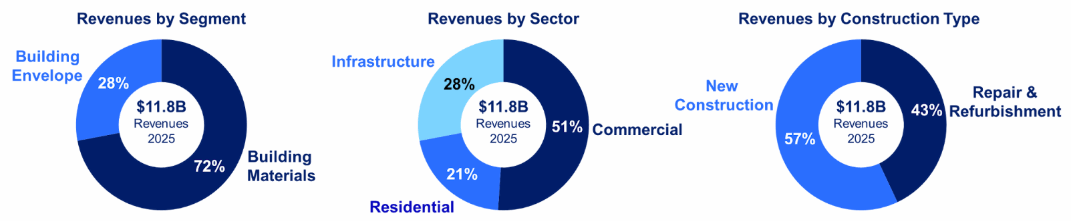
The Company is organized into two reportable segments — Building Materials and Building Envelope — that
are aligned with the products and services it provides and based upon the information used by the chief
operating decision maker (“CODM”) in evaluating the performance of the business and allocating resources
and capital. Our services span new construction as well as repair and refurbishment (“R&R”).
•Building Materials: The building materials segment offers a range of branded solutions delivering
high-quality products for a wide range of applications. These include cement and aggregates, as well
as a variety of downstream products and solutions such as ready-mix concrete, asphalt and other
construction materials.
•Building Envelope: The building envelope segment offers advanced roofing and wall systems,
including single-ply membranes, insulation, shingles, sheathing, waterproofing and protective
coatings, along with adhesives, tapes and sealants that are critical to the application of roofing and
wall systems.
Our Products
Our products are essential in commercial and residential new construction, public infrastructure construction
projects and R&R activities. Within each of our product lines, we typically offer specialized products that are
tailored for specific projects.
5
Amrize Ltd
Building Materials offerings include cement and aggregates, ready-mix concrete, and other construction
materials.
•Cement: We provide high-quality cement products developed through our professional knowledge
and experience. These products are customized to satisfy our clients’ specific requirements.
•Aggregates: We supply natural aggregates, such as crushed stone, sand, and gravel, and alternative
aggregates, including recycled concrete and slag, to the construction market. These products are
primary components for ready-mix concrete, asphalt, and road construction projects.
•Ready-Mix Concrete: We manufacture customized ready-mix concrete through blending cement,
aggregates, and specialized additives to meet the precise requirements of our customers. Our
formulations are engineered for project-specific variables, including transportation logistics and site
weather conditions which ensures high-performance results across a broad range of applications.
Building Envelope offerings include a range of advanced roofing and wall systems solutions to meet
commercial and residential building requirements.
•Duro-Last: Provides full system roofing, offering a range of thermoplastic single-ply solutions.
Custom-fabricates high-quality PVC roofing membranes, accessories, edge metal, and fasteners in-
house, providing waterproofing and long-term leak protection.
•Elevate: Offers a range of advanced roofing systems for commercial buildings, including energy-
efficient insulation boards.
•Malarkey: Provides a complete residential roofing solution, from premium roofing shingles to ice and
water barriers.
•OX Engineered Products: Develops and manufactures a range of wall insulation and sheathing
solutions, with proprietary technologies ranging from house wraps and structural sheathing to
integrated wall systems.
•Enverge: Offers spray foam insulation, including both open-cell and closed-cell spray foam products.
•Gaco: Offers liquid-applied coating systems for roof restoration, decking and waterproofing, and
anti-slip protection. As well as adhesives, tapes, and sealants critical to weatherproofing.
Business Strategy
Our strategy for profitable growth is broken down into six key pillars:
•Positioned in the most attractive markets to service our North American customers: Population
growth, urbanization, onshoring and investments in infrastructure are shaping the construction
industry and driving demand for innovative and sustainable solutions. We are positioned to capitalize
on these trends by leveraging our footprint and our innovative and sustainable solutions.
•Comprehensive range of building solutions powering growth opportunities: Through our
comprehensive product offering, we aim to provide our customers with a full suite of synergistic
building solutions, offering advanced solutions that address their most sophisticated needs and
enable them to meet goals across their building lifecycle.
•Deeply embedded performance culture and dedication to employee safety: Our performance-based
culture drives customer-focused decision-making and superior financial performance, while
maintaining a rigorous commitment to protecting the health and safety of our people.
•Value accretive and disciplined acquisitions: Through a track record of disciplined and value-focused
acquisitions, we have established ourselves as a leader in advanced roofing and wall systems,
creating a platform for further organic and inorganic growth in the Building Envelope segment. We
also pursue an active strategy of synergistic bolt-on acquisitions in the highly fragmented
construction materials market, particularly for aggregates and concrete.
•Committed to driving shareholder value: We strive to maintain a disciplined capital structure based
on an investment grade credit rating. Our capital allocation strategy includes investing in our
business to drive sustainable growth, pursuing strategic acquisitions in fragmented markets in line
with our segment ambitions, and returning capital to shareholders.
•Emphasis on innovation: Through our internal innovation process to external partnerships, we seek to
make cutting-edge investments to address customer challenges.
6
Amrize Ltd
Customers
Our more than 23,000 customers include home builders, commercial builders, architects and designers,
distributors, contractors and government authorities. No material part of our Building Materials segment is
dependent upon a single customer or upon a few customers. In our Building Envelope segment, our revenues
are largely attributable to a few large distributors. However, no individual customer represents more than 10%
of the Company’s revenues and there are no material dependencies or concentrations of individual customers
that require disclosure.
Research & Development
Research and development activities include the development of new product lines, the modification of
existing product lines to comply with regulatory changes and the research of cost efficiencies through raw
material substitution and process improvements. We have research and development application centers and
innovation hubs where scientists and technical and training experts work to strengthen our expertise and
develop innovative technologies.
Intellectual Property
The protection of our brands, technology and intellectual property is an important aspect of our business. We
protect our intellectual property and other proprietary assets through a combination of patents, trademarks,
copyrights, trade secrets, contractual provisions, confidentiality procedures and non-disclosure agreements,
as well as application of applicable law. We protect our intellectual property rights in the United States,
Canada and other jurisdictions. We own approximately 300 patents that have been issued by and patent
applications that are pending with the U.S. Patent and Trademark Office (“USPTO”), and approximately 200
issued patents and pending patent applications outside the United States. In general, our patents are directed
to construction materials and their manufacturing, as well as construction and building technologies. The
protection afforded by patents (and the availability of legal remedies for infringement or other violation
thereof) varies from jurisdiction to jurisdiction, and although the term of our patents is, in general, up to
approximately 20 years from the filing date, such term also varies depending on jurisdiction and the type of
patent protection, as well as our portfolio management strategy. Additionally, we own or have rights to use
various trademarks, service marks or trade names that we use in conjunction with the marketing of our
products. We own approximately 240 trademarks that are registered or pending with the USPTO, and
approximately 2,300 trademarks that are registered or pending outside the United States. Ownership rights in
trademarks (including trademark registrations) in most jurisdictions generally do not expire if the trademarks
are renewed, continued in use and properly protected. Where appropriate, we supplement our owned
intellectual property portfolio by licensing intellectual property from third parties, including Holcim, and seek
to protect our trade secrets and other confidential and proprietary information through internal controls,
contractual protections and confidentiality agreements with our employees and third-party service providers.
Competition
The nature of the competition in the industry in which we operate varies among our product lines, in part due
to the widely differing amounts of capital necessary to build and maintain production facilities. In the concrete
industry, lower capital requirements result in fewer barriers to entry. As a result, depending on the local
market, we may face competition from small producers as well as large, vertically integrated companies.
The cement industry in the markets where we operate is highly competitive, including international, national
and regional cement producers. Companies compete on a variety of factors, including quality, value
proposition, capacity, price, customer service, delivery time and proximity to the customer. Our principal
competitors in the United States are Cemex, Buzzi-Unicem, Heidelberg Materials and CRH, as well as
numerous local and regional players.
Many of the regions in which we operate ready-mix concrete are highly fragmented, and as a result, our
products face strong competition.
The construction materials industry is highly localized due to the high cost of transportation relative to the
price of the product. Cement imports into the United States occur mostly to supplement domestic cement
production or to supply a particular region. Cement is typically imported into deep water ports along the coast
or on the Great Lakes or transported on the Mississippi River system near major population centers.
In our Building Envelope business, the competitive landscape varies depending on products and end markets.
Competitive dynamics are shaped by the scale of each competitor and the ability of each competitor to
develop innovative products, with energy efficiency and environmentally conscious building solutions in
7
Amrize Ltd
demand. The market is further shaped by each company’s distribution capabilities, as well as its ability to
provide comprehensive service and support to customers.
While we compete with a range of local, regional and multi-national firms, given our broad offering of
products and solutions across both the commercial and residential end markets, we do not face competition
across all of our product offerings from any one particular competitor. Principal competitors across our
products in North America include Carlisle, CertainTeed, GAF, Johns Manville, Owens Corning and RPM. While
larger companies maintain strong positions due to their extensive, differentiated product portfolios and
established brands, regional players and new entrants also seek to capitalize on specialized areas of the
market by offering tailored solutions to meet the unique demands of specific geographic areas.
Raw Materials
Our cement, ready-mix and aggregates businesses depend on a reliable supply of mineral resources, such as
aggregates, sand and limestone, as well as mineral additives such as slag and fly ash. We generally maintain
our own reserves of limestone, aggregates and other materials that we use to manufacture our products. For
items outside of our reserves, we secure supply of such materials, products or resources through long-term
renewable contracts. Our Building Envelope segment requires a different set of raw materials, with a large
dependency on petroleum-based products, chemicals, resins, asphalt, glass fiber, granules and other
commodities.
Human Capital Resources
As of December 31, 2025, we employed more than 19,000 people across the United States, Canada,
Colombia, Switzerland, and Jamaica. The numbers of our employees fluctuate depending on the time of year
due to seasonality. During our primary operational seasons, of our more than 19,000 employees,
approximately 6,800 are salaried and approximately 12,700 are hourly. Approximately 6,200 of the hourly
employees are employed under collective bargaining agreements and various supplemental agreements with
local unions.
Recruiting, developing and retaining qualified employees is essential to executing our strategy and
maintaining our competitive position. We are a people-first company and investing in training our people
supports skill development, employee retention, and long-term business continuity. We provide our
employees with the tools, training, and time to perform their work safely and successfully coupled with
competitive wages and benefits, and by providing a safe and respectful work environment. We embrace the
diverse backgrounds and viewpoints of our team members so that we may learn from one another, and
continue to improve our culture.
Health, Safety, and Well-Being
Safety is a core value and an organizational priority. We maintain comprehensive safety programs, including
training, incident investigation, and continuous improvement initiatives. Our safety performance is tracked
using industry-standard metrics. In addition to physical safety, we further support employee well-being
through health programs, mental health resources, and wellness initiatives.
Talent Attraction and Development
We utilize a broad recruiting strategy to reach a wide array of potential employees, including partnerships
with universities, trade schools, and specialized recruiting firms focused on identifying candidates with
diverse experiences and backgrounds. Our onboarding and training programs are designed to foster
continuous learning and professional growth. Examples of these initiatives include the Build for Growth
program, which provides early-career employees with exposure to the technical elements of the business
while developing future leadership capabilities; sales training programs designed to strengthen commercial
acumen and drive performance; and leadership development programs focused on enhancing the skills and
effectiveness of managerial staff to support long-term organizational success. Tuition reimbursement is also
available to support career advancement.
Employee Engagement
We regularly assess employee engagement through surveys and other feedback mechanisms, using the
results to develop action plans that improve the workplace experience. This approach ensures that
employees have a voice in shaping their work environment, and we monitor key metrics such as engagement
rates, satisfaction, and turnover to further guide our human capital strategy.
8
Amrize Ltd
Respect and Equal Opportunity
We are committed to maintaining a culture of inclusion, respect, and equal opportunity. Our policies prohibit
discrimination based on race, religion, gender, sexual orientation, age, disability, national origin, or veteran
status. We strive for fair treatment and pay equity across our workforce and regularly review compensation
practices to maintain equity. Our Employee Resource Groups and inclusion initiatives aim to foster a sense of
belonging and encourage diverse perspectives, which are essential for innovation and high engagement.
Seasonality
Our business is subject to significant seasonality, consistent with trends observed across the building
materials industry. Construction activity and, consequently, demand for our products and services, is heavily
influenced by weather conditions. Periods of higher activity typically occur from the late spring to early fall,
when favorable weather supports increased construction, renovation, and repair projects. Conversely,
demand and production may decrease substantially in winter due to inclement weather and extreme
conditions, which can negatively impact both production processes and the ability of workers to operate
outdoors. We continuously monitor market conditions and adjust our production and inventory management
strategies to align with anticipated seasonal demand and potential weather-related disruptions.
Regulatory Matters
Our operations are subject to and affected by federal, state, provincial and local laws and regulations relating
to, among other things, environmental matters (including climate change and greenhouse gas emissions),
health and safety matters (including related to the use of hazardous materials), consumer protection, trade
regulations, anti-bribery, anti-corruption and taxation. These laws and regulations are constantly evolving and
may be interpreted, applied, created, or amended, in a manner that could harm our business. In addition, the
applicability and interpretation of these laws and regulations often are uncertain, particularly in new and
rapidly evolving areas of the law, such as those relating to climate change.
Our mining operations are required to comply with government land use plans and zoning requirements. We
are required by government authorities to obtain specific licenses and permits to allow for the extraction and
processing of mineral reserves. These requirements vary between the United States and Canada, between
individual states and provinces, and within local markets. The terms and general availability of government
permits required to conduct our business influence the scope of our operations on the respective sites. The
time periods for these operating licenses and permits can vary between jurisdictions and sites. We are also
required to adhere to applicable restrictions, often including establishing appropriate environmental
management systems, to minimize the risk that necessary permits are revoked, modified or not renewed. We
are also subject to multiple laws that require us, as a mine operator, to reclaim and restore properties after
mining activities have ceased. As a result, we are required to record reasonable provisions for such
reclamation in our consolidated financial statements.
We are also subject to the Foreign Corrupt Practices Act in the United States and similar anti-bribery, anti-
money laundering, anti-corruption, antitrust and other international laws and regulations applicable in
Switzerland and other jurisdictions in which we operate. Such laws generally prohibit, among other things,
corruptly providing, offering, promising or authorizing, directly or indirectly, anything of value to foreign
officials, political parties or candidates for political office or private parties for the purposes of obtaining or
retaining business. Although we have implemented policies and procedures, there can be no assurance these
will be sufficient to prevent or detect these inappropriate practices. See “Risk Factors—Risks Relating to
Regulatory and Legal Matters.”
Corporate Information
Amrize Ltd was incorporated in Switzerland on April 6, 2023 as Holcim North America Finance Ltd. On July 1,
2024, Holcim acquired all of the ordinary shares and thereafter the name of this entity was changed to Amrize
Ltd. On June 23, 2025, Holcim completed the spin-off of its North American business, pursuant to which
transaction Holcim distributed 100% of the Company Shares to its stockholders, completing the Spin-Off
through a pro rata distribution (the “Distribution”) of the Company Shares held by Holcim as a dividend-in-
kind to the holders of ordinary shares of Holcim. As a result of the Distribution, Amrize Ltd became an
independent public company. The Company Shares are listed under the symbol “AMRZ” on the New York
Stock Exchange and the SIX Swiss Exchange.
Our principal executive offices are located at Grafenauweg 8, 6300 Zug, Switzerland, and our telephone
number is +41 (0) 58 858 58 58. We also have operational headquarters in Chicago.
9
Amrize Ltd
Our Annual Reports on Form 10-K, Quarterly Reports on Form 10-Q, Current Reports on Form 8-K, and
amendments to reports filed pursuant to Sections 13(a) and 15(d) of the Securities Exchange Act, are filed
with the U.S. Securities and Exchange Commission (the “SEC”). We are subject to the informational
requirements of the Exchange Act and file or furnish reports, proxy statements, and other information with the
SEC. Such reports and other information filed by us with the SEC are available at www.amrize.com when such
reports are available on the SEC's website.
Item 1A. Risk Factors
Our consolidated results of operations, financial position, cash flows and reputation can be adversely
affected by various risks. These risks include the principal factors listed below and the other matters set forth
in this Annual Report on Form 10-K. There may be additional risks of which we are not presently aware or that
we currently believe are immaterial that could have an adverse impact on our business. Certain statements
contained in the risk factors described below are forward-looking statements. See "Cautionary Note
Regarding Forward-Looking Statements" for more information.
Risk Factor Summary
Risks Relating to our Business and Industry
•Economic conditions, including inflation, have affected and may continue to adversely affect our
business, financial condition, liquidity and results of operations.
•We are affected by the level of demand in the construction industry.
•We and our customers participate in cyclical industries and regional markets, which are subject to
industry downturns.
•Changes in the cost and/or availability of raw materials required to run our business, including related
supply chain disruptions, could have a material adverse effect on our business, financial condition
and results of operations.
•High energy and fuel costs have had and may continue to have a material adverse effect on our
operating results.
•The development and introduction of new products and technologies, or the failure to do so, could
have a material adverse effect on our business, financial condition, liquidity and results of operations.
•We operate in a highly competitive industry with numerous players employing different competitive
strategies and if we do not compete effectively, our revenues, market share and results of operations
may be adversely affected.
•We may not be able to successfully integrate or realize the expected benefits from any acquisitions
or joint ventures.
•The loss of, a significant decline in business with, or pricing pressures from, one or more of our key
customers or distributors could adversely affect our financial condition, liquidity and results of
operations.
•If we fail to accurately forecast project budgets and timelines, or if we deliver projects that do not
meet contracted standards, it could have a material adverse effect on our business, financial
condition, liquidity and results of operations.
•We could be adversely affected by any significant or prolonged disruption to our production facilities.
•Our business is capital intensive, resulting in significant fixed and semi-fixed costs. Therefore, our
earnings are sensitive to changes in volume.
Risks Relating to Regulatory and Legal Matters
•We are subject to the laws and regulations of the countries where we operate and do business and
non-compliance, any material changes in such laws and regulations and/or any significant delays in
assessing the impact and/or adapting to such changes in laws and regulations may have an adverse
effect on our business, financial condition, liquidity and results of operations.
•We or our third-party suppliers may fail to maintain, obtain or renew or may experience material
delays in obtaining requisite governmental or other approvals, licenses and permits for the conduct
of our business.
•We are subject to litigation proceedings, including, but not limited to, government investigations
relating to antitrust and other proceedings, that could harm our business and our reputation.
10
Amrize Ltd
•Our operations are subject to environmental laws and regulations, which could have a material
adverse effect on our business, financial condition, liquidity and results of operations.
•We are subject to anti-corruption, anti-bribery, anti-money laundering, antitrust, anti-boycott,
economic sanctions, trade embargoes and export control laws and regulations in the countries in
which we do business. Any violation of any such laws or regulations could have a material adverse
impact on our business, financial condition, liquidity and results of operations, as well as harm our
reputation.
•We operate in multiple tax jurisdictions. Changes in tax law or its application in the jurisdictions in
which we operate, or successful challenges to our tax positions by tax authorities, could adversely
affect our results of operations and cash flow.
Risks Relating to the Ownership of Company Shares
•The market price and trading volume of the Company Shares may fluctuate significantly.
•We cannot guarantee the timing, amount or payment of dividends on Company Shares.
•Dividends on Company Shares may subject our shareholders to Swiss withholding tax.
•The price of Company Shares and the Swiss franc value of any dividends may be negatively affected
by fluctuations in the U.S. dollar/Swiss franc exchange rate.
•Swiss law imposes certain restrictions on our ability to repurchase our shares.
•Our Articles of Association contain an exclusive forum provision that could limit a shareholder’s ability
to bring a claim in a judicial forum that the shareholder believes is favorable for such disputes and
may discourage lawsuits against us and any of our directors, officers or other employees.
Risks Relating to the Spin-Off
•We may not achieve some or all of the expected benefits of the Spin-Off, and the Spin-Off may
adversely impact our business.
•The non-recurring and recurring costs of the Spin-Off may be greater than we expected.
•We have limited history operating as an independent, publicly traded company, and our financial
information is not necessarily representative of the results that we would have achieved as a
separate, publicly traded company, and therefore may not be a reliable indicator of our future results.
•If we are unable to implement and maintain an effective system of internal control over financial
reporting, investors could lose confidence in the accuracy and completeness of our financial reports
and the market price of Company Shares could be adversely affected.
•We have incurred, and expect to continue to incur, debt obligations that could adversely affect our
business, profitability and our ability to meet obligations.
Risks Relating to our Business and Industry
Economic conditions, including inflation, have affected and may continue to adversely affect
our business, financial condition, liquidity and results of operations.
Global economic conditions have had and may continue to have a material adverse effect on our business,
financial condition, liquidity and results of operations. In recent years, inflation has reached record highs in
the United States and Canada, driven mainly by supply chain issues (including input shortages, labor
constraints and rising commodity prices), an excess demand for goods and services and a significant
increase in energy and food prices, in part due to geopolitical events. High inflation can deteriorate global
economic conditions and cause a rise in the costs of manufacturing our products, as well as an increase in
related expenses, such as freight related expenses. High inflation can also increase our costs of capital.
Inflation and its related effects could have a material adverse effect on our business, financial condition,
liquidity and results of operations. See “High energy and fuel costs have had and may continue to have a
material adverse effect on our operating results” for information on how energy and fuel costs affect the
costs of manufacturing our products and related expenses. In recent years, central banks worldwide have
increased interest rates in an attempt to reduce persistent inflation, anchor inflation expectations and, in
many cases, protect their own currencies from potential depreciation and market turmoil. Energy or food price
shocks could cause inflation to persist despite these efforts. If higher interest rates or other efforts to curb
inflation fail to reduce inflation in the short term, central banks may be inclined to keep interest rates higher
for longer, potentially causing deep damage to their economies (affecting the investment capacity of
consumers and enterprises and damaging the purchasing power of consumers due to higher loan payments,
11
Amrize Ltd
causing governments to issue debt), enlarging and deepening a potential recession in many of the markets
where we operate.
In addition to inflation, potential causes of deterioration in global economic conditions include worsening
geopolitical relations, pandemics or epidemics, cyber-attacks involving critical infrastructure, decreased trade
and capital flows, social unrest and adverse climate shocks. In general, demand for our products is strongly
correlated to levels of construction activity, as well as private and public infrastructure spending. Declines in
the construction industry are usually correlated with declines in general economic conditions. As a result, the
deterioration of global economic conditions could have a material adverse effect on our business, financial
condition, liquidity and results of operations.
We are affected by the level of demand in the construction industry.
Demand for our construction products and materials is directly related to the level of activity in the
construction industry, which includes residential, commercial and infrastructure construction. Although our
products are essential to commercial and residential construction, any decrease in demand for such
construction projects could have a material adverse effect on our business, financial condition, liquidity and
results of operations. Our products are also used in a variety of public infrastructure projects that are funded
and financed by federal, state and local governments, including public construction projects and projects to
build, expand and repair roads and highways. Infrastructure spending may be adversely affected by several
factors. For instance, under U.S. law, annual funding levels for highways are subject to yearly appropriation
reviews. The uncertainties associated with these reviews or other factors, including changing government
priorities, fiscal constraints, delays in project approvals and shifts in political leadership, could result in states
being reluctant to undertake large multi-year highway projects. In addition, disruptions in federal funding due
to government shutdowns, sequestration measures or debt ceiling negotiations could further delay or reduce
infrastructure investment. In general, there can be no assurance as to the amount and timing of
appropriations for spending on federal, state or local projects. Any decrease in the amount of government
funds available for such projects could have a material adverse effect on our business, financial condition,
liquidity and results of operations.
We and our customers participate in cyclical industries and regional markets, which are subject
to industry downturns.
A majority of our revenues is from customers who are in industries and businesses that are cyclical in nature
and subject to changes in general economic conditions. For example, many of our customers operate in the
construction industry, which is affected by a variety of factors, such as general economic conditions, changes
in interest rates, inflationary pressures, fluctuations in raw material costs, supply chain disruptions,
demographic and population shifts, levels of infrastructure spending and other factors beyond our control.
Such factors may materially impair the ability of current and/or prospective customers to obtain credit. In
addition, since our operations are in a variety of geographic markets within the Amrize territories, our
business may be impacted by differing economic conditions in a particular geographic market within the
Amrize territories.
Our business may suffer as a result of worsening economic conditions. Economic downturns in the industries
to which we sell our products or localized downturns in the regions where we sell our products, particularly in
North America, generally have an adverse effect on demand for our products and negatively affect our ability
to collect receivables. In general, any downturns in these industries or regions could have a material adverse
effect on our business, financial condition, liquidity and results of operations. While demand for certain of our
Building Envelope products is driven by R&R activities (such as re-roofing) which are less likely to be
postponed during periods of recession or slower economic growth, economic downturns may have a stronger
impact on new construction, which could have a material impact on demand for our Building Materials
products.
Changes in the cost and/or availability of raw materials required to run our business, including
related supply chain disruptions, could have a material adverse effect on our business, financial
condition and results of operations.
Our cement, ready-mix and aggregates businesses, as well as our trading operations, depend on a reliable
supply of mineral resources, such as aggregates, sand and limestone, as well as mineral additives such as
slag and fly ash. Our Building Envelope segment requires a different set of raw materials, with a large
dependency on petroleum-based products, chemicals, resins, asphalt, glass fiber, granules and other
commodities. While we try to secure our needed supply of such materials, products or resources through
long-term renewable contracts, those contracts may not be sufficient to meet our needs, or we may be
unable to renew or replace existing contracts when they expire or are terminated in the future. If our suppliers
12
Amrize Ltd
are not able to deliver to us the contractual quantities because of volatile shipping or trade situations, or if
laws and/or regulations limit our access to these materials, products, reserves or resources, sourcing costs
for these materials could increase significantly or require us to find alternative sources for these materials.
Our focus on sustainable sourcing practices may also limit the pool of qualified suppliers from which we may
choose to source, as we prioritize contractors that respect decent working conditions, protect the
environment and observe human rights standards. If our existing suppliers are unable to satisfy our demand,
and we are unable to secure supply elsewhere, it could have a material adverse effect on our business,
financial condition, liquidity, results of operations and prospects.
Further, although we generally maintain our own reserves of limestone, aggregates and other materials that
we use to manufacture our products, costs of such resources could increase and we may be unable to find
alternative suppliers at more reasonable costs, if at all. Our ability to find and develop quality reserves and
accurately calculate and report our reserve estimates depend upon geological interpretation and statistical
inferences or assumptions drawn from drilling and sampling analyses, which are subject to inherent
uncertainties. If any of these estimates prove to be inaccurate, our operations and financial condition could be
materially adversely impacted.
High energy and fuel costs have had and may continue to have a material adverse effect on our
operating results.
Energy, including diesel fuel, natural gas, electricity, coal, petroleum coke and liquid asphalt represent an
important part of our cost structure. The price and availability of energy and fuel are generally subject to
market volatility and inflation, and have had, and may continue to have, an adverse impact on our costs and
operating results. If third-party suppliers fail to provide to us the required amounts of energy or fuel under
existing agreements, we may need to acquire energy or fuel at an increased cost from other suppliers to fulfill
contractual commitments with third parties or for use in our operations. Governments have introduced and
may continue to introduce or tighten clean energy obligations or impose excise taxes and carbon emission
caps. For example, Canada, where we produce cement, has a cap-and-trade system, which imposes a dollar/
carbon tax applied directly to oil and gas emissions. Any new carbon emission caps or taxes, or any tightening
of existing caps, could increase our energy costs and have a material adverse effect on our business,
financial condition, liquidity and results of operations.
Our commitment to transition to and increase the use of alternative energy sources and fuels may limit our
flexibility to use energy sources and fuels that may be more cost-effective and require us to incur more in
capital expenditures and investments than we currently have planned. However, if our efforts to increase our
use of alternative fuels are unsuccessful, due to their limited availability, price volatility or otherwise, we
would be required to use traditional fuels, which may be more expensive at any given time and increase our
energy and fuel costs. Further, use of traditional fuels may subject us to increased governmental scrutiny and
regulations. Any of this could have a material adverse effect on our business, financial condition, liquidity and
results of operations.
The development and introduction of new products and technologies, or the failure to do so,
could have a material adverse effect on our business, financial condition, liquidity and results of
operations.
Materials such as plastic, aluminum, ceramics, glass, wood and steel can be used in construction as a
substitute for cement, ready-mix concrete or aggregates. In addition, the integration of new technologies in
the construction industry, such as 3D printing, mini-mills and mobile plants, could adversely impact the
demand and price for our existing products. Research aimed at developing new construction techniques and
modern materials and digitalizing the construction industry may result in the introduction of new products and
technologies that could reduce the demand for and prices of our products. While we strive to introduce new
products or products with non-traditional compositions, and to develop and market new construction
techniques and technologies, our efforts to introduce new products and develop construction techniques and
technologies may be unsuccessful or unprofitable, which could adversely affect our business, financial
condition, liquidity and results of operations.
We may also from time to time pursue opportunities which are natural extensions of our existing core
businesses and which allow us to take advantage of our core competencies, existing infrastructure and
customer relationships. Our likelihood of success in pursuing and realizing these opportunities must be
considered in light of the expenses, difficulties and delays frequently encountered in connection with the
early phases of business development or product line expansion, including the difficulties involved in
obtaining permits; planning and constructing new facilities; transporting and storing products; establishing,
maintaining or expanding customer relationships; as well as navigating the regulatory environment in which
13
Amrize Ltd
we operate. We may not be successful in the pursuits and realization of such opportunities, and any resulting
investment losses or impairments could have a material adverse effect on our business, financial condition,
liquidity, and results of operations.
We operate in a highly competitive industry with numerous players employing different
competitive strategies and if we do not compete effectively, our revenues, market share and
results of operations may be adversely affected.
The industry in which we operate is highly competitive and are served by numerous companies with
recognized brand names, as well as new entrants and increasing imports. Companies in this industry compete
based on a variety of factors. For example, we generally compete based on quality, value proposition,
capacity, price, customer service, delivery time and proximity to the customer. In certain regions in which we
compete, some of our competitors may be more established, benefit from greater brand recognition or have
greater manufacturing and distribution channels and other resources than we do or offer a better customer
experience than we do. In addition, if our competitors were to combine, or if our competitors individually
acquire operations from one another, they may be able to compete more effectively with us. In addition, if our
competitors were to dispose of assets to new entrants, asset optimization by buyers of the disposed assets
could result in an operational cost advantage. As a result, if we are not able to compete effectively, we may
lose market share and our revenues could decline or grow at a slower rate and our business and results of
operations would be harmed, which could have a material adverse effect on our business, financial condition,
liquidity and results of operations.
Activities in our business can be hazardous and can cause injury to people or damage to
property in certain circumstances.
Most of our production facilities, as well as mineral extraction locations, require individuals to work with
chemicals and other hazardous substances, equipment and other materials that have the potential to cause
fatalities, harm and injury. An accident or injury that occurs at our facilities could result in disruptions to our
business and operations and could have legal and regulatory, as well as reputational, consequences. Such
injuries, as well as any liabilities related thereto, could have a material adverse impact on our reputation,
business, financial condition, liquidity, results of operations and prospects.
Additionally, cement production raises a number of health and safety risks, which could expose us to possible
liability claims for personal injury or property damage, including due to alleged design or manufacturing
defects in our products. Some of our aggregates products contain and some of our construction and material
processing operations release particles that may directly or indirectly lead to personal injury, and we may face
claims related to exposure to these products or substances, which could have a material adverse impact on
our reputation, business, financial condition, liquidity, results of operations and prospects.
Other health and safety risks related to our business include burns arising from contact with hot cement kiln
dust or dust on preheater systems; noise, including from chutes and hoppers, milling plants, exhaust fans and
blowers; the potential for dioxin formation if chlorine-containing alternative fuels are introduced into kilns;
plant cleaning and maintenance activities involving working at elevated heights or in confined or other
awkward locations, and the storage and handling of coal, pet coke and certain alternative fuels, which, in their
finely ground state, can pose a risk of fire or explosion; and health hazards associated with operating ready-
mix concrete trucks.
We may also be exposed to liability resulting from injuries or fatalities involving third-party service providers,
such as drivers for our suppliers when delivering products or services to us. While we actively seek to
minimize the risk posed by these issues, personal injury claims may be made and substantial damages
awarded against us, which could have a material adverse impact on our reputation, business, financial
condition, liquidity and results of operations. Additionally, we may also be required to change our operational
practices, which may require material capital expenditure.
We could face claims related to product liability, workers’ compensation, automotive liability
and general liability and we may not have sufficient insurance to cover those claims.
We are subject to a broad range of liability risks, including claims related to product liability, workers’
compensation, automotive liability, general liability, and other claims. Our products are used in a variety of
residential, commercial, and infrastructure applications, which exposes us to potential claims alleging product
defects, improper installation, or inadequate warnings. Such claims may result in personal injury, property
damage, or other losses, and can have a significant impact on our financial condition and results of
operations.
14
Amrize Ltd
In addition to product liability, our employees work in environments where workplace injuries may occur,
subjecting us to workers’ compensation claims that can be unpredictable in both frequency and severity. We
also operate vehicles and require employees to drive as part of their job responsibilities, which exposes us to
automotive liability risks, including claims arising from accidents resulting in bodily injury or property damage.
Our business activities further expose us to general liability risks, such as premises liability and third-party
injuries occurring at our facilities or in connection with our operations.
While we maintain insurance coverage for many of these risks, there is no assurance that such coverage will
be adequate to cover all claims or that we will be able to obtain or maintain such coverage at reasonable
costs in the future. Insurance policies may have limitations, exclusions, or may not cover certain types of
claims. Furthermore, adverse developments in the insurance market could result in increased premiums or
reduced availability of coverage. Any liability not covered by insurance or that exceeds our established
reserves could materially and adversely impact our business, financial condition and results of operations.
We may face warranty claims if customers are not satisfied with the performance of our
Building Envelope products.
We provide standard warranties on many of our products within the Building Envelope segment. Standard
warranty terms range from one year to limited lifetime coverage. We also offer extended warranty contracts
on sales of certain products within the Building Envelope segment, including extended warranties generally
ranging from five to 30 years on many of our roofing systems. We may experience costs of warranty claims
when our products are not performing to the satisfaction of the customer even though they have not caused
harm to others or property. We have received and may in the future receive notices of claims arising from
such warranties. We estimate our future warranty costs based on historical trends and product sales, but we
may fail to accurately estimate those costs. Warranty claims are not insurable, and any increase in warranty
claims relative to historical levels could have an adverse impact on our results of operations.
Our portfolio of products, and in particular our Building Envelope portfolio, has grown largely
through acquisitions, and there is no assurance that we will be able to continue to acquire
additional products to support future growth.
In prior years, we have been able to increase the size and scope of our product offerings in large part through
acquisitions from third parties. For example, in 2023, we completed the acquisition of Duro-Last, a
manufacturer of polyvinyl chloride (“PVC”) roofing systems, and in 2022 we acquired Malarkey, a residential
roofing company. Companies producing building materials at scale in the United States and Canada typically
become available for purchase only infrequently, and often only in connection with a merger, acquisition or
corporate reorganization or refinancing. When companies become available for purchase, the process is often
highly competitive, which tends to result in relatively high valuations for the target company. There can be no
assurance that we will be able to continue to identify appropriate acquisition candidates or acquire new
products at values that we consider reasonable.
We may not be able to successfully integrate or realize the expected benefits from any
acquisitions or joint ventures.
Strategic acquisitions are a core part of our growth strategy, and we expect to acquire new operations and
enter into joint ventures or investments and integrate such operations or assets into our existing operations in
the future. We may not be successful in identifying or acquiring suitable assets in the future, and we may not
be able to acquire assets or enter into joint ventures on favorable terms or at all. Acquisitions, joint ventures
or investments may have a material impact on our business, financial condition, liquidity and results of
operations. Our ability to realize the expected benefits from any acquisitions, joint ventures, investments or
partnerships depends, in large part, on our ability to integrate acquired operations with our existing
operations in a timely and effective manner or our ability to properly manage, together with our partners, any
joint venture, partnership or other business where we hold an interest. These efforts may not be successful.
In particular, we may not be able to retain key employees of the companies we acquire, we may not identify
all material issues in the course of our due diligence and we may fail to achieve any anticipated cost savings
from any acquisitions, joint ventures or investments. Failure to realize the expected benefits from such
acquisitions or joint ventures, if at all made, may cause us to not achieve certain of our strategic goals and, in
turn, our business, financial condition, liquidity and results of operations could be materially and adversely
affected.
15
Amrize Ltd
The loss of, a significant decline in business with, or pricing pressures from, one or more of our
key customers or distributors could adversely affect our financial condition, liquidity and
results of operations.
We operate in several niche areas within our Building Envelope segment in which a significant portion of our
revenues are attributable to a few large distributors. A significant reduction in purchases by one or more of
these distributors could have an adverse effect on the performance of our Building Envelope segment. Some
of our key customers enjoy significant purchasing power that may be used to exert pricing pressure on us.
Additionally, as many of our products are purchased as part of a long supply chain to the ultimate consumer,
our business, financial condition, liquidity and results of operations could be adversely affected if one or more
key customers or distributors elects to in-source or find alternative suppliers for any of the products that we
currently provide.
Our operations and ability to source products and materials can be affected by adverse
weather conditions and natural disasters, which could have a material adverse effect on our
business, financial condition, liquidity and results of operations.
Construction activity, and thus demand for our products, has historically substantially decreased during
periods of cold weather, or generally in any rainy and snowy weather. Consequently, demand for our products
has historically been significantly lower during the winter or raining and snowing seasons in the United States
and Canada. Generally, winter weather significantly reduces our first quarter sales volumes, and to a lesser
extent our fourth quarter sales volumes. Sales volumes in these regions generally increase during the second
and third quarters because of normally better weather conditions and thus our ability to source materials, and
our customers’ ability to utilize these materials for construction activity. However, high levels of rainfall and/or
snow can also adversely affect our operations during these periods, as well as our access to products and
materials used in our operations.
In addition, natural disasters, such as severe droughts, hurricanes, snowstorms, tornadoes and other such
weather phenomena have had, and in the future could have, a negative impact on our sales volumes, which
could also have a material adverse effect on our results of operations. Our operations in the southeastern
United States are particularly exposed to hurricanes and similar weather events. Severe weather conditions
could increase our costs. In general, decreases in sales volumes because of weather events or natural
disasters are usually counterbalanced by the increase in the demand for our products during the
reconstruction phase after such events, unless any of our operating units or facilities are impacted by the
natural disaster, or if our access to our sources of raw materials and the general supply chain is also affected.
Such adverse weather conditions and natural disasters, the severity and frequency of which may be
exacerbated by climate change, can have a material adverse effect on our business, financial condition,
liquidity and results of operations if they occur with unusual intensity, during abnormal periods, or last longer
than usual, or if they cause scarcity and increases in the cost of the products we need to run our business,
especially during peak construction periods.
If we fail to accurately forecast project budgets and timelines, or if we deliver projects that do
not meet contracted standards, it could have a material adverse effect on our business,
financial condition, liquidity and results of operations.
Construction projects are complex endeavors, with each project posing a unique set of requirements,
challenges and variables. A substantial portion of our revenues is derived from projects that involve multiple
parties, years and/or products. The confluence of geographical conditions, regulatory environments and
fluctuating costs of raw materials can introduce uncertainties that complicate the process of demand
estimation for our products. While we employ sophisticated forecasting models and consider historical data to
predict project needs with the highest possible accuracy, the inherent variability of project specifications and
external market conditions means that there is always a risk of deviation from our projections. An incorrect
forecast of the quantity or type of products required for a particular project can lead to either a surplus or a
shortage, each carrying its own set of financial implications. A surplus may result in increased inventory
holding costs and potential write-downs if the product remains unsold, while a shortage could lead to project
delays, contractual penalties or the loss of future business opportunities due to an inability to meet customer
demand in a timely manner.
16
Amrize Ltd
We could be adversely affected by any significant or prolonged disruption to our production
facilities.
Any prolonged and/or significant disruption to our production facilities, whether due to repair, maintenance or
servicing, governmental or administrative actions, regulatory issues, civil unrest, industrial accidents,
unavailability or excessively high cost of raw materials such as energy to the point of making it inefficient to
run our production facilities, mechanical equipment failure, human error, cyber-attack to our systems, public
health threat or other reasons, could adversely affect our operations. Additionally, any major or sustained
disruptions in the supply of utilities such as water, gas or electricity or any fire, flood, earthquake, hurricane,
volcanic eruption, landslide, blizzard or other natural calamities or communal unrest or acts of terrorism may
disrupt our operations or damage our production facilities or inventories and could have a material adverse
effect on our business, financial condition, liquidity and results of operations. We typically shut down our
facilities to undertake maintenance and repair work at scheduled intervals. Although we schedule shutdowns
such that not all our facilities are shut down at the same time, the unexpected shutdown or closure of any
facility or the unexpected prolongation for unforeseen reasons of any scheduled shutdown or temporary
closure, may materially affect our business, financial condition, liquidity and results of operations from one
period to another.
Labor activism and unrest, rising labor rates, further unionization, work stoppages or failure by
us to maintain satisfactory labor relations, could adversely affect our results of operations.
Labor activism and unrest may adversely affect our operations and thereby adversely affect our business,
financial condition, liquidity, results of operations and prospects. We may experience labor unrest, activism,
disputes or actions in the future, including as a result of labor laws and regulations. Further, rising labor rates
may lead to significant increases in our operating and administrative expenses.
A significant portion of our work force is unionized under several different unions. The unions in several of our
facilities require us to negotiate the wages, benefits and other terms of employment with these employees
collectively pursuant to collective bargaining agreements. Our financial results could be materially adversely
affected if such labor negotiations result in substantially higher compensation costs or materially restrict how
we are able to run our operations. In addition, our inability to negotiate acceptable contracts with any of these
labor unions as existing collective bargaining agreements expire could result in strikes or work stoppages by
the affected workers. While we do not currently expect any labor interruptions of significant duration, if our
unionized employees were to engage in a strike or other work stoppage, at one or more of our major facilities,
we could experience a significant disruption of our operations, which could materially adversely affect our
business, financial condition, liquidity and results of operations.
Although we are not aware of any present active union organizing drives at any of our other facilities, we
cannot predict the impact of any further unionization of our workplace. Future labor disagreements could
result in work stoppages. Any prolonged work stoppages at any of our facilities could have a material adverse
effect on our business.
In addition, some of our direct or indirect customers, third-party suppliers and critical transportation providers
have unionized work forces. Strikes, work stoppages or slowdowns experienced by these customers,
suppliers or transportation providers could cause delays in our ability to produce and deliver our products
and/or result in decreased demand for our products, such as due to closures of construction sites where our
products are used. In recent years, labor strikes and work stoppages have become more frequent in North
America and in the United States in particular. Any interruption in our business due to a labor strike or
slowdown could have a material adverse effect on us.
We depend on the recruitment and retention of qualified personnel, and our failure to attract
and retain such personnel could adversely affect our businesses.
Our success depends to a significant degree upon the continued services of, and on our ability to attract and
retain, our key personnel and executive officers, including qualified management, operations, engineering,
manufacturing, technical, marketing and sales, and support personnel. Competition for such personnel is
intense, and we may not be successful in attracting or retaining such qualified personnel, which could
negatively affect our businesses. Our future success depends, in part, on our ability to identify and develop or
recruit talent to succeed our senior management and other key positions throughout the organization. If we
fail to identify and develop or recruit successors, we are at risk of being harmed by the departures of these
key employees. Failure to ensure effective transfer of knowledge and smooth transitions involving key
employees could hinder our strategic planning and execution and adversely affect our results of operations
and prospects.
17
Amrize Ltd
We are increasingly dependent on information technology and our systems and infrastructure,
as well as those provided by third-party service providers, face certain risks, including
cybersecurity risks. An inability to successfully maintain information technology systems and
their security, as well as protect data and other confidential information, could adversely affect
our business and reputation.
We increasingly rely on a variety of information technology and automated operating systems to manage and
support our operations, including for the processing, storage and transmission of confidential, sensitive,
proprietary, personal and other types of information. The proper functioning of this technology and these
systems is critical to the efficient operation and management of our business. Our systems and technologies
may require modifications or upgrades as a result of technological changes, growth in our business and to
enhance our business security. These changes may be costly and disruptive to our operations and could
impose substantial demands on our systems and increase system outage time. See “—The transitional
services Holcim has agreed to provide to us may not be sufficient for our needs. In addition, Holcim may fail
to perform under various transaction agreements that will be executed as part of the Separation, which may
create risks to the protection and value of our trade secrets, or we may fail to have necessary systems and
services in place when Holcim is no longer obligated to provide services under the various agreements.”
Our information technology systems, as well as those provided by third-party service providers, may be
vulnerable to damage, disruption or intrusion, such as physical or electronic break-ins, catastrophic events,
power outages, natural disasters, acts of terrorism, telecommunication and computer system malfunctions or
network failures. Such information technology systems are also vulnerable to security breaches, vendor
software supply chain compromises, computer viruses and cyber-attacks, including malicious codes, worms,
ransomware, malware, phishing, hacking, denial of service attacks and unauthorized access. Furthermore,
while we expect to further integrate digital technologies into our operations, these integration efforts and the
engagement of additional technology service providers and systems in our operations could increase our
exposure to these risks. To try to minimize such risks, we attempt to safeguard our systems and electronic
information through a set of cybersecurity controls, processes and a proactive monitoring service designed to
attend to potential breaches, but such policies and procedures may not be sufficient to avoid all damage,
disruption or intrusion to our information technology systems, particularly as the sophistication of bad actors
continues to evolve.
In addition, we have disaster recovery plans in case of incidents that could cause major disruptions to our
business. However, these measures may not be sufficient, and our systems may have in the past been, and
may in the future be, subject to certain intrusions that could result in a material breach or material impact to
us, including distributed denial of service attacks, unauthorized access attempts, brute force attacks and
phishing. We cannot assure you that our systems will not be subject to certain intrusions, or that we will be
able to promptly identify every intrusion that may occur. In a business environment that relies on complex
digital networks, cybercriminals are often outpacing a company’s ability to prevent and manage cyberthreats.
The digitalization of global supply chains creates new risks as we increasingly rely on technology and third-
party service providers.
In recent years there has been an increase in security threats, including, but not limited to, phishing and
malware/ransomware campaigns and exploitation of video collaboration vulnerabilities, among other things.
The techniques used by cyber criminals change frequently and may be enhanced through the use of artificial
intelligence. Protecting against these threats may require significant resources, and we may not anticipate all
types of security threats or implement measures that protect against all of the significant risks to our
systems. In addition, we rely on a number of third-party service providers to execute certain business
processes and maintain certain information technology systems and infrastructure, and any breach of
security of, or failure to perform by, such service providers could impair our ability to effectively operate.
Furthermore, as the number of employees working from home and from jurisdictions in which we do not have
material business operations, such as Colombia, has increased, and may continue to increase, so does cyber
risk due to inadequate security configurations of domestic (home) networks and use of non-corporate
devices. While we have implemented additional cybersecurity technology and controls designed to reduce
and mitigate the impact of such risks, we cannot assure you that intrusions will not occur.
Any significant information leakages or theft of information, or any unlawful processing of or access to
personal data, including in connection with activities of our applicable third-party service providers, could
affect our compliance with data privacy laws in the countries in which we currently operate, or operate in the
future, and make us subject to regulatory and civil actions, including substantial fines and private litigation,
and could damage our relationship with our employees, customers and suppliers, which could have a material
adverse impact on our reputation, business, financial condition, liquidity, results of operations and prospects.
18
Amrize Ltd
Furthermore, while we may from time to time carry insurance coverage that, subject to its terms and
conditions, is intended to address certain costs associated with cyber incidents, network failures and data
privacy-related concerns, this insurance coverage may not, depending on the specific facts and
circumstances surrounding an incident, cover all losses or types of claims that may arise from an incident or
the damage to our reputation or brands that may result from an incident. Additionally, if the information
technology systems of our third party service providers become subject to security breaches or disruptions,
we may have insufficient recourse against such third parties. Accordingly, any significant disruption to our
systems could have a material adverse effect on our business, financial condition, liquidity and results of
operations, and could also harm our reputation.
Our intellectual property rights may not provide meaningful commercial protection for our
products, manufacturing processes or services, which could have a material adverse impact on
our business, financial condition and results of operations.
We rely on our intellectual property, including patents, trademarks, trade secrets, copyrights, confidential
information, as well as intellectual property licensed from third parties, to protect and differentiate our
products, manufacturing processes and services. We attempt to monitor and protect against activities that
might infringe, dilute, or otherwise violate our intellectual property rights and try to rely on intellectual
property laws to protect our rights. However, we may not protect our intellectual property to the maximum
extent permitted under applicable law, and we may be unaware of unauthorized use of our intellectual
property. To the extent we cannot protect our products, manufacturing processes or services with intellectual
property law protection, or are unable to enforce our intellectual property rights, unauthorized use and misuse
of our intellectual property or innovations, including by Holcim, could harm our competitive position and have
a material adverse impact on our business, financial condition and results of operations. In addition, the laws
of some jurisdictions outside of the United States provide lesser protection for our proprietary rights, and we
therefore may not be able to effectively enforce our intellectual property rights in these jurisdictions.
Additionally, there can be no assurance as to the breadth or degree of protection that future intellectual
property, such as patents and trademarks, may afford us, or that any pending patent or trademark
applications will result in issued patents or trademark registrations, or that competitors will not develop similar
or superior methods or products outside the protection of any intellectual property owned by us or licensed
or sublicensed to us. Current employees, contractors and suppliers have, and former employees, contractors
and suppliers may have, access to trade secrets and confidential information regarding our business that
could be disclosed improperly and in breach of contract to our competitors or otherwise used to materially
adversely harm us.
We may be required to defend our intellectual property against infringement or against
infringement claims of others.
It is possible that our patents, trademarks or other intellectual property rights may be alleged or deemed not
to be valid or that infringement, misappropriation or other violation by us of patents, trademarks or other
intellectual property rights of others may occur. In the event that our products, manufacturing processes or
services or our names and marks, including new names and marks adopted by us in connection with the Spin-
Off, are deemed to infringe upon, misappropriate or otherwise violate the patent, trademark or other
proprietary rights of others, we could be required to modify the design of our products, manufacturing
processes or services, change such names and marks, obtain a license for the use of certain technologies
incorporated into our products, manufacturing processes or services or otherwise take appropriate action to
cease any such infringement, misappropriation or other violation (including by ceasing to sell or otherwise
commercially exploit affected products, names or brands). There can be no assurance that we would be able
to do any of the foregoing in a timely manner, upon acceptable terms and conditions or at all, and the failure
to do so could have a material adverse effect on our business. In addition, enforcing or defending a patent,
registered trademark or other proprietary right may require substantial financial resources and management
attention, and if our products, manufacturing processes or services are deemed to infringe upon or otherwise
violate the patents, trademarks or other proprietary rights of others, we could become liable for damages,
which could also have a material adverse effect on our business, financial condition, liquidity and results of
operations.
Our insurance coverage may not cover all the risks to which we may be exposed, and
unexpected factors affecting our self-insurance could adversely affect our business and
financial condition.
Among others, we face the risks of fatalities and injury of our employees and contractors, loss and damage to
our products, property and machinery due to, among other things, public health threats, fire, theft and natural
19
Amrize Ltd
disasters, and also face risks related to cybersecurity related matters. Such events may cause a disruption to,
or cessation of, our operations and business. Further, we face risks of litigation for injuries or other damage as
a result of our operations and the use of our products by customers and other third parties. See “—Activities
in our business can be hazardous and can cause injury to people or damage to property in certain
circumstances.”
With respect to certain claims arising out of certain matters that occur at or prior to the Spin-Off, we may
seek coverage under certain Holcim third-party insurance policies to the extent that coverage may be
available thereunder. Our insurance coverage may not be sufficient to cover all of our potential losses and
liabilities. In addition, our insurance coverage may not cover all the risks to which we may be exposed. If our
losses exceed our insurance coverage, or if we are not covered by the insurance policies we have taken up,
we may be liable to cover any shortfall or losses. Our insurance premiums may also increase substantially
because of such claims. Such circumstances could have a material adverse effect on our business, financial
condition, liquidity and results of operations.
In addition to our responsibility for standard deductibles charged by our insurers, we have elected to self-
insure a portion of our property, healthcare, auto, workers’ compensation, product liability, marine cargo and
cyber risks. While self-insurance can provide cost savings by reducing premium expenses to third-party
insurers, it exposes us to potential volatility in expense levels due to unpredictable and potentially significant
claims. The lack of predictability in claims may result in substantial financial exposure, which could materially
affect our financial condition and operating results. While we maintain a reserve for estimated self-insurance
liabilities, if actual claims exceed these reserves, or if a catastrophic event occurs that is not fully covered by
our excess insurance policies, our earnings and cash flows could be adversely impacted.
Future pandemics and epidemics, such as the COVID-19 pandemic, could materially adversely
affect our financial condition and results of operations.
Our operations expose us to risks associated with pandemics, epidemics or other public health emergencies,
such as the COVID-19 pandemic. Pandemics have in the past resulted and may in the future result in
governments implementing strict measures to help control the spread of a virus, including quarantines,
“shelter in place” and “stay at home” orders, travel restrictions, business curtailments, school closures and
other measures. Such public health emergencies may have negative impacts on our operations, supply chain,
transportation networks and customers. The extent to which a resurgence of the COVID-19 pandemic, or any
variant thereof, or any other pandemic, in our primary areas of operation may impact our employees,
employee productivity, business, results of operations, financial condition or cash flows will depend on future
developments, which remain highly uncertain and cannot be predicted, including, but not limited to, the
duration and geographic spread of any outbreak, its severity, the actions to contain the virus or treat its
impact.
Some of our products are commodities, which are subject to significant changes in supply and
demand and price fluctuations.
Some of the products sold by us are commodities, and competition among manufacturers is based largely on
price. Prices are often subject to material changes in response to relatively minor fluctuations in supply and
demand, general economic conditions and other market conditions beyond our control. Increases in the
production capacity of industry participants for products such as asphalt or cement, or increases in cement
imports, tend to create an oversupply of such products leading to an imbalance between supply and demand,
which can have a negative impact on product prices. There can be no assurance that prices for products sold
by us will not decline in the future or that such declines will not have a material adverse effect on our
business, financial condition, liquidity and results of operations.
Our business is capital intensive, resulting in significant fixed and semi-fixed costs. Therefore,
our earnings are sensitive to changes in volume.
Due to the high levels of fixed capital required to produce our products, our ability to remain profitable is
dependent on achieving and maintaining strong volumes of production and sales. Any decreases in volume
could have an adverse effect on our ability to raise capital in the private or public markets, our financial
condition and our results of operations. In addition, our plants require significant capital expenditures to
support our business. If we are unable to generate sufficient cash to maintain the property and machinery
necessary to operate our business, we may be required to reduce or delay planned capital expenditures or
incur additional debt, which could in turn materially adversely affect our business, financial condition, liquidity
and results of operations. Following the Spin-Off, we are no longer able to rely on the earnings, assets or cash
flows of Holcim and Holcim does not provide funds to finance our working capital or other cash requirements,
which may impact the interest rate charged to us on debt financings, the amounts of indebtedness, types of
20
Amrize Ltd
financing structures and debt markets that may be available to us, and our ability to make payments on and
to refinance any indebtedness”.
Significant changes in the cost and availability of transportation and related logistical
disruptions could adversely affect our financial condition, liquidity, results of operations and
business, including our trading operations.
Some of the raw materials used in our manufacturing processes, such as coal or coke, are transported to our
facilities by truck, rail cars, ships, barges or tugs. In addition, transportation logistics play an important part in
allowing us to supply products to our customers, whether by truck, rail or marine. Certain of our products are
more difficult and costly to transport over long distances, which limits the areas typically served by our
business. Significant increases in the cost of fuel or energy can result in material increases in the cost of
transportation, which could materially and adversely affect our operating income. In addition, reductions in
the availability of certain modes of transportation, such as rail, marine or trucking, could limit our ability to
deliver products and therefore materially and adversely affect our operating income, business, financial
condition and liquidity.
Fluctuations in foreign exchange rates may have an adverse effect on our business.
Although the majority of our operations are in the United States and Canada, we have suppliers and
customers across the world, and therefore face foreign exchange risks arising from various currency
exposures such as the U.S. dollar and Canadian dollar. As a result, movements in exchange rates may have a
negative influence on our business, financial condition, liquidity and results of operations. Currency
fluctuations can result in the recognition of foreign exchange losses on transactions, which are reflected in
our consolidated financial statements. With regard to transaction-based foreign currency exposures, our
policy is to hedge material foreign currency exposures through derivative instruments. If we are unable to
manage foreign exchange risk effectively through hedging or otherwise, our business, financial condition,
liquidity and results of operations could be adversely affected in the future.
Our use of derivative financial instruments could negatively affect our net income and liquidity.
We may use various derivative financial instruments, including interest rate swaps, foreign exchange forwards
and swaps and commodity contracts, to manage our exposure to certain market risks. Our actual hedging
decisions will be determined in light of the facts and circumstances existing at the time of the hedge and may
differ from time to time. There is no assurance that our use of such instruments will allow us to achieve these
objectives due to the inherent risks in any derivatives transaction or the risk that we may be unable to access
such instruments at reasonable costs, or at all. If we enter into new derivative financial instruments, we may
incur net losses and be subject to margin calls requiring a substantial amount of cash to be covered, which
may reduce the funds available to us for our operations or other capital needs. In addition, as with any
derivative position, we assume the creditworthiness risk of the counterparty, including the risk that the
counterparty may not honor its obligations to us.
Political, social and geopolitical events, possible changes in public policies and other societal
risks could have a material adverse effect on our business, financial condition, liquidity and
results of operations.
Our operations are mostly located in the United States, Canada and Jamaica. We also have employees and
support operations in Colombia. We are also exposed to the circumstances prevalent in the countries from
which we procure materials and in which we market our products. Political, economic, geopolitical or social
developments such as elections, new governments, changes in public policy, economic circumstances, laws
and/or regulations, trade policies, political agreements or disagreements, civil disturbances or a rise in
violence or the perception of violence, could have a material adverse effect on global or local financial
markets, and in turn on our business, financial condition, liquidity and results of operations.
A change in federal or national government and the political party in control of the legislature in any of the
countries where we operate could result in changes to the countries’ economic, political or social conditions,
as well as changes to laws, regulations and public policies, which may contribute to economic uncertainty or
adverse business conditions and could also materially impact our business, financial condition, liquidity and
results of operations. For example, a new administration may decrease infrastructure spending, which could
adversely affect our business, financial condition, liquidity and results of operations. Similarly, if no political
party wins a clear majority in the legislative bodies of these countries, legislative gridlock and political and
economic uncertainty may continue or result. For example, gridlock in the United States could impact, among
other things, the ability of the U.S. Congress to raise the U.S. government’s federal debt ceiling.
21
Amrize Ltd
We expect an increase of “green” taxes in jurisdictions where we operate. Our operations may also be subject
to risks such as increases in governmental royalties, as well as any laws and policies affecting foreign trade,
taxation and investment. We supply and ship certain materials and goods pursuant to the North American
Free Trade Agreement, now known as the U.S.-Mexico-Canada Agreement, and may be subject to audits,
assessments and penalties for non-compliance. While we maintain records to support such inquiries and
confirm our compliance, we may face costs and penalties for non-compliance which may be material to our
operations. Our ability to import raw materials may be affected by changes in local regulations and
government policies regarding such importations. These and any other policies, laws and regulations which
are further adopted could result in a deterioration of investment sentiment, political and economic
uncertainty, and increased costs for our business, which may in turn have a material adverse effect on our
business, financial condition, liquidity and results of operations.
Further, we sell to customers in countries, including in North America and Europe, where the governments
have indicated a willingness to impose, and have in fact imposed, new or strengthened trade protection
measures, including tariffs on imports of certain products. New or existing tariffs and other trade measures
could adversely affect our business, financial condition, liquidity and results of operations. Some foreign
governments, including China, have instituted retaliatory measures on certain U.S. goods and indicated a
willingness to impose additional tariffs. We cannot be sure that such additional tariffs will not impact our
business, thereby adversely affecting our financial condition. Further conflict between the United States and
China, or similar geopolitical challenges, could cause important disruptions in the global economic, financial
markets and trade dynamics which could impact the markets in which we operate and materially and
adversely affect our business, financial condition, liquidity and results of operations.
Our operations and facilities are subject to risks beyond our control, including terrorist attacks and civil
unrest. There may be new attacks or threats that cause any damage to our facilities, or harm our employees,
including members of our Board of Directors or senior management, or lead to an economic contraction,
financial markets volatility or erection of material barriers to trade.
Our goodwill and intangible long-lived assets represent a substantial amount of our total
assets. Significant underperformance in any of our operations in the future may give rise to a
material write-down of goodwill or long-lived assets, adversely effecting on our business,
results of operations and financial condition.
Our goodwill and long-lived intangible assets represent 44%, 45% and 47% of our total assets as of
December 31, 2025, 2024 and 2023, respectively. Our consolidated financial statements and accompanying
notes included elsewhere in this Annual Report have been prepared in accordance with U.S. GAAP, under
which goodwill is not amortized but rather is tested for impairment once a year, during the fourth quarter, or
more frequently if events or changes in circumstances indicate that the carrying amount may not be
recoverable. Such events and changes in circumstances may include continued economic uncertainty, lower
than forecasted revenue, reduced future cash flow estimates, a sustained decline in stock price or a
substantial decline in business performance. We assess goodwill for impairment at the reporting unit level,
which is at the operating segment level, or one level below. If we determine that the carrying amount of the
reporting unit exceeds its fair value, then we recognize an impairment loss equal to that excess, up to the
total amount of goodwill associated with that reporting unit.
We also review long-lived intangible assets for impairment whenever events or changes in circumstances
indicate that the carrying amount of the long-lived intangible assets may not be recoverable. Such events and
changes in circumstances may include significant changes in performance relative to expected operating
results, significant changes in asset use, significant negative industry or economic trends and changes in our
business strategy. If any such indication exists, the recoverable amount of the long-lived asset is estimated in
order to determine the extent of the impairment loss, if any. If the recoverable amount of a long-lived asset is
determined to be less than the carrying amount, the carrying amount of the long-lived asset is reduced to its
recoverable amount.
The impairment assessment requires us to estimate future cash flows based on cash flow models that
incorporate various significant assumptions. These significant assumptions generally include forecasted
revenues, expenses, resulting EBITDA Margins (as defined in “Management’s Discussion and Analysis of
Financial Condition and Results of Operations”) and related cash flows based on assumed long-term growth
rates and demand trends, future projected investments to expand our units, discount rates and terminal
growth rates. The outcome of the impairment assessment could vary significantly based on the different
assumptions used. Impairment losses are recognized in the statement of operations and may therefore have a
material adverse effect on our results of operations and financial condition.
22
Amrize Ltd
Risks Relating to Regulatory and Legal Matters
We are subject to the laws and regulations of the countries where we operate and do business
and non-compliance, any material changes in such laws and regulations and/or any significant
delays in assessing the impact and/or adapting to such changes in laws and regulations may
have an adverse effect on our business, financial condition, liquidity and results of operations.
Our operations are subject to the laws and regulations of the countries where we operate and do business,
which laws and regulations (and/or governmental interpretations of such laws and regulations) are subject to
change. Such changes in laws and regulations, and/or governmental interpretations of such laws and
regulations, may require us to devote a significant amount of time and resources to assess and, if required, to
adjust our operations to be compliant with any such changes, which could have a material adverse effect on
our business, financial condition, liquidity and results of operations. In addition, any significant delays in
assessing the impact and/or adapting to changes in laws and regulations and/or governmental interpretations
of such laws and regulations could result in a failure to comply with such laws and regulations, which in turn
could lead to significant investigation costs, financial penalties, debarment, profit disgorgement and
reputational damage. All of the aforementioned may have a material adverse effect on our business, financial
condition, liquidity and results of operations.
We or our third-party suppliers may fail to maintain, obtain or renew or may experience material
delays in obtaining requisite governmental or other approvals, licenses and permits for the
conduct of our business.
We and our third-party suppliers require various governmental, environmental, mining and other approvals,
licenses, permits, concessions and certificates in the conduct of our business and operations of our facilities.
We and our third-party suppliers may encounter significant problems in obtaining new or renewing existing
approvals, licenses, permits, concessions and certificates and may need to expend significant capital to
ensure we continue to satisfy the current or new conditions to such approvals, licenses, permits, concessions
and certificates that we currently have or may be granted in the future. There may also be delays on the part
of regulatory and administrative bodies in reviewing our applications and granting approvals which we cannot
control.
We make efforts to maintain good long-term relationships and continuous communication with cities and
neighboring communities where we operate; however, such communities may develop interests or objectives
which are different from, or even in conflict with, our objectives, which could result in legal or administrative
proceedings, protests, negative media coverage, direct action or campaigns, including, but not limited to,
requests for the government to revoke or deny our concessions, licenses or other permits to operate. This
could delay our ability to obtain the related approvals, licenses, permits, concessions and certificates, or
could result in us not being able to obtain them at all.
In addition, implementation of new laws and regulations on environmental matters in the Amrize Territories or
in the countries from which our third-party suppliers source the materials they deliver to us could delay our
ability to obtain the related approvals, licenses, permits, concessions and certificates, or could result in us not
being able to obtain them at all. If previously obtained approvals, licenses, permits and certificates are
revoked and/or if we or our third-party suppliers fail to obtain and/or maintain the necessary approvals,
licenses, permits, concessions and certificates required for the conduct of our business, we may be required
to incur substantial costs or temporarily suspend or alter the operation of one or more of our facilities, mineral
extraction locations or of any relevant component of them, which could have a material adverse effect on our
business, financial condition, liquidity and results of operations.
Further, title to, and the area of, mineral properties and water rights may be disputed. Mineral properties
sometimes contain claims or transfer histories that examiners cannot verify. A successful claim that we do not
have title to one or more of our properties or lack appropriate water rights could cause us to lose any rights to
explore, develop and extract any minerals or utilize water on that property, without compensation for our prior
expenditures relating to such property. Our business may suffer a material adverse effect in the event one or
more of our properties are determined to have title deficiencies. In some instances, we have received access
rights or easements from third parties, which allow for a more efficient operation than would exist without the
access or easement. A third party could take action to suspend such access or easement, and any such
action could have a material adverse effect on our results of operations or financial condition.
23
Amrize Ltd
We are subject to litigation proceedings, including, but not limited to, government
investigations relating to antitrust and other proceedings, that could harm our business and our
reputation.
From time to time, we are and may become involved in litigation, investigations and other legal or
administrative proceedings relating to claims arising from our operations or arising from violations or alleged
violations of laws, regulations or acts. Investigations and litigation, and in general any legal or administrative
proceedings, are subject to inherent uncertainties and unfavorable rulings may occur. Defending ourselves
against such lawsuits and invitations can prove costly and divert management’s attention, which could
materially adversely affect our business. Regulatory matters and legal proceedings may harm our reputation
or affect our ability to conduct our business in the manner that we expect. We may incur substantial costs to
settle such matters. In addition, an adverse ruling in any legal proceeding could have a material adverse
effect on our business, financial condition, liquidity and results of operations.
Our operations are subject to environmental laws and regulations, which could have a material
adverse effect on our business, financial condition, liquidity and results of operations.
Our operations are subject to a broad range of environmental laws and regulations in each of the jurisdictions
in which we operate. See “Business—Regulatory Matters.” These laws and regulations impose stringent
environmental protection standards, which in recent years have become and in the future are expected to
continue becoming, progressively stricter regarding, among other things, air emissions (including greenhouse
gas emissions), land use and biodiversity, use of alternative fuels, water availability, wastewater discharges,
the use and handling of hazardous waste or materials, disclosures and reporting obligations related to the use
and handling of hazardous materials, and the remediation of environmental impacts from our operations.
These environmental laws and regulations expose us to the risk of substantial costs and liabilities, including,
among other things, taxes, higher investment in equipment and technology, administrative, civil and criminal
fines and other sanctions, the payment of compensation to third parties, removal and remediation costs,
business disruption and damage to reputation. Under these laws and regulations, we could also be liable for
costs of investigation, damages to and loss of use of natural resources, loss of profits or impairment of
earning capacity, property damages, costs of increased public services and the issuance of orders enjoining
future operations. Certain environmental statutes impose strict joint and several liability for costs required to
clean up and restore sites where hazardous substances or other waste products have been disposed of or
otherwise released. Moreover, it is not uncommon for neighboring landowners and other third parties to file
claims for personal injury and property or natural resources damage allegedly caused by the release of
hazardous substances or other waste products into the environment.
Under certain environmental laws and regulations, liability associated with investigation or remediation of
hazardous substances can arise at a broad range of properties, including properties currently or formerly
owned or operated by us, as well as facilities at which any hazardous substances or wastes generated by us
were sent for treatment, storage or disposal, or any areas affected while any hazardous substances or
wastes were transported. Such laws and regulations may apply without regard to fault, causation or
knowledge of contamination. We occasionally evaluate various alternatives with respect to our facilities,
including possible dispositions or closures. Investigations undertaken in connection with these activities (or
ongoing operational or construction activities) may lead to hazardous substance releases or discoveries of
historical contamination that must be remediated, and closures of facilities may trigger compliance
requirements that are not applicable to operating facilities. Compliance with these laws and regulations could
adversely affect our operations in the future. Furthermore, we cannot assure you that existing or future
circumstances or developments with respect to the impact of our operations will not require us to make
significant remediation or restoration expenditures, which could have a material adverse effect on our
business, financial condition, liquidity and results of operations.
The cement manufacturing process requires the combustion of large amounts of fuel and creates carbon
dioxide as a by-product of the calcination process. While we expect to meet all emissions standards in the
areas in which we operate, we estimate that we will continue to incur operating costs at each plant to comply
and could incur penalties if we fail to comply.
Further, we have in the past, and may in the future, receive notices of violations for various infractions
associated with our plants. We have also in the past, and may in the future, be subject to consent decrees,
which are time-consuming to litigate and costly to remediate should it be found that we in fact violated
certain federal, state, provincial or other environmental laws and regulations. Such violations could require us
to not only pay a fine but make certain upgrades to our facilities and equipment. Further, we may be required
to obtain certain operating permits under various environmental laws and regulations, including Title V of the
24
Amrize Ltd
U.S. Clean Air Act (“CAA”), which are timely, costly, difficult to obtain and may subject us to public opposition,
which may materially adversely affect our business, financial condition and results of operations.
While we arrange certain types of environmental impairment insurance as part of our broader corporate
insurance strategy, we cannot assure you that a given environmental incident will be covered by the
environmental insurance we have in place, or that the amount of such insurance will be sufficient to offset the
liability arising from the incident. Any such liability may be deemed to be material to us and could have a
material adverse effect on our business, financial condition, liquidity and results of operations, as well as our
reputation.
Climate change legislation or regulations, including those related to energy supply and
greenhouse gas emissions, could become increasingly stringent and may adversely affect our
business operations or results of operations.
A number of governmental bodies have finalized, proposed, or are contemplating, legislative and regulatory
changes in response to the potential effects of climate change. For example, Canada has in effect a cap-and-
trade system, which imposes a dollar/carbon tax applied directly to oil and gas emissions, and has committed
to reducing greenhouse gas emissions by 30% from 2005 levels by 2030. Other governments, including state
level governments in the United States, have previously proposed and may in the future implement similar
regulatory frameworks. These climate-related goals and regulatory frameworks subject us to taxations on our
emissions, as well as increased costs in implementing “green” policies in our manufacturing processes.
New enforcement initiatives may also result in the need for additional investments beyond what we had
projected or expected to incur, which could result in a material decline in our profitability. Any additional
regulatory restrictions on emissions of greenhouse gases imposed by rules and regulations promulgated by
the U.S. Environmental Protection Agency (the “EPA”), the Canadian Environmental Protection Act, 1999 (the
“CEPA”) or any state, provincial or other laws and regulations will likely impact our cement plants. However, it
is impossible to estimate the cost of any such future requirements at this time. We may not be able to recover
any increased operating costs, taxes or capital investments relating to greenhouse gas emission limits at
those plants from our customers in order to remain competitive in pricing.
The nature of future climate change legislation and regulation (including regulation concerning greenhouse
gas emissions) is highly uncertain and difficult to estimate. However, because a chemical reaction inherent to
the manufacture of Portland cement releases carbon dioxide, a greenhouse gas, cement kiln operations may
be disproportionately affected by future regulation of greenhouse gas emissions. Our cement plants, like
those of other cement operators, require combustion of significant amounts of fuel to generate high kiln
temperatures and create carbon dioxide as a product of the calcination process, which is an unavoidable step
in making cement clinker. Accordingly, we continue to closely monitor environmental regulations and their
potential impact on our cement business. There is also a potential for climate change legislation and
regulation that adversely affects the cost of purchased energy and electricity, which could have a material
adverse effect on our business, results of operations and liquidity.
We may communicate certain initiatives and goals regarding greenhouse gas emissions and other
sustainability matters in our SEC filings or in other public disclosures. The initiatives and goals we undertake
may be difficult and expensive to implement or may not advance at a pace sufficient to meet our goals, and
we could be criticized for the scope, accuracy, adequacy or completeness of the disclosure. Further,
statements about our progress towards these goals may be based on standards, internal controls and
processes that are still developing, and assumptions that are subject to change in the future. If our data,
processes and reporting are inaccurate or incomplete, or if we fail to achieve progress with respect to these
goals or initiatives on a timely basis or at all, our operations and financial performance could be adversely
affected.
Increased attention to sustainability and social impact related matters and our response to
these matters could negatively affect our business.
We are subject to increasing governmental, stakeholder and societal attention to sustainability and social
impact related matters, including, among other things, climate change, air emissions, waste management,
water management, community engagement, human rights, labor, health and safety and information
disclosure. Such attention may alter the environment in which we do business and may increase the ongoing
costs of compliance, assessment and reporting and adversely impact our financial condition, results of
operations and liquidity. For example, the SEC has in the past considered and may in the future adopt new
disclosure requirements related to sustainability matters, such as a requirement to disclose any climate-
related risks that have had or are reasonably likely to have a material impact on us and describe any material
expenditures incurred and material impacts on financial estimates and assumptions that result from any
25
Amrize Ltd
mitigation or adaptation activities. In addition, we are required by the Swiss Code to publish an annual report
regarding non-financial matters including environmental matters (including goals related to carbon dioxide
emissions), social impact matters, employee-related matters, human rights and combating corruption, as well
as due diligence and reporting requirements on child labor. These and other rules that may apply to us in the
future could also become more extensive or stricter. Such requirements may be cumbersome to comply with
and may divert funds and management’s attention from other matters.
Additionally, there has been increasing scrutiny of sustainability-related claims, including frequent allegations
of incomplete, false or misleading claims with respect to the sustainable nature of operations and products.
Various regulators have adopted, or are considering adopting, regulations on the use of “sustainable,” “eco-
friendly,” “green” or similar language in the marketing of products and services or the prevention of
“greenwashing” more generally.
Non-compliance with, or a failure to address, the regulatory, stakeholder and societal expectations and
accompanying regulation and policy requirements (and related interpretations) may result in cost increases,
fines, penalties, production restrictions, brand or reputational damage, loss of customers, failure to retain and
attract talent and investor activism. Furthermore, in the past year, sentiment against sustainability and social
impact related matters has gained momentum across the United States, with several states and the federal
government having proposed or enacted targeted policies, legislation or initiatives or issued related legal
opinions. Such policies, legislation, litigation and scrutiny could result in us facing additional compliance
obligations, becoming the subject of investigations, enforcement actions or litigation, or sustaining
reputational harm. All of the above could have a material adverse effect on our business, financial condition
and results of operations.
We are subject to anti-corruption, anti-bribery, anti-money laundering, antitrust, anti-boycott,
economic sanctions, trade embargoes and export control laws and regulations in the countries
in which we do business. Any violation of any such laws or regulations could have a material
adverse impact on our business, financial condition, liquidity and results of operations, as well
as harm our reputation.
We are subject to anti-corruption, anti-bribery, anti-money laundering, antitrust and other laws and
regulations and are required to comply with the applicable laws and regulations of the countries in which we
do business. In addition, we are subject to regulations on international trade that restrict dealings with certain
sanctioned countries and territories, individuals and entities, including regulations administered by the United
States, Canada, Switzerland and other countries in Europe in which we do business, including export control
regulations, economic sanctions and trade embargoes.
Although we have implemented policies and procedures, which include training certain groups of our
employees, seeking compliance with anti-corruption and other applicable laws and regulations, there can be
no assurance that our internal policies and procedures will be sufficient to prevent or detect all inappropriate
practices, fraud or violations of law by our affiliates, employees, directors, officers, partners, agents,
contractors and service providers or that any such persons will not take actions in violation of our policies and
procedures. If we fail to comply in any material respect with applicable laws and regulations, the relevant
government authorities have the power and authority to investigate us and, if necessary, impose fines,
penalties and remedies, which could cause us to lose customers, suppliers and access to debt and capital
markets. Any violations by us, or the third parties we transact with, of anti-bribery, anti-corruption, anti-
money laundering, antitrust, anti-boycott, economic sanctions, trade embargoes and export control laws or
regulations could have a material adverse effect on our business, financial condition, liquidity and results of
operations, as well as our reputation.
We face risks associated with our pension and other postretirement benefit plan obligations,
including multiemployer pension plans.
We sponsor a range of defined benefit pension plans, other postretirement benefit plans and defined
contribution plans in which only our employees, retirees and former employees participate. The assets and
liabilities of these schemes and plans are susceptible to significant volatility based on prevailing market
conditions. Our employees also participate in certain union-sponsored multiemployer pension plans to which
we contribute along with other employers. We have minimal control over the management of these plans. The
assets and liabilities of these plans are also susceptible to substantial deficits arising from market conditions,
business decisions, trustee decisions, plan failures and the actions and decisions of other contributing
employers. Any deficits in these plans may require us to make cash contributions to fund unrecoverable
amounts, which could impact our results of operations. See Note 15 (Pension and other postretirement
benefits) to our audited consolidated financial statements included elsewhere in this Annual Report.
26
Amrize Ltd
We operate in multiple tax jurisdictions. Changes in tax law or its application in the jurisdictions
in which we operate, or successful challenges to our tax positions by tax authorities, could
adversely affect our results of operations and cash flow.
We conduct operations in multiple tax jurisdictions. In the ordinary course of our business, certain judgments
and estimations are required in determining our provision of income, sales, value-added and other taxes and
duties (including but not limited to stamp duties, custom duties and excise taxes) as well as employment
taxes and social security contributions. Accordingly, there may be various transactions for which the ultimate
tax determination or the timing of the tax effect is uncertain.
We are regularly audited, and our tax calculations and interpretation of tax laws are regularly reviewed by tax
authorities. We believe that we operate in compliance with our tax filing obligations and that our tax estimates
are reasonable; however, the final determination of any such tax audits or reviews could differ from our tax
provisions and accruals, and any additional tax liabilities resulting from such final determination or any
interest or any penalties or any regulatory, administrative or other sanctions relating thereto could have a
material adverse effect on our business, results of operations and financial condition. We may become
involved in proceedings with national or regional tax authorities that take different views on our tax positions.
While we attempt to assess in advance the likelihood of adverse judgments or outcomes to these
proceedings or claims, it is difficult to predict final outcomes with certainty. Adverse outcomes in any such
tax proceedings could have a material adverse effect on our business, results of operations and financial
condition.
Additionally, the integrated nature of our operations can produce conflicting claims from tax authorities in
different countries as to the profits to be taxed in the individual countries (including claims of tax residence or
permanent establishment). While the main jurisdictions in which we operate have double tax treaties with
other foreign jurisdictions, which provide a framework for mitigating the impact of double taxation on our
revenues and capital gains, efforts to resolve conflicting claims can be very lengthy and costly, without
certainty that double taxation may be avoided.
The tax laws of the jurisdictions in which we operate generally require that transfer prices between affiliated
companies in different jurisdictions be the same as those between unrelated companies dealing at arm’s
length, and that such prices be supported by contemporaneous documentation. While we aim to operate in
compliance with applicable transfer pricing laws, our transfer pricing procedures are not binding on applicable
tax authorities and could be challenged by tax authorities. If our intercompany transactions were to be
successfully challenged as not reflecting arm’s length transactions, we could be required to adjust such
transfer prices and thereby reallocate part of our income to reflect these revised transfer prices, which could
result in a higher overall tax liability to us, and possibly interest and penalties.
In recent years, international tax regulations and initiatives have led to increased focus on tax transparency
and international exchange of information between tax authorities. In this context, the Organization for
Economic Cooperation and Development first introduced its Base Erosion and Profit Shifting (“BEPS”) Action
Plan to address issues relating to aggressive tax planning and cross-border taxation, with a specific focus on
transfer pricing. The BEPS project has been further expanded and is organized around a two-pillar approach
implementing (i) a new right to tax companies regardless of physical presence in the applicable jurisdiction
(Pillar One) and (ii) a global minimum effective tax rate (Pillar Two) which has been implemented in the
meantime by Switzerland and by certain other jurisdictions in which we operate, such as Canada. Such taxes
in Switzerland and other jurisdictions in which we operate have impacted and may continue to impact us
adversely and have led to and may continue to lead to a higher tax compliance burden for us.
Further, the Inflation Reduction Act of 2022 (the “IRA”) includes a 15% corporate alternative minimum tax for
certain large corporations and a 1% excise tax on certain share repurchases by U.S. domestic subsidiaries of
publicly traded foreign corporations (including repurchases conducted by such foreign corporations that are
treated as funded by such U.S. domestic subsidiaries for purposes of the excise tax). If we become subject to
additional taxes under the IRA or otherwise, our financial condition and our operations could be negatively
impacted.
In general, tax reform initiatives, including with respect to tax rates, transfer pricing, intercompany dividends,
cross border transactions and limitations on tax relief for interest on intercompany debt, as well as the global
minimum effective tax rate under OECD Pillar Two, could increase our compliance and administrative costs
and could lead to an increased risk of international and domestic tax disputes and an increase in our effective
tax rate, and could adversely affect our financial condition.
27
Amrize Ltd
In 2022, representatives from the governments of Switzerland and the United States announced an intention
to commence negotiations regarding potential revisions to the tax treaty between Switzerland and the United
States that is currently in force. Any such revisions could have potentially adverse effects on us and our U.S.
shareholders, including by increasing the taxes imposed on our operations or payments made by us (including
distributions) by, for example, increasing the rates of withholding taxes imposed on entities in our ownership
structure (including with respect to payments made from the United States to Switzerland) or otherwise
changing the manner in which a holder qualifies for the benefits of the treaty.
Risks Relating to the Ownership of Company Shares
The market price and trading volume of the Company Shares may fluctuate significantly.
The price at which Company Shares trade may fluctuate significantly. The market price of Company Shares
may fluctuate significantly due to a number of factors, some of which may be beyond our control, including:
•our business profile, market capitalization or capital allocation policies may cause a shift in our
investor base;
•the localization of the trading of Company Shares on either NYSE or the SIX;
•actual or anticipated fluctuations in our operating results;
•changes in earnings estimates by securities analysts or our ability to meet those estimates;
•our ability to meet our forward looking guidance;
•the operating and share price performance of other comparable companies;
•overall market fluctuations and domestic and worldwide economic conditions;
•regulatory or legal developments in the United States, Switzerland and other countries;
•changes in tax laws; and
•other factors described in these “Risk Factors” and elsewhere in this Annual Report.
Stock markets in general have experienced volatility that has often been unrelated to the operating
performance of a particular company. Broad market and industry factors may materially harm the market
price of Company Shares, regardless of our operating performance. In the past, following periods of volatility
in the market price of a company’s securities, shareholder derivative lawsuits and/or securities class action
litigation has often been instituted against such company. Such litigation, if instituted against us, could result
in substantial costs and a diversion of management’s attention and resources, and in turn materially adversely
affect our business and results of operations.
We cannot guarantee the timing, amount or payment of dividends on Company Shares.
While we expect to pay dividends, it will (subject to the requirements under Swiss law) fall within the
discretion of our Board of Directors to propose to shareholders the timing and amount of any future dividends
on Company Shares. There can be no assurance that we will pay or declare dividends in the future. Under
Swiss law, we may only pay dividends if (i) we have sufficient net income from the immediately preceding
fiscal year, (ii) we have brought forward net income from prior fiscal years and/or (iii) we have otherwise
freely distributable reserves, each as evidenced by our audited annual standalone financial statements
prepared pursuant to Swiss law, after allocations of net income to statutory retained earnings as required by
Swiss law and by our Articles of Association. Additionally, any decision by our Board of Directors to propose
to shareholders the payment of a dividend will depend on many factors, such as our financial condition,
earnings, corporate strategy, credit rating, capital requirements, debt service obligations, debt covenants,
industry practice, legal requirements, regulatory constraints and other factors that our Board of Directors
deems relevant. Additionally, the declaration, timing and amount of any dividends to be paid by us following
the Distribution will be subject to approval by our shareholders at the relevant general meeting of
shareholders. Our ability to pay dividends will depend on our ongoing ability to generate cash from operations
and access to the capital markets. We cannot guarantee that we will pay a dividend in the future or pay any
further dividend if we have paid dividends at some point.
Dividends on Company Shares may subject our shareholders to Swiss withholding tax.
Dividends paid on Company Shares are generally subject to Swiss withholding tax at a rate of 35% on any
amount that cannot be allocated to (i) share capital (as reported on our annual standalone financial
statements prepared pursuant to Swiss law) (i.e., result from a reduction of the nominal amount (par value) of
the Company Shares) or (ii) capital reserves from tax capital contributions (as reported on our annual
standalone financial statements prepared pursuant to Swiss law and recognized as such by the Swiss Federal
28
Amrize Ltd
Tax Administration). Swiss listed companies such as the Company are only permitted to allocate up to 50% of
any dividend to capital reserves from tax capital contributions (unless the distribution is made out of the
“foreign” capital reserves from tax capital contributions), and the remaining portion of any dividend will be
allocated to other reserves (to the extent the Company has such reserves) and will thus be subject to Swiss
withholding tax at a rate of 35%.
Additionally, there can be no assurance that our shareholders will approve a dividend out of capital reserves
from tax capital contributions. As of December 31, 2025, we have $2,163 million of capital reserves from tax
capital contributions available. Because Swiss listed companies such as the Company are required to allocate
at least 50% of the purchase price (less the nominal amount (par value) of such repurchased Company
Shares) for Company Shares repurchased for cancellation to capital reserves from tax capital contributions,
any repurchases of Company Shares would reduce the amount of capital reserves from tax capital
contributions available for dividend distributions without the deduction of the Swiss withholding tax.
It is also possible that Swiss withholding tax rules will be changed in the future or that a change in Swiss law
will adversely affect us or our shareholders, in particular as a result of distributions out of capital reserves
from tax capital contributions becoming subject to additional corporate law or other restrictions. If we are
unable to allocate any portion of a dividend to share capital (i.e., reduce the nominal amount (par value) of the
Company Shares) or capital reserves from tax capital contributions, we will not be able to make distributions
without subjecting our shareholders to Swiss withholding tax.
The price of Company Shares and the Swiss franc value of any dividends may be negatively
affected by fluctuations in the U.S. dollar/Swiss franc exchange rate.
Company Shares trade on NYSE in U.S. dollars and on the SIX in Swiss francs. Accordingly, the value of
Company Shares may be affected by fluctuations in the U.S. dollar/Swiss franc exchange rate. In addition,
since any dividends we declare will be denominated in U.S. dollars, exchange rate fluctuations will affect the
Swiss franc equivalent of dividends received by holders of Company Shares. If the value of the U.S. dollar
decreases against the Swiss franc, the price at which Company Shares listed on the SIX may—and the value
of the Swiss franc equivalent of any dividend will—decrease accordingly.
Swiss law imposes certain restrictions on our ability to repurchase our shares.
Swiss law limits our ability to hold or repurchase Company Shares. We and our subsidiaries may only
repurchase Company Shares to the extent that (i) we have freely distributable reserves in the amount of the
purchase price (as reported on our annual standalone financial statements prepared pursuant to Swiss law)
and (ii) the aggregate nominal amount (par value) of all Company Shares held by the Company and its
subsidiaries does not exceed 10% of our share capital (excluding any treasury shares dedicated for
cancellation pursuant to a shareholder-ratified repurchase program) registered in the Zug Commercial
Register. As a result, should we choose to repurchase Company Shares in the future, our shareholders would
be required to periodically approve, or authorize the Board of Directors to effect, a reduction in our share
capital through the cancellation of designated blocks of repurchased shares held in treasury and may from
time to time, as necessary, in a separate vote, have to approve share repurchase programs. If our
shareholders do not approve the cancellation of repurchased shares or, if necessary, approve a proposed
share repurchase program, we may be unable to return capital to shareholders through share repurchases.
Repurchases of Company Shares could be subject to Swiss and U.S. tax.
The repurchase of Company Shares for cancellation is treated as a partial liquidation for tax purposes, and
the proceeds from any repurchase of Company Shares are generally subject to Swiss withholding tax at a
rate of 35% on any amount that cannot be allocated to share capital (as reported on our annual standalone
financial statements prepared pursuant to Swiss law) or capital reserves from tax capital contributions (as
reported on our annual standalone financial statements prepared pursuant to Swiss law and recognized as
such by the Swiss Federal Tax Administration). Swiss listed companies such as the Company are required to
allocate at least 50% of the purchase price (less the nominal amount (par value) of such repurchased
Company Shares) for Company Shares repurchased for cancellation to capital reserves from tax capital
contributions (to the extent available) which would reduce the amount of capital reserves from tax capital
contributions available for dividend distributions without the deduction of the Swiss withholding tax. As of
December 31, 2025, we have $2,163 million of capital reserves from tax capital contributions available after
the Distribution. While the repurchase of Company Shares for purposes other than for cancellation (such as to
retain the repurchased Company Shares as treasury shares for use in connection with acquisitions, equity
incentive plans, convertible debt or other instruments) would generally not be subject to Swiss withholding
tax, the repurchase of Company Shares for purposes other than cancellation would also be treated as a
29
Amrize Ltd
partial liquidation for tax purposes if we repurchase Company Shares in excess of certain thresholds or if we
fail to sell or reissue such Company Shares within the applicable time period after the repurchase.
In most instances, Swiss companies with shares listed on the SIX will repurchase shares for cancellation
through a second trading line on the SIX. On the second trading line, the Swiss withholding tax of 35% is
deducted from the portion of the purchase price that is subject to Swiss withholding tax as required by Swiss
tax laws, and certain shareholders may subsequently apply for a full or partial refund of this Swiss withholding
tax. Should we repurchase Company Shares without such deduction of the Swiss withholding tax of 35% (for
example, in the case of a repurchase on an ordinary trading line), we would have to pay the grossed-up Swiss
withholding tax (53.8%) upon cancellation of the repurchased Company Shares.
In addition, on August 16, 2022, the U.S. government enacted the IRA, which includes an excise tax on certain
share repurchases by certain publicly traded foreign corporations. This excise tax is currently 1% and may
increase in the future. If repurchases of Company Shares cause us to be subject to the excise tax, our
financial condition and our operations could be negatively impacted, and we may be restricted or unable to
return capital to shareholders through share repurchases.
Certain provisions of our Articles of Association and Swiss law may limit our flexibility to raise
capital, issue dividends and otherwise manage ongoing capital needs.
The rights of our shareholders are governed by Swiss law and our Articles of Association. Swiss law requires
approval by shareholders for certain corporate actions over which a board of directors would have authority
in some other jurisdictions. For example, Swiss law provides that the payment of dividends and other
distributions and the cancellation of treasury shares must be approved or authorized by shareholders. Swiss
law also requires that our shareholders resolve to, or authorize our Board of Directors to, increase our share
capital. While shareholders may authorize a board of directors to increase or reduce the company’s share
capital by introducing a capital band into the company’s articles of incorporation, Swiss law limits this capital
band to between 50% and 150% of our issued share capital (as registered in the Zug Commercial Register) at
the time of the introduction of the capital band. The capital band, furthermore, has a limited duration of up to
five years unless renewed by shareholders (by the affirmative vote of holders of at least two-thirds of the
votes represented at a general meeting of shareholders) from time to time. According to our Articles of
Association, our Board of Directors is authorized to increase our share capital to a maximum of $6,802,506.15
and/or reduce it to a minimum of $5,101,879.62 without a shareholder vote. However, this capital band
authorization will expire on May 15, 2030, at which point a new capital band must be approved by
shareholders before our Board of Directors may increase and/or reduce our share capital under a capital
band.
Additionally, Swiss law grants preemptive rights to existing shareholders to subscribe for new issuances of
shares and advance subscription rights for convertible bonds or similar instruments with conversion or option
rights.
Swiss law also does not provide as much flexibility in the various terms that can attach to different classes of
shares as the laws of some other jurisdictions. These Swiss law requirements relating to our capital
management may limit our flexibility, and situations may arise where greater flexibility would have provided
substantial benefits to our shareholders.
In addition to being listed on NYSE, Company Shares are also listed on the SIX. Therefore,
holders of Company Shares are subject to Swiss financial market rules and regulations that may
make certain acquisition bids for Company Shares more difficult. In addition, certain provisions
in our Articles of Association may limit or preclude your ability to exercise control over us.
Swiss law provides certain protections for shareholders of a Swiss company with shares listed on a Swiss
stock exchange. In particular, the Swiss Federal Act on Financial Market Infrastructures and Market Conduct
in Securities and Derivatives Trading of 19 June 2015 (the “FinMIA”) and its implementing ordinances require
that persons who directly, indirectly or in concert with other parties acquire or dispose of Company Shares or
purchase or sell rights relating to Company Shares, and thereby, directly, indirectly or in concert with other
parties reach, exceed or fall below certain thresholds of the Company’s voting rights (whether exercisable or
not), must notify the Company and the SIX of such transactions in writing within four trading days.
In addition, pursuant to the applicable provisions of the FinMIA, if any person (or group of persons acting in
concert within the meaning of art. 121 FinMIA) directly or indirectly acquires equity securities which, together
with equity securities already owned by such person or group of persons, exceed 1/3 of the voting rights
(whether exercisable or not) of a Swiss company that has shares listed on a Swiss stock exchange, that
30
Amrize Ltd
person or group of persons is required to launch a mandatory tender offer to acquire all of the listed equity
securities of the company.
This tender offer must meet certain requirements including the “minimum price rule” and the “best price rule,”
which are generally aimed at preventing an acquiror from acquiring a controlling stake without making an
offer to acquire the listed equity securities from all shareholders at the same price. A company’s articles of
association may provide that the relevant provisions of the FinMIA do not apply (“opting-out”), or raise the
relevant threshold to up to 49% of the company’s voting rights (“opting-up”). However, our Articles of
Association do not contain an opting-out or opting-up provision.
Our Articles of Association will contain provisions that are intended to limit your ability to exercise control
over us. For example, our Articles of Association provide that, until the conclusion of the annual general
meeting of shareholders in 2028, no person (or group of persons acting in concert within the meaning of art.
121 FinMIA) may be registered in the Company Share Register with voting rights with respect to 20% or more
of the Company’s share capital (as registered in the Zug Commercial Register) or, even if registered in the
Company Share Register with voting rights, may exercise, directly or indirectly (including by proxy), voting
rights with respect to Company Shares representing more than 20% of the Company’s share capital (as
registered in the Zug Commercial Register), in each case subject to certain exceptions (such as for central
securities depositaries and their nominees). Shareholders linked to one another pursuant to an agreement or
otherwise within the meaning of art. 121 FinMIA are counted together as a group of persons acting in concert.
In addition, our Articles of Association will provide that our Board of Directors is authorized to issue new
Company Shares through the capital band or conditional share capital, withdraw or limit the subscription
rights or preemptive rights of shareholders and allocate such rights to third parties as a defense of an actual,
threatened or potential takeover bid. A removal of these restrictions requires the approval of two-thirds of the
votes represented at a general meeting of shareholders.
These rules under Swiss law and our Articles of Association may make an unsolicited tender offer or other
acquisition of controlling stakes in the Company more difficult. These provisions could discourage potential
takeover attempts that some shareholders may consider to be in their interest.
We are a Swiss corporation. Therefore, the rights provided to our shareholders may differ in
certain aspects from the rights that would typically be enjoyed by shareholders of a U.S.
corporation.
Swiss law and our Articles of Association may not grant our shareholders certain of the rights and protections
generally afforded to shareholders of U.S. corporations. In particular, Swiss corporate law limits the ability of a
shareholder to challenge resolutions or actions of the board of directors in court. Under Swiss law,
shareholders generally cannot bring a suit to reverse a decision by the board of directors, but may seek
damages for breaches of duty. Furthermore, remedies against transactions involving conflicts of interest or
other procedural flaws may be limited if a claimant cannot prove that the benefits inuring to us are manifestly
disproportionate to the consideration rendered in return.
We could be subject to actions or proposals from shareholders that do not align with our business strategies
or the interests of our other shareholders.
While we seek to actively engage with shareholders and consider their views on business, strategy, and
environmental, social and governance issues, responding to these shareholders could be costly and time-
consuming, disrupt our business and operations, and divert the attention of our Board of Directors and senior
management. Uncertainties associated with such activities could interfere with our ability to effectively
execute our strategic plan, impact customer retention and long-term growth, and limit our ability to hire and
retain personnel. In addition, actions of these shareholders may cause periods of fluctuation in the price of
Company Shares based on temporary or speculative market perceptions or other factors that do not
necessarily reflect the underlying fundamentals and prospects of our business.
Your percentage of ownership in us may be diluted in the future.
We may choose to raise additional capital in the future, depending on market conditions or strategic
considerations. To the extent that additional capital is raised through the issuance of equity securities or
other securities that are convertible into equity securities, the issuance may dilute your proportional holding
of Company Shares. The equity securities we issue in any future capital raising transaction may include
liquidation or other preferences that adversely affect your rights as a shareholder.
31
Amrize Ltd
Your percentage ownership in us may, in particular, be diluted because of equity issuances for acquisitions,
capital market transactions or otherwise, including, without limitation, equity awards that we may grant to our
directors, officers and employees using conditional share capital provided for in our Articles of Association for
employee participation plans. Certain of our employees will have rights to purchase or receive Company
Shares after the Distribution as a result of the conversion of their Holcim Equity Awards into equity awards
denominated in Company Shares. We expect to grant additional equity awards denominated in or relating to
Company Shares to our employees and directors after the Spin-Off. Company Shares for such awards may
also be issued under the capital band that is limited to 120% of our issued share capital (as registered in the
Zug Commercial Register) on the Ex-Dividend Date. These additional awards will have a dilutive effect on our
earnings per Company Share, which could adversely affect the market price of Company Shares.
Shareholders may not be able to exercise preemptive rights in future issuances of equity or
other securities that are convertible into equity.
Under Swiss law, shareholders may receive certain preemptive rights to subscribe on a pro rata basis to
issuances of equity or other securities that are convertible into equity. Due to laws and regulations in their
respective jurisdictions, however, non-Swiss shareholders may not be able to exercise such rights unless we
take action to register or otherwise qualify the rights offering under the laws of such shareholders’
jurisdiction. We cannot give any assurance that we will register or otherwise qualify the offering of
subscription rights or shares under the law of any jurisdiction where the offering of such rights is restricted. If
shareholders in such jurisdictions were unable to exercise their subscription rights, their ownership interest in
us would be diluted.
The obligations associated with being a standalone public company require significant
resources and management attention.
We are directly subject to reporting and other obligations under the Exchange Act, the Sarbanes-Oxley Act,
the Dodd-Frank Wall Street Reform and Consumer Protection Act and the rules and regulations of the SEC, as
well as Swiss law requirements and the rules and regulations of the SIX. As a public company, we are required
to:
•prepare and distribute periodic reports, proxy statements and other shareholder communications in
compliance with the U.S. federal securities laws and rules as well as Swiss laws and SIX
requirements;
•have our own Board of Directors and committees thereof, which comply with U.S. federal securities
laws and rules and NYSE requirements, as well as Swiss corporate law;
•maintain an internal audit function;
•institute our own financial reporting and disclosure compliance functions;
•institute our own non-financial reporting and disclosure compliance functions;
•establish an investor relations function; and
•establish internal policies, including those relating to trading in our securities and disclosure controls
and procedures.
These reporting and other obligations will continue to place significant demands on our management,
diverting their time and attention from sales-generating activities to compliance activities, and require
increased administrative and operational costs and expenses that we did not incur prior to the Spin-Off,
which could adversely affect our business, results of operations or financial condition. Our accounting and
management resources may not be adequately prepared to meet these obligations. See “—Risks Relating to
the Spin-Off—If we are unable to implement and maintain an effective system of internal control over financial
reporting, investors could lose confidence in the accuracy and completeness of our financial reports and the
market price of Company Shares could be adversely affected.”
The listing of Company Shares on both NYSE and the SIX require us to comply with the listing, reporting and
other regulations for each exchange, which may have different standards and requirements.
Holders of Company Shares may not be able to exercise certain shareholder rights if they are
not registered as shareholders of record on the Company Share Register.
We issue Company Shares as uncertificated securities which are either held in the name of Cede & Co.
through the Depository Trust Company, the U.S. central securities depositary (“DTC”), or directly registered
on the Company Share Register. Given that Company Shares are primarily held through DTC, the U.S. central
securities depositary, SIX SIS will not serve as the primary central securities depositary for Company Shares,
32
Amrize Ltd
and any Company Shares held through SIX SIS, including those received in the Distribution, will be derivatives
of Company Shares held through DTC. Therefore, and contrary to the practice at Parent and other Swiss
companies with shares listed on the SIX, Company Shares will not be eligible for the system of SIX SIS (AREG-
Data) that allows for the automated registration of a company’s shareholders in the company’s share register.
Accordingly, holders of Company Shares are not registered as holders of record of Company Shares on the
Company Share Register in an automated manner. Rather, holders of Company Shares have to contact their
bank or broker, which in turn will have to move their Company Shares out of DTC and register them directly
on the Company Share Register. It may be difficult to make such arrangements with banks or brokers that are
unfamiliar with DTC’s practices or if Company Shares are held by investors outside the United States.
In relation to the Company, only those shareholders directly registered in the Company Share Register are
recognized as shareholders. Voting rights may only be exercised by holders of Company Shares registered
with voting rights in the Company Share Register. While holders of Company Shares who are not registered
as shareholders of record on the Company Share Register will be able to receive dividends and in certain
cases, if duly authorized by a proxy issued by the relevant holder of record and depending on their bank or
broker, vote their Company Shares at general meetings of shareholders, certain other shareholder rights
(such as the right to request that a general meeting of shareholders be called, the right to put items on the
agenda of a general meeting of shareholders, the right to sue our corporate bodies, or the right to inspect our
books and records) will not be available to such holders of Company Shares who are not registered as
shareholders of record on the Company Share Register.
U.S. shareholders may not be able to obtain judgments or enforce civil liabilities against us or
our executive officers or members of our Board of Directors.
We are organized under the laws of Switzerland and our jurisdiction of incorporation is Switzerland. In
addition, certain of our directors and executive officers (including Mr. Jenisch, Mr. Brouwer, Mr. Oleas, Mr.
Poletti, Ms. Roth Pellanda and Ms. Wilbur) reside outside the United States. Certain of our assets and the
assets of such persons are located in Switzerland or other jurisdictions outside the United States. As a result,
it may not be possible for investors to effect service of process within the United States upon us or upon
such persons, obtain documents or other discovery in connection with any legal proceedings against such
persons in the United States or enforce judgments obtained in U.S. courts against such persons.
In addition, judgments obtained in the United States or other jurisdictions may not be enforceable in
Switzerland, including because a Swiss court may conclude that a foreign court does not have jurisdiction
with respect to corporate matters, such as directors’ liability claims, due to the exclusive forum clause in our
Articles of Association. Further, there is doubt as to the enforceability in Switzerland of original actions, or in
actions for enforcement of judgments of U.S. courts, of civil liabilities to the extent predicated upon the civil
liability provisions of the federal and state securities laws of the United States. Some remedies available
under the laws of U.S. jurisdictions, including some remedies available under the U.S. federal securities laws,
may not be allowed in Swiss courts as contrary to public policy. Also, provisions of Swiss law may be
applicable regardless of any other law that would otherwise apply.
Our Articles of Association contain an exclusive forum provision that could limit a shareholder’s
ability to bring a claim in a judicial forum that the shareholder believes is favorable for such
disputes and may discourage lawsuits against us and any of our directors, officers or other
employees.
Our Articles of Association will provide that, except as set forth below, the exclusive forum for any disputes
arising from company matters (including but not limited to disputes between individual shareholders and the
Company or its corporate bodies, as well as between the Company and its corporate bodies, or between the
corporate bodies themselves) is at the registered seat of the Company in Zug, Switzerland. The exclusive
forum for any disputes arising under the Securities Act, the Exchange Act and any rules and regulations
promulgated thereunder is the United States District Court for the Southern District of New York, except that
if the United States District Court for the Southern District of New York does not have jurisdiction over the
claims assigned to it, any other federal district court of the United States of America may hear such claims.
This exclusive forum provision may limit a shareholder’s ability to bring a claim in a judicial forum that the
shareholder believes is favorable for such disputes and may discourage lawsuits against us and any of our
directors, officers or other employees. However, a court could also find our forum selection provisions to be
inapplicable or unenforceable and, accordingly, we could be required to litigate claims in multiple jurisdictions,
incur additional costs or otherwise not receive the benefits that we expect our forum selection provisions to
provide.
33
Amrize Ltd
Risks Relating to the Spin-Off
We may not achieve some or all of the expected benefits of the Spin-Off, and the Spin-Off may
adversely impact our business.
We may not be able to achieve the full strategic and financial benefits expected to result from the Spin-Off on
a timely basis or at all. The Spin-Off was expected to provide the following benefits, among others:
•greater strategic focus of financial resources and management’s efforts;
•direct and differentiated access to capital resources;
•value creation by offering separate investment opportunities;
•improved ability to use stock as an acquisition currency; and
•improved management incentive tools.
We may not achieve these and other anticipated benefits for a variety of reasons, including, among others: (a)
our share price may be more susceptible to market fluctuations and other events particular to the Amrize
business than if we were still a part of Holcim; and (b) following the Spin-Off, our operational and financial
profile has changed such that our diversification of revenue sources across multiple geographic markets has
diminished, and our results of operations, cash flows, working capital and financing requirements may be
subject to greater volatility than they were prior to the Spin-Off. Additionally, we may experience
unanticipated competitive developments, including changes in the conditions of the markets in which we
operate, that could negate the expected benefits from the Spin-Off. If we do not realize some or all of the
benefits expected to result from the Spin-Off, or if such benefits are delayed, our business, financial
condition, results of operations and cash flows could be adversely impacted.
The non-recurring and recurring costs of the Spin-Off may be greater than we expected.
We have incurred, and expect to incur, non-recurring costs associated with the establishment of Amrize as a
standalone public company (such as rebranding costs, employee-related costs (i.e., recruitment and
relocation expenses) and costs to establish certain standalone functions). We expect that non-recurring costs
related to the establishment of Amrize as a standalone public company will be approximately $80 million in
aggregate. Through 2025, we have incurred $43 million and we expect to incur the remaining non-recurring
costs primarily over the next 12 to 24 months. As a standalone public company, we have incurred, and expect
to continue incurring costs required to operate new functions as a public company (such as executive
leadership compensation, accounting and financial reporting, compliance and regulatory, human resources,
information technology, marketing and communications, insurance and other operating costs). We also have
incurred financing costs in connection with the Separation. If we are unable to transition effectively or within
the envisaged time frame, we may incur temporary interruptions in business operations. The costs of the
Separation, whether incurred before or after the Spin-Off, may be significantly greater than anticipated. In
addition, any delay in separating and implementing, or any operational interruptions suffered while separating
and implementing, our information technology infrastructure could disrupt our business and have a material
adverse effect on our business, financial condition, liquidity and results of operations.
We have limited history operating as an independent, publicly traded company, and our
financial information is not necessarily representative of the results that we would have
achieved as a separate, publicly traded company and therefore may not be a reliable indicator
of our future results.
We have only operated as an independent company since June 23, 2025, the effective date of the
Distribution. We have historically operated as wholly-owned subsidiaries of Holcim, and the results of the our
business were historically consolidated under Holcim and reported under its North America and Solutions &
Products segments. We have limited operating history as a standalone company. As a result, separate
financial statements have not historically been prepared for us. Our historical financial information in this
Annual Report have been derived from the consolidated financial statements and historical accounting
records of Holcim. Accordingly, such historical financial information may not reflect what our financial
condition, results of operations or cash flows would have been had we been a standalone company during
the periods presented or what our financial condition, results of operations and cash flows may be in the
future. In particular, as part of Holcim, we historically benefited from certain functions performed by Holcim
such as accounting and financial reporting, treasury, tax, legal, human resources, information technology,
insurance, employee benefits and other general and administrative functions. Following the Spin-Off, Holcim
does not perform these functions for us other than certain functions that are being provided for a limited time
pursuant to the Transition Services Agreement.
34
Amrize Ltd
Although we have entered into certain agreements with Holcim in connection with the Spin-Off pursuant to
which Holcim performs certain functions for a limited time pursuant to the Transition Services Agreement,
these arrangements do not fully capture the benefits that we have enjoyed as a result of being integrated
with Holcim. As a result of us being a standalone public company on a smaller scale, our costs of performing
these functions are estimated to be higher than the amounts reflected in our consolidated financial
statements and accompanying notes included elsewhere in this Annual Report.
If we are unable to implement and maintain an effective system of internal control over financial
reporting, investors could lose confidence in the accuracy and completeness of our financial
reports and the market price of Company Shares could be adversely affected.
As a standalone public company, pursuant to Section 404 of the Sarbanes-Oxley Act of 2002 (the “Sarbanes-
Oxley Act”), we will be required to maintain internal control over financial reporting and to report any material
weaknesses in our internal control, as well as to furnish a report by management on the effectiveness of our
internal control over financial reporting starting with our second Annual Report on Form 10-K.
Internal control over financial reporting is a process designed to provide reasonable assurance regarding the
reliability of financial reporting and the preparation of consolidated financial statements in accordance with
U.S. GAAP. A material weakness is defined as a deficiency, or a combination of deficiencies, in internal control
over financial reporting, such that there is a reasonable possibility that a material misstatement of a
company’s annual or interim financial statements will not be prevented or detected on a timely basis by the
company’s internal controls.
Our consolidated financial statements included elsewhere in this Annual Report were prepared on a “carve-
out” basis and in accordance with U.S. GAAP and have been derived from the consolidated financial
statements and historical accounting records of Holcim, which were prepared under IFRS.
As we were a wholly-owned subsidiary of Holcim and had no prior operating history as a standalone company
prior to the Spin-Off, including reporting under U.S. GAAP, we had identified a material weakness in the
design and operation of our internal control over financial reporting related to insufficient accounting and
supervisory personnel who have the appropriate level of U.S. GAAP technical accounting experience and
training. In response to this material weakness, we have hired and utilized additional U.S. GAAP qualified
personnel within our financial reporting function to assist with the preparation and review of our financial
statements and we are currently implementing additional controls for that purpose.
Also, as part of our remediation we may identify additional material weaknesses. The process of designing,
implementing and testing the internal control over financial reporting required to comply with requirements of
Section 404 of the Sarbanes-Oxley Act is complex, time-consuming and costly. If we identify additional
material weaknesses in our internal control over financial reporting, the accuracy and timing of our financial
reporting may be adversely affected, potentially resulting in restatements of our consolidated financial
statements.
If we are unable to comply with the requirements of Section 404 of the Sarbanes-Oxley Act in a timely
manner or to assert that our internal control over financial reporting is effective, or if our independent
registered public accounting firm is unable to express an opinion as to the effectiveness of our internal
control over financial reporting, investors could lose confidence in the accuracy and completeness of our
financial reports and the market price of Company Shares could be adversely affected. We could also
become subject to investigations by the SEC or other regulatory authorities, which could require additional
financial and management resources.
The transitional services Holcim has agreed to provide to us may not be sufficient for our
needs. In addition, Holcim may fail to perform under various transaction agreements have been
executed as part of the Separation, which may create risks to the protection and value of our
trade secrets, or we may fail to have necessary systems and services in place when Holcim is
no longer obligated to provide services under the various agreements.
Each of the Separation and Distribution Agreement and related ancillary agreements entered into in
connection with the Spin-Off (the “the Ancillary Agreements”) provide for the performance by each of us and
Holcim for the benefit of the other for a period of time after the Spin-Off.
We rely on Holcim to satisfy its performance and payment obligations under these agreements. If Holcim is
unable to satisfy its obligations under these agreements, including its indemnification obligations in favor of
us, we could incur operational difficulties or losses. If we do not have in place our own systems and services,
and do not have agreements with other providers of these services when the Transition Services Agreement
or other Ancillary Agreements terminate, or if we do not implement the new systems or replace Holcim’s
35
Amrize Ltd
services successfully, we may not be able to operate our business effectively, which could disrupt our
business and have a material adverse effect on our business, financial condition, liquidity and results of
operations. These systems and services may also be more expensive to install, implement and operate, or
less efficient or effective than the systems and services Holcim is expected to provide during the transition
period. After the Transition Services Agreement and other Ancillary Agreements terminate, Holcim will no
longer pay us for certain services and rights we provide to Holcim, and accordingly, our cost of carrying the
assets used to provide such services and rights may increase.
After the expiration of our rights to continue to use the “Holcim” brand, “Lafarge” brand and other product or
service brands owned by Holcim following the Spin-Off, we may not be able to replace the use of such
brands with new brands that are as familiar to, or positively viewed by, our customers, service providers,
investors and other applicable third-party stakeholders, which could materially and adversely affect our
businesses. Additionally, as disclosed above, we rely on our intellectual property, including trade secrets, to
protect and differentiate our products and services, and Holcim may have had access to some or all of such
trade secrets prior to the Spin-Off by virtue of our affiliated relationship. Holcim also has certain rights to own
and/or use certain such trade secrets following the Spin-Off, as discussed further in “Certain Relationships
and Related Person Transactions—Agreements with Holcim.” These agreements may not effectively prevent
disclosure or misappropriation of our trade secrets, know-how or other proprietary information, and we may
not have adequate remedies for any disclosure or misappropriation of our trade secrets, know-how or other
proprietary information in violation of these agreements.
Further, we will grant Holcim a license to use certain of our intellectual property and technologies, in certain
markets following the Spin-Off, as discussed further in “Certain Relationships and Related Person
Transactions—Agreements with Parent,” and we may offer the same or similar product and/or service
offerings, and use the same or similar intellectual property and technologies, in the same or other markets
and for the same or related product and/or service offerings as Holcim. Although Holcim may conduct its
business, and offer products and/or services, under different names or brands than us, the similarity in our
and Holcim’s product and/or service offerings, as well as the similarity in the intellectual property and
technology related thereto, may create additional risk exposure related to product safety, quality and
sustainability, among other potential risks, including risks to our intellectual property and our reputation. If
Holcim fails to maintain appropriate quality standards and other controls with respect to product and/or
service offerings, and intellectual property and technology related thereto, such issues or conduct by Holcim
could materially and adversely affect our similar product and/or service offerings, and intellectual property
and technology related thereto.
Under applicable tax law, we may be liable for certain tax liabilities of Holcim following the Spin-
Off if Holcim were to fail to pay such taxes.
There is the possibility that certain liabilities of Holcim could become our obligations. This could occur if,
notwithstanding our intentions, we take or fail to take any action we are prohibited from taking or required to
take by the terms of the Tax Matters Agreement to preserve the intended tax treatment of the transaction, a
representation or covenant we made that serves as the basis for the Swiss Tax Rulings is determined to be
false or as a result of the application of legal rules that depend in part on facts outside our control. If we are
required to indemnify Holcim, we may be subject to substantial liabilities that could materially and adversely
affect our financial position.
In connection with the Separation, Holcim has indemnified us for certain liabilities. However,
there can be no assurance that the indemnity will be sufficient to insure us against the full
amount of such liabilities, or that Holcim’s ability to satisfy its indemnification obligation will not
be impaired in the future.
Holcim has agreed to indemnify us for certain liabilities, pursuant of the Separation and Distribution
Agreement. However, third parties could also seek to hold us responsible for liabilities that Holcim has agreed
to retain, and there can be no assurance that the indemnity from Holcim will be sufficient to protect us
against the full amount of such liabilities, or that Holcim will be able to fully satisfy its indemnification
obligations. In addition, Holcim’s insurers may attempt to deny coverage to us for liabilities associated with
certain occurrences of indemnified liabilities prior to the Spin-Off.
36
Amrize Ltd
In connection with the Separation we have assumed, and indemnified Holcim for, certain
liabilities. If we are required to make payments pursuant to these indemnities to Holcim, our
financial results could be adversely impacted.
We have agreed to assume, and indemnified Holcim for, certain liabilities pursuant to the Separation and
Distribution Agreement. Payments pursuant to these obligations may be significant and could adversely
impact our business, financial condition, liquidity and results of operations, particularly indemnities relating to
our actions that could impact the tax-free nature of the Distribution or indemnities relating to environmental
matters.
If the Separation and Distribution, together with certain related transactions, do not qualify as a
reorganization within the meaning of Section 368(a)(1)(D) and Section 355 of the Internal
Revenue Code that is generally tax-free for U.S. federal income tax purposes or as a tax-neutral
restructuring for Swiss tax purposes, we, and Holcim could be subject to significant U.S. federal
income tax liability and/or Swiss tax liability, as applicable and, in certain circumstances, we
could be required to indemnify Holcim for material taxes pursuant to indemnification
obligations under the Tax Matters Agreement.
It was a condition to the consummation of the Distribution that Holcim receive a tax opinion from counsel (the
“Tax Opinion”). Additionally, Holcim has received an IRS Ruling to the effect that the Distribution, together
with certain internal reorganization transaction undertaken in anticipation of the Distribution, qualifies as a
tax-free transactions under Section 355, Section 368(a)(1)(D) and related provisions. The IRS Ruling, does not
address all of the requirements relevant to the qualification of the Distribution, together with certain internal
reorganization transactions undertaken in anticipation of the Distribution, as tax-free for U.S. federal income
tax purposes. As a result, the IRS could challenge the intended U.S. federal income tax treatment of the
Distribution or any such related transaction in the event that it determines that any of the requirements not
addressed in the IRS Ruling is not satisfied. Furthermore, the Swiss Federal Tax Administration and the tax
administration of the Canton of Zug have considered the tax consequences of the Separation, the Distribution
and certain related transactions under applicable Swiss tax law and provided written confirmations that the
Separation, the Distribution and certain related transactions generally qualify as a tax-neutral restructuring.
However, certain tax attributes or latent tax positions may transfer to us and other Swiss companies within
the group in the course of the tax-neutral restructuring. The Swiss Tax Rulings, the Tax Opinion and the IRS
Ruling rely on certain facts, assumptions, representations and undertakings from Holcim and us, including
those regarding the past and future conduct of the companies’ respective businesses and other matters.
Notwithstanding the Tax Opinion, the Swiss Tax Rulings and the IRS Ruling, each relevant tax authority could
determine that the Separation and/or Distribution or any such related transaction is taxable if it determines
that any of these facts, assumptions, representations or undertakings are not correct or have been violated.
The Tax Opinion and the Swiss Tax Rulings will not be binding in any court, and no assurance can be given
that the relevant tax authorities or any court will not take a contrary position. Although a private letter ruling is
generally binding on the IRS, if any of the facts, representations, assumptions or undertakings described or
made in connection with the IRS Ruling are not correct, are incomplete or have been violated, the IRS Ruling
could be revoked or retroactively modified by the IRS.
If the Separation, Distribution or any of the above referenced related transactions is determined to be taxable
for U.S. federal income tax purposes and/or Swiss tax purposes, a holder of Holcim Shares that has received
Company Shares in the Distribution could incur significant U.S. federal and/or Swiss income tax liabilities.
Further, we and Holcim could incur, among other types of tax obligations, significant U.S. federal income tax,
Swiss corporate income tax, Swiss withholding tax, Swiss stamp duty and capital tax obligations, whether
under applicable law or under the Tax Matters Agreement.
We are subject to significant restrictions, including on our ability to engage in certain corporate
transactions, which may reduce our strategic and operating flexibility.
U.S. federal income and Swiss tax treatment of the Distribution, together with certain internal reorganization
transactions. Under the Tax Matters Agreement, for the two-year period following the Distribution, we are
subject to specific restrictions on our ability to enter into acquisition, merger, liquidation, sale, and stock
redemption transactions with respect to our stock. In addition, under the Tax Matters Agreement, we are
generally required to indemnify Holcim against certain tax liabilities that may result from the acquisition of our
stock or assets, even if we do not participate in or otherwise facilitate the acquisition. Furthermore, we are
subject to specific restrictions on discontinuing the active conduct of our trade or business, moving our
registered seat and/or tax residence. issuing or selling our securities, and selling assets outside the ordinary
course of business. These restrictions, as well as restrictions under applicable tax laws, may limit our ability to
37
Amrize Ltd
pursue certain strategic transactions or other transactions that we may believe to be in the best interests of
our shareholders or that might increase the value of our business.
Certain of our executive officers and directors may have actual or potential conflicts of interest
because of their previous positions at Holcim.
Our Board consists of a majority of directors who are independent, and our executive officers who were
employees of Holcim ceased to be employees of Holcim in connection with the Separation. However, because
of their former positions with Holcim, certain of our executive officers and directors continue to have a
financial interest in Holcim shares. This ownership of Holcim shares could create, or appear to create,
potential conflicts of interest if we and Holcim pursue the same corporate opportunities or face decisions that
could have different implications for us and Holcim.
The Separation and Distribution Agreement and Ancillary Agreements were negotiated in the
context of an affiliated relationship.
The agreements entered into between the Company and Holcim in connection with the Spin-Off were
prepared in the context of our separation from Holcim while the Company was still a wholly-owned subsidiary
of Holcim. Accordingly, the terms of those agreements were negotiated between persons who were all, at the
time of preparation and negotiation, employees of Holcim. While we believe the agreements reflect arm’s
length and market terms for transactions of their type, we might have received terms more favorable to us if
the negotiations had involved unaffiliated third parties from the outset.
Our suppliers or other companies with whom we conduct business may need assurances that
our financial stability on a standalone basis is sufficient to satisfy their requirements for doing
or continuing to do business with them.
Some of our suppliers or other companies with whom we conduct business may need assurances that our
financial stability on a standalone basis is sufficient to satisfy their requirements for doing or continuing to do
business with them. Any failure of our suppliers or other parties to be satisfied with our financial stability
could have a material adverse effect on our business, financial condition, results of operations and cash
flows.
We are not able to rely on the earnings, assets or cash flows of Holcim and Holcim will not
provide funds to finance our working capital or other cash requirements, which may impact the
interest rate charged to us on debt financings, the amounts of indebtedness, types of financing
structures and debt markets that may be available to us, and our ability to make payments on
and to refinance any indebtedness.
From time to time, we relied upon Holcim to finance the working capital requirements and other cash
requirements of the Amrize Business. After the Spin-Off, we are not able to rely on the earnings, assets or
cash flows of Holcim and Holcim will not provide funds to finance our working capital or other cash
requirements. As a result, we are responsible for obtaining and maintaining sufficient working capital and
other funds to satisfy our cash requirements and service our own debt. Our access to and cost of debt
financing may be different from our access to and cost of debt financing as a part of Holcim. Differences in
access to and cost of debt financing may result in differences in the interest rate charged to us on debt
financings, as well as the amounts of indebtedness, types of financing structures and debt markets that may
be available to us, which could have an adverse effect on our business, financial condition, results of
operations, and cash flows.
In addition, if our cash flow from operations is less than we anticipate, or if our cash requirements are more
than we expect, we may need to incur additional debt or raise additional funds. However, debt or equity
financing may not be available to us on terms acceptable or favorable to us, if at all, and will depend on a
number of factors, many of which are beyond our control, such as the state of the credit and financial
markets and other economic, financial and geopolitical factors. The terms of such debt may impose additional
and more stringent restrictions on our operations. If we are unable to raise additional capital when needed, it
could affect our financial condition, which could adversely impact the value of your notes.
38
Amrize Ltd
We have incurred, and expect to continue to incur, debt obligations that could adversely affect
our business, profitability and our ability to meet obligations.
As of December 31, 2025, we had $5.3 billion in aggregate principal amount of senior unsecured notes
outstanding, as well as a revolving credit facility with commitments of $2.0 billion. We also had a commercial
paper program for the issuance of short-term promissory notes with a maximum aggregate principal amount
of $2.0 billion outstanding at any time. This amount of debt could potentially have important consequences to
us and our debt investors, including:
•requiring a substantial portion of our cash flow from operations to make interest payments on this
debt;
•making it more difficult for us to satisfy debt and other obligations;
•increasing the risk of a future credit ratings downgrade of our debt, which could increase future debt
costs and limit the future availability of debt financing;
•increasing our vulnerability to general adverse economic and industry conditions;
•reducing the cash flow available to fund capital expenditures and grow our business;
•limiting our flexibility in planning for, or reacting to, changes in our business and industry; and
•placing us at a competitive disadvantage relative to our competitors that may not be as highly
leveraged with debt;
To the extent that we incur additional indebtedness, the foregoing risks could increase. In addition, our actual
cash requirements in the future may be greater than expected. Our cash flow from operations may not be
sufficient to repay all of our outstanding debt as it becomes due, and we may not be able to borrow money,
sell assets or otherwise raise funds on acceptable terms, or at all, to refinance our debt.
Item 1B. Unresolved Staff Comments
None.
Item 1C. Cybersecurity
protection of our stakeholders’ interests. Our approach to cybersecurity is integrated into our broader
Enterprise Risk Management (“ERM”) framework, ensuring that risks from cybersecurity threats are identified,
assessed, managed, and monitored at multiple levels across the organization.
Our cybersecurity risk management program leverages industry standards and frameworks, including the
National Institute of Standards and Technology (“NIST”) Cybersecurity Framework, to organize our efforts
around the key functions of identify, protect, detect, respond, and recover. We maintain a layered
cybersecurity strategy that includes:
•Regular risk assessments to identify and evaluate potential threats to our information systems, data,
and operational technology.
•Comprehensive policies and procedures governing information security, incident response, and the
use of technology resources.
•Continuous monitoring of our systems for unusual activity or potential incidents, supported by both
•Employee training and awareness programs, including annual mandatory cybersecurity training,
phishing simulations, and specialized training for employees in sensitive roles.
•Incident response planning, including tabletop exercises and simulations involving senior
management, to validate and improve our response capabilities.
•Ongoing investments in security technologies and processes to strengthen our defenses and adapt
to the evolving threat landscape.
•Third-party risk management, including annual reviews of critical vendors, SOC 1/SOC 2 report
39
Amrize Ltd
We also conduct periodic external penetration tests and maturity assessments to evaluate the effectiveness
of our controls and identify areas for improvement. Our incident response plan provides a structured
approach to triage, contain, eradicate, recover from, and analyze cybersecurity incidents.
that cybersecurity threats are constantly evolving, and we remain vigilant in our efforts to protect our
systems and data.
Our Board of Directors is responsible for overseeing risk management, including cybersecurity. The Board has
management, including our Chief Information Officer (“CIO”) and information security leadership, on the status
of our cybersecurity program, recent developments, and any significant incidents.
dedicated cybersecurity team, which includes internal experts and external advisors. This team is responsible
for monitoring threats, managing incident response, and ensuring compliance with our policies and regulatory
requirements.
Financial Officer, Chief Information Officer, Chief People Officer, Operation Presidents and Vice President
Audit and Controls, among others. This team is responsible for identifying and assessing risks, including those
related to cybersecurity, and for recommending mitigation strategies. The team provides regular updates to
organization and are committed to fostering a culture of security awareness and continuous improvement.
Item 2. Properties
Our locations for Building Materials encompass aggregate operations such as quarries, production facilities,
both stationary and mobile processing units, as well as depot-retail facilities. Our cement manufacturing
facilities feature quarries, crushers, raw material mills, kilns, finishing mills, storage silos, and terminals for
distribution. Our footprint is comprised of over 1,000 sites and facilities, including 18 cement plants, 143
terminals, 56 cementitious product operations, 273 ready-mix concrete plants, 467 aggregates operations, 37
concrete product sites, and 50 asphalt operations. Additionally, we maintain a commercial real estate
presence throughout the United States and Canada. These locations consist of owned and leased properties
that are primarily utilized as offices for administrative and business purposes. We have a principal executive
office in Zug, Switzerland, operational headquarters in Chicago and regional offices throughout the United
States and Canada (including in Nashville, Toronto and Calgary), as well as shared service center in Colombia.
Our network of quarries, pits and mills provide us with raw materials such as hard rock, sand and gravel to
manufacture various building materials such as aggregates, cement, asphalt, ready-mix concrete and other
concrete products. Our reserves and resources are sourced from 376 aggregates pits and quarries and 16
cement quarries across the United States and Canada. Most cement plants have one or more associated
quarries adjacent to the plant. The majority of production sites use surface mining methods.
We own or lease the real estate on which our main raw materials, aggregates and other minerals are located.
Of our 376 aggregates pits and quarries, 239 are on owned lands, 114 are on leased lands and 23 are on
lands owned in part and leased in part. Of our 16 cement quarries, 15 are on owned lands and one is on leased
land. None of our mineral reserve and resource sites are deemed individually material to our business or
financial condition. The following map presents the location of our mining properties:
40
Amrize Ltd
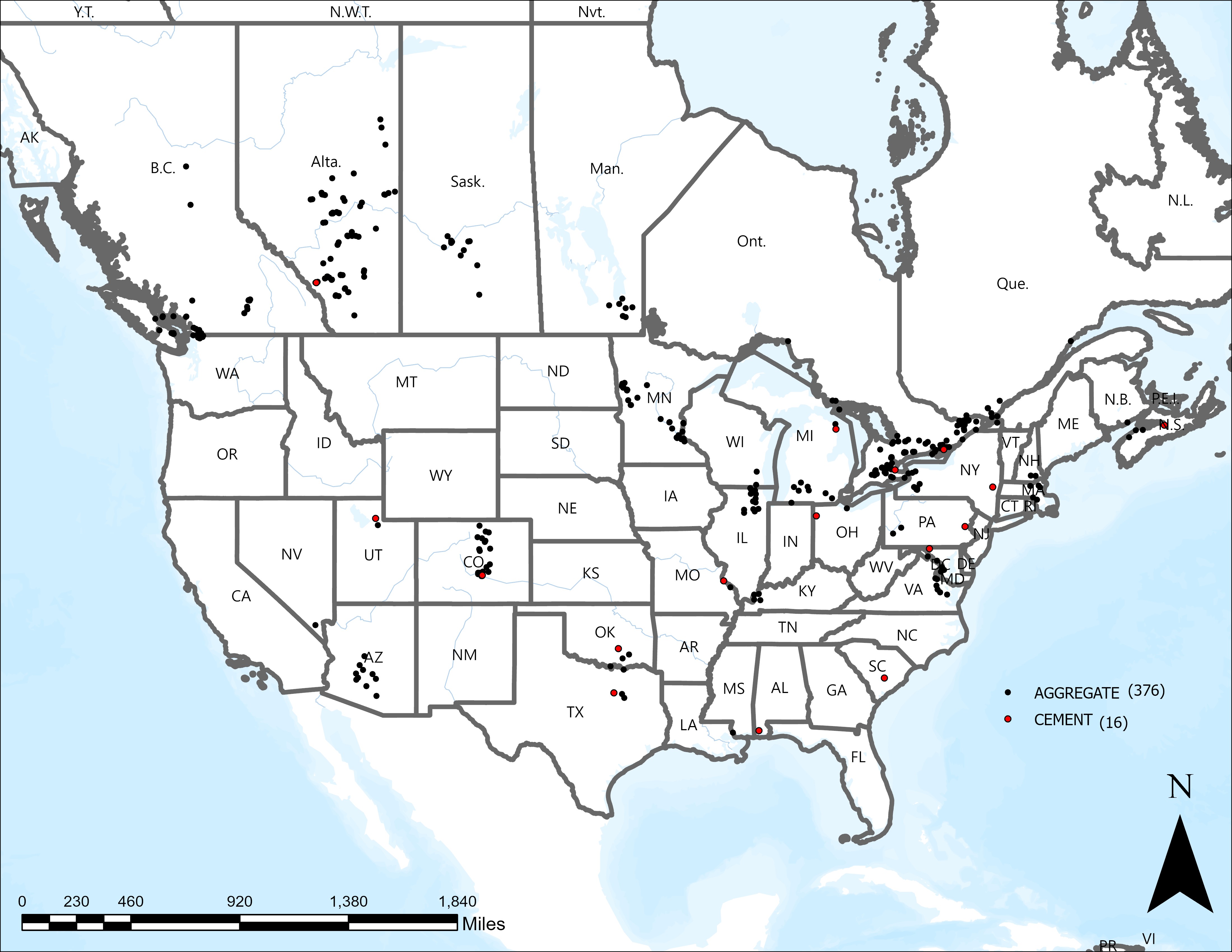
As of December 31, 2025, our Building Materials segment includes estimated total reserves of 8,220 million
tons (consisting of 3,952 million tons of proven reserves and 4,268 million tons of probable reserves) and
estimated total resources of 6,412 million tons (consisting of 1,072 million tons of measured resources, 1,827
million tons of indicated resources and 3,513 million tons of inferred resources). Our reserve and resource
estimates have been estimated by qualified persons in accordance with Subpart 1300 of SEC Regulation S-K.
Across our Building Envelope operations, we maintain 51 facilities throughout North America, which
encompass 34 manufacturing facilities, 12 warehouses and five centers focused on research and
development applications. We maintain 12 facilities under our Elevate business and 9 locations within our
Duro-Last operations. Malarkey and Gaco each operate from 4 locations, while the remaining 5 sites support
our Ox and Enverge business lines.
Reserves
A mineral reserve is an estimate of tonnage and grade or quality of indicated and measured mineral resources
that, in the opinion of a qualified person, can be the basis of an economically viable project. More specifically,
it is the economically mineable part of a measured or indicated mineral resource, which includes diluting
materials and allowances for losses that may occur when the material is mined or extracted. Mineral reserves
are classified into two categories — probable and proven reserves — based on geological confidence and the
application of modifying factors to demonstrate that the extraction of indicated or measured mineral
resources is economically viable under reasonable investment and market assumptions. A probable mineral
reserve is the economically mineable part of an indicated and, in some cases, a measured mineral resource. A
proven mineral reserve is the economically mineable part of a measured mineral resource.
Our estimated 3,952 million tons of proven reserves and 4,268 million tons of probable reserves are broken
down by material type (between hard rock and sand & gravel). Reserve estimates include hard rock and sand
41
Amrize Ltd
& gravel of suitable quality that are economically viable for extraction based on drilling, sampling, testing and
modeling completed by or under the supervision of qualified persons, as well as supervised contractors and
consultants. The application of reasonable modifying factors including economic, operational, commercial,
legal, environmental compliance, permitting and other factors have been considered by the qualified persons
in converting indicated or measured resources to reserves.
During the year ended December 31, 2025, the average sales price for aggregates (excluding freight) in the
United States was $16.32 per ton, while cement averaged $169.33 per ton. In Canada, the average sales
price for aggregates (excluding freight) was $11.43 per ton, and cement was $168.92 per ton. These prices,
which are used for estimation of both mineral reserves and resources, are impacted by product mix,
geographic location, and foreign currency rates.
The following table provides a summary of our proven and probable reserves as of December 31, 2025:
Reserves | |||||||||||||||||
Proven | Probable | Total | |||||||||||||||
(In millions of tons, except percentage data) | Total | Hard Rock | Sand & Gravel | Total | Hard Rock | Sand & Gravel | Total | Hard Rock | Sand & Gravel | ||||||||
Aggregates | |||||||||||||||||
United States | 1,395 | 82% | 18% | 2,178 | 98% | 2% | 3,573 | 91% | 9% | ||||||||
Canada | 1,002 | 92% | 8% | 1,594 | 87% | 13% | 2,596 | 89% | 11% | ||||||||
Subtotal | 2,397 | 86% | 14% | 3,772 | 93% | 7% | 6,169 | 90% | 10% | ||||||||
Cement | |||||||||||||||||
United States | 1,466 | 100% | 152 | 100% | 1,618 | 100% | |||||||||||
Canada | 89 | 100% | 344 | 100% | 433 | 100% | |||||||||||
Subtotal | 1,555 | 100% | 496 | 100% | 2,051 | 100% | |||||||||||
Total | 3,952 | 92% | 8% | 4,268 | 94% | 6% | 8,220 | 93% | 7% | ||||||||
Resources
Mineral resources represent concentrations or occurrences of material of economic interest in or on the
earth’s crust in such form, grade or quality, and quantity that there are reasonable prospects for economic
extraction. A mineral resource is a reasonable estimate of mineralization, taking into account relevant factors
such as cut-off grade, likely mining dimensions, location or continuity, that, with the assumed and justifiable
technical and economic conditions, is likely to, in whole or in part, become economically extractable.
Mineral resources are classified into three categories — measured, indicated or inferred resources — in order
of decreasing geological confidence. A measured mineral resource is that part of the mineral resource for
which quantity and grade or quality are estimated on the basis of conclusive geological evidence and
sampling in sufficient detail to support detailed extraction planning and final evaluation of the economic
viability of the deposit to be quarried or mined. An indicated mineral resource is that part of a mineral
resource for which quantity and grade or quality are estimated on the basis of adequate geological evidence
and sampling in sufficient detail to support mine planning and evaluation of the economic viability of the
deposit of the material to be quarried or mined. Inferred mineral resources are that part of a mineral resource
for which quantity and grade or quality are estimated on the basis of limited geological evidence and
sampling.
Although an inferred resource may not be converted to a mineral reserve, indicated or measured resources
can be converted to reserves by the application of certain modifying factors which include, but are not limited
to, consideration of mining, processing, metallurgical, infrastructure, economic, marketing, legal,
environmental compliance, plans, permitting and other factors. An indicated resource can be converted to a
probable reserve, and a measured resource can be converted to a probable or proven reserve. We conduct
investigations in order to apply modifying factors in sufficient detail to evaluate the economic viability and
support the conversion of indicated and measured resources to probable and proven reserves.
There is no certainty that any of our indicated or measured resources will be converted into proven or
probable reserves in the future, and the resources reported have not been fully assessed using modifying
factors.

1 Based on average extraction during the years ended December 31, 2025, 2024 and 2023.
42
Amrize Ltd
The following table shows our measured, indicated and inferred resources as of December 31, 2025:
Resources | |||||||||||||||||||||||||
Measured | Indicated | Total Measured & Indicated | Inferred | Total | |||||||||||||||||||||
(In millions of tons, except percentage data) | Total | Hard Rock | Sand & Gravel | Total | Hard Rock | Sand & Gravel | Total | Hard Rock | Sand & Gravel | Total | Hard Rock | Sand & Gravel | |||||||||||||
Aggregates | |||||||||||||||||||||||||
United States | 779 | 64% | 36% | 537 | 90% | 10% | 1,316 | 74% | 26% | 1,004 | 90% | 10% | 2,320 | ||||||||||||
Canada | 126 | 60% | 40% | 787 | 81% | 19% | 913 | 78% | 22% | 2,046 | 77% | 23% | 2,959 | ||||||||||||
Subtotal | 905 | 63% | 37% | 1,324 | 85% | 15% | 2,229 | 76% | 24% | 3,050 | 81% | 19% | 5,279 | ||||||||||||
Cement | |||||||||||||||||||||||||
United States | 167 | 100% | 496 | 100% | 663 | 100% | 143 | 100% | 806 | ||||||||||||||||
Canada | 7 | 100% | 7 | 100% | 320 | 100% | 327 | ||||||||||||||||||
Subtotal | 167 | 100% | 503 | 100% | 670 | 100% | 463 | 100% | 1,133 | ||||||||||||||||
Total | 1,072 | 69% | 31% | 1,827 | 89% | 11% | 2,899 | 82% | 18% | 3,513 | 84% | 16% | 6,412 | ||||||||||||
Additional Information
The following table provides a summary of our mineral reserve and resource sites as of December 31, 2025
along with the extraction for the years ended December 31, 2025, 2024 and 2023:
Additional Info | |||||||||||||||
No. of Sites | Extraction (in millions of tons) | ||||||||||||||
Total | Owned | Leased | Owned & Leased | 2025 | 2024 | 2023 | Years to Depletion1 | ||||||||
Aggregates | |||||||||||||||
United States | 147 | 88 | 51 | 8 | 63 | 61 | 63 | 58 | |||||||
Canada | 229 | 151 | 63 | 15 | 57 | 60 | 65 | 43 | |||||||
Subtotal | 376 | 239 | 114 | 23 | 120 | 121 | 128 | 50 | |||||||
Cement | |||||||||||||||
United States | 12 | 12 | 0 | 0 | 23 | 25 | 25 | 68 | |||||||
Canada | 4 | 3 | 1 | 0 | 5 | 5 | 5 | 81 | |||||||
Subtotal | 16 | 15 | 1 | 0 | 28 | 30 | 30 | 70 | |||||||
Total | 392 | 254 | 115 | 23 | 148 | 151 | 158 | ||||||||
Internal Controls
We have established internal control processes to support the annual reporting of resources and reserves.
Reserve and resource estimates are completed using internal and external qualified persons to estimate
mineral reserves and resources, and are subject to annual review by management teams in conjunction with
the relevant qualified persons. This review includes scrutinizing the major assumptions used in determining
estimates to ensure they are materially accurate. For reserve and resource additions, management, together
with internal and external qualified persons, performs its due diligence and reviews the study of technical,
environmental, economic and operating factors, as well as applicable supplemental information, including the
site’s geology and quality.
The qualified persons use a number of sources of geological information to estimate reserves and resources
for production and development stage sites, including geological mapping, drilling, sampling and testing of
sites. The type of drilling and testing depends on the type and complexity of the deposit, as well as whether it
is a greenfield or production site. Mineral exploration requirements such as frequency of sampling are
determined by the qualified persons and geological/mining experts based on the specific characteristics of
the site and the underlying geology in order to properly characterize the deposit. Sample testing can include
gradational, physical and chemical testing depending on the site and the intended product to be used or sold.
43
Amrize Ltd
In rock environments, geological core logging is undertaken. Collected samples are analyzed at internal
company laboratories or regionally and/or nationally accredited laboratories for all relevant analyses and tests
to confirm the quality of the material and the types of products that can be produced.
The reserve and resource estimates include allowances for processing and wash loss that can occur when
the mineral is extracted and processed into a saleable product.
Our estimates of reserves and resources are based on the relative confidence of the geology and the
application of modifying factors where applicable. The economic viability of our reserves is evaluated by the
application of modifying factors and involves review by various internal departments. There are inherent risks
associated with estimates of mineral reserves and resources. Risks include, but are not limited to, accuracy
and completeness of geological information, data interpretation and interpolation, changing geotechnical,
market and permitting conditions and other operational and economic factors. These risks are assessed by
qualified persons and our management team on a periodic basis to determine if adjustments are required as
new information becomes available. Our estimated reserves and resources are based on the best information
available at the time of reporting. These estimates are reviewed and updated whenever new and relevant
information is obtained at any of our sites that indicate changes in the reported reserves and resources.
Item 3. Legal Proceedings
In the ordinary course of conducting our business activities, we are involved in judicial, administrative and
regulatory investigations and proceedings, as well as lawsuits and claims of various natures, involving both
private parties and governmental authorities, relating to product liability, general and commercial liability,
competition, environmental, employment, health and safety and other matters. These claims and proceedings
include insured and uninsured matters that are brought on an individual, collective, representative and class-
action basis. Such proceedings may have a material adverse effect on our reputation, business, financial
position, results of operations and cash flows.
See Note 17 (Commitments and Contingencies) in Item 8. “Financial Statements and Supplementary Data” for
a discussion of our material legal proceedings. The Company has elected to use a $1 million sanctions
threshold for disclosing certain proceedings under environmental laws to which a governmental authority is a
party. Applying this threshold, there were no relevant legal proceedings to disclose for this period.
Item 4. Mine Safety Disclosures
The information concerning mine safety violations or other regulatory matters required by Section 1503(a) of
the Dodd-Frank Wall Street Reform and Consumer Protection Act and Item 104 of Regulation S-K is included
Information About Our Executive Officers
The following sets forth certain information regarding the executive officers as of February 1, 2026. Each was
appointed in connection with the Spin-Off in 2025:
Name | Age | Position | ||
Jan Philipp Jenisch | 59 | Chief Executive Officer and Chairman | ||
Roald Brouwer | 51 | Chief Technology Officer | ||
Stephen Clark | 57 | Chief People Officer | ||
Nollaig Forrest | 49 | Chief Marketing and Corporate Affairs Officer | ||
Jake Gosa | 50 | President, Building Envelope | ||
Mario Gross | 47 | Chief Supply Chain Officer | ||
Jaime Hill | 56 | President, Building Materials | ||
Ian Johnston | 51 | Chief Financial Officer | ||
Samuel J. Poletti | 44 | Chief Strategy and M&A Officer | ||
Denise R. Singleton | 63 | Chief Legal Officer and Corporate Secretary |
Jan Philipp Jenisch
Mr. Jenisch serves as our Chairman of the Board of Directors and Chief Executive Officer. Previously, Mr.
Jenisch served as Chairman of the Holcim Board of Directors from 2023 to 2025, where he was tasked with
leading the planned U.S. listing of Holcim’s North American business. Mr. Jenisch also served as Chief
44
Amrize Ltd
Executive Officer of Holcim from 2017 to April 2024, where he transformed Holcim into a leader in advanced
building solutions and helped Holcim reach new levels of financial performance. Before joining Holcim, Mr.
Jenisch served as Chief Executive Officer of Sika AG from 2012 to 2017. Under his leadership, Sika AG set
new performance standards for sales and profitability, becoming a member of the Swiss Market Index (“SMI”),
which is made up of the 20 largest and most liquid stocks listed on SIX. Mr. Jenisch studied in the United
States and Switzerland, obtaining his MBA from the University of Fribourg in 1993. In 2021, he received a Dr.
h.c. for his accomplishments as Chief Executive Officer of two SMI companies.
Mr. Jenisch’s qualifications include his two-time experience as a public company chief executive officer for
global companies with significant operations and customer bases in North America, his deep experience
leading organic and inorganic growth at the enterprise level and his understanding of the Amrize Business,
including the Company’s customers, markets and external stakeholders.
Roald Brouwer
Mr. Brouwer serves as our Chief Technology Officer. Mr. Brouwer previously served as Holcim’s Senior Vice
President, Group Head of Decarbonization, a position he held from 2022 to 2025. Prior to joining Holcim, Mr.
Brouwer held several positions at Shell plc, including as Director Energy Transition Technologies, Global
Technology Deployment Consultant, Team Lead Carmon Creek Field Development Project and Reservoir
Engineering Advisory Heavy Oil from 2014 to 2022. Mr. Brouwer holds a Master of Science degree in
Geochemistry from Utrecht University in Utrecht, Netherlands and a PhD in Petroleum Engineering from Delft
University of Technology in Delft, Netherlands.
Stephen Clark
Mr. Clark serves as our Chief People Officer, a role he held for Holcim’s North American business from August
2024 to 2025. Prior to joining Holcim, Mr. Clark served as Executive Vice President and Chief Human
Resources Officer of Gainwell Technologies LLC from 2022 to July 2024. Prior to that, Mr. Clark held several
positions at Lear Corporation, including Chief Administrative Officer, Asia-Pacific and Global Vice President of
Leadership & Organizational Development, Total Rewards and Human Resources Shared Services from 2018
to 2022. From 2015 to 2017, Mr. Clark served as Senior Vice President, Chief Human Resources and
Corporate Services Officer for Vista Outdoor, Inc. Mr. Clark holds a Master of Organizational Behavior from
the Brigham Young University Marriott School of Business in Provo, Utah, and a Bachelor of Arts degree in
French and Psychology from Brigham Young University.
Nollaig Forrest
Ms. Forrest serves as our Chief Marketing and Corporate Affairs Officer. Ms. Forrest previously served as
Holcim’s Chief Sustainability Officer, a position she held from 2023 to 2025, overseeing sustainability,
corporate affairs and health and safety. Prior to her role as Chief Sustainability Officer, Ms. Forrest served as
Holcim’s Global Head of Corporate Affairs from 2020 to 2024, overseeing corporate communications,
branding and government and public affairs. Prior to joining Holcim, Ms. Forrest was Vice President,
Corporate Communications for Firmenich SA from 2014 to 2020. Ms. Forrest holds a Master of Arts degree in
International Relations from the Graduate Institute of International Studies in Geneva, Switzerland.
Jake Gosa
Mr. Gosa serves as our President of Building Envelope. Mr. Gosa previously served as Executive Vice
President and Chief Commercial Officer for Beacon Building Products, where he held several executive roles
of increasing responsibility from 2007 to 2025. Prior to that, Mr. Gosa served in a variety of roles for Elk
Corporation and GAF Roofing. Mr. Gosa holds a Bachelor of Business degree from Shepherd University in
Shepherdstown, West Virginia.
Mario Gross
Mr. Gross serves as our Chief Supply Chain Officer. Mr. Gross previously served as Chief Operating Officer of
Holcim Building Envelope, a position he held from 2024 to 2025. Prior to serving as Chief Operating Officer,
Mr. Gross served as Chief Procurement Officer of Holcim from 2020 to 2024, Senior Project Leader, Lafarge
Holcim Group from 2019 to 2020 and Chief Executive Officer, Lafarge Malaysia from 2018 to 2019. Prior to
joining Holcim, Mr. Gross was Head of Global Procurement, Engineering, Quality, and Sustainability at Sika AG
from 2013 to 2017. Mr. Gross holds an MBA from the University of Strathclyde in Glasgow, United Kingdom,
and a Bachelor of Arts degree in Economy & Law from Saarland University in Saarbrucken, Germany.
45
Amrize Ltd
Jaime Hill
Mr. Hill serves as our President, Building Materials. Mr. Hill previously served as Holcim’s Region Head North
America, a position he held from 2024 to 2025. Prior to serving as Region Head North America, Mr. Hill served
in various other roles at Holcim, including Chief Executive Officer of Holcim Mexico from 2019 to 2024, Chief
Executive Officer of Holcim Colombia from 2015 to 2019 and Commercial Director of Holcim Colombia from
2008 to 2014. Mr. Hill holds a Bachelor of Science degree in Business Administration from Georgetown
University in Washington, D.C.
Ian Johnston
Mr. Johnston serves as our Chief Financial Officer, a role he held for Holcim’s North American business from
2018 to 2025. Mr. Johnston had 26 years of experience with Holcim, including as Chief Financial Officer, U.S.
from 2016 to 2018, Chief Financial Officer, Canada from 2015 to 2016 and Chief Financial Officer, Western
Canada from 2012 to 2015. Mr. Johnston holds a Bachelor of Commerce degree in Accounting with honors
from the University of Ottawa in Ottawa, Canada. Mr. Johnston became a Chartered Professional Accountant
in 1999.
Samuel J. Poletti
Mr. Poletti serves as our Chief Strategy and M&A Officer. Mr. Poletti previously served as Holcim’s Global
Head of M&A, a position he held from 2018 to 2025. Mr. Poletti served in various other roles at Holcim,
including as Vice President, Senior M&A Manager from 2014 to 2018 and Assistant Vice President, Head of
Strategy and Business Development South Asia from March 2014 to July 2014. Mr. Poletti holds a dual Master
of Arts degree in Law & Economics from the University of St. Gallen in St. Gallen, Switzerland and a dual
Bachelor of Arts degree in Law & Economics from the University of St. Gallen.
Denise R. Singleton
Ms. Singleton serves as our Chief Legal Officer and Corporate Secretary, a role she held for Holcim’s North
American business from 2024 to 2025. Prior to joining Holcim, Ms. Singleton served as Executive Vice
President, General Counsel and Secretary of WestRock Company from 2022 to 2024. From 2015 to 2022, Ms.
Singleton served as Senior Vice President, General Counsel and Corporate Secretary of IDEX Corporation.
From 2011 to 2015, she served as Senior Vice President, General Counsel, Corporate Secretary and Chief
Compliance Officer of SunCoke Energy, Inc. Ms. Singleton holds a Juris Doctor degree from Georgetown
University Law Center in Washington, D.C. and a Bachelor of Arts degree in Journalism from Marquette
University in Milwaukee, Wisconsin.
46
Amrize Ltd
PART II
Item 5. Market for Registrant’s Common Equity, Related Stockholder Matters and
Issuer Purchases of Equity Securities
Market Information
Our Ordinary Shares trade on the New York Stock Exchange and SIX Swiss Exchange under the symbol
“AMRZ.”
Holders of Ordinary Shares
As of December 31, 2025, there was 1 holder of record of our ordinary shares, which doesn’t reflect the
number of beneficial owners.
Securities authorized for issuance under equity compensation plans
Plan Category | (A) Number of securities to be issued upon exercise of outstanding options, warrants and rights | (B) Weighted-average exercise price of outstanding options, warrants and rights | (C) Number of securities remaining available for future issuance under equity compensation plans (excluding securities reflected in column (A) |
Equity compensation plans approved by security holders | 3,913,655(1) | $ 31.98(2) | 32,886,345(3) |
Equity compensation plans not approved by security holders(4) | — | — | — |
Total | 3,913,655 | $ 31.98 | 32,886,345 |
__________________
(1)Includes an aggregate of 2,711,801 performance stock options, 971,039 performance share units, and 121,687
restricted share units under the Amrize Ltd 2025 Omnibus Incentive Plan, and 109,128 shares under the Amrize Ltd
Employee Stock Purchase Plan.
(2)Weighted-average exercise price of outstanding options, which excludes performance share units, restricted share
units, and the rights to purchase shares under the ESPP.
(3)This amount includes 21,695,473 shares available under the Amrize Ltd 2025 Omnibus Incentive Plan and 11,190,872
shares available under the Amrize Ltd Employee Stock Purchase Plan. Under the Amrize Ltd 2025 Omnibus Incentive
Plan, Amrize may issue share options (including incentive stock options and nonqualified stock options), share
appreciation rights, restricted shares, restricted share units, performance share units, other share-based awards,
share bonuses, cash awards, and substitute awards.
(4)Amrize has no equity compensation plans that have not been approved by shareholders.
Recent sales of unregistered securities; use of proceeds from registered securities
None.
Share Performance Graph
The following graph compares the total shareholder return on the Company's ordinary shares for the last 6
months since the Company started trading on June 23, 2025 with the Standard & Poor's (“S&P”) 500 and S&P
500 Materials indices. The graph assumes $100 was invested in each of these indices on June 23, 2025, the
first day of “regular way” trading, for the Company's ordinary shares. The comparisons are based on historical
data and are not indicative of, nor intended to forecast, the future performance of the Company's ordinary
shares.
47
Amrize Ltd
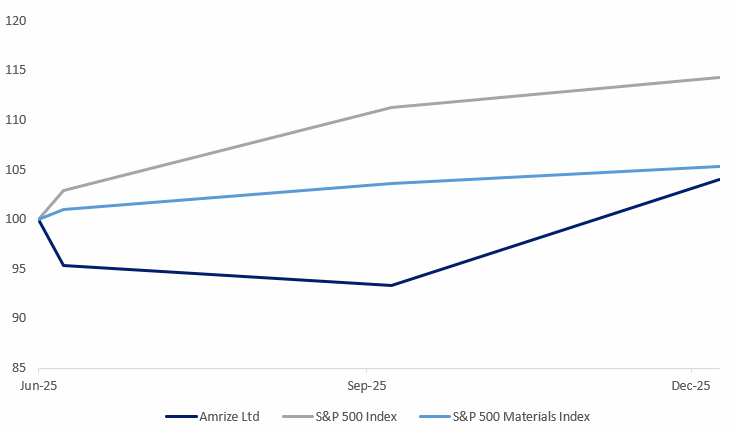
Comparative Total Return1 | June 23, 2025 | June 30, 2025 | September 30, 2025 | December 31, 2025 |
Amrize Ltd | $100.00 | $95.31 | $93.34 | $104.02 |
S&P 500 Index | 100.00 | 102.95 | 111.31 | 114.27 |
S&P 500 Materials Index | 100.00 | 101.00 | 103.57 | 105.35 |
______________________________________________________
1 Assumes reinvestment of dividends.
Item 6. Reserved
48
Amrize Ltd
Item 7. Management’s Discussion and Analysis of Financial Condition and Results of
Operations
The following discussion and analysis of our financial condition and results of operations should be read in
conjunction with our consolidated financial statements and accompanying notes included elsewhere in this
Annual Report. Some of the information contained in the following discussion and analysis includes forward-
looking statements that involve risks and uncertainties. Refer to the sections entitled “Cautionary Note
Regarding Forward-Looking Statements” and “Risk Factors” for a discussion of forward-looking statements
and important factors that could cause actual results to differ materially from the results described in or
implied by the forward-looking statements contained in the following discussion and analysis.
Overview
We are a building solutions company focused on the North American market, offering customers a broad
range of advanced building solutions from foundation to rooftop. We serve customers across the
infrastructure, commercial, and residential construction markets, from new builds to repair and refurbishment
(“R&R”). Our more than 19,000 employees operate across more than 1,000 sites and facilities in the United
States, Canada, Colombia, Switzerland and Jamaica, providing customers with trusted brands and advanced
building solutions for the full building lifecycle. Our trusted brands and advanced solutions, combined with our
operational expertise, make us a trusted partner for customers, consisting of contractors, building owners,
architects, engineers, public authorities and cities across the United States and Canada.
We earn revenue from the sale of cement, aggregates, ready-mix concrete, asphalt, roofing systems and
other building solutions. We operate in two reportable segments, offering a complete range of advanced
solutions to support large-scale and complex construction projects from bridges to data centers in the areas
of residential, commercial and infrastructure construction. Our services span new construction as well as R&R,
with R&R accounting for 43% of overall revenues in the year ended December 31, 2025.
•Our Building Materials segment offers a range of branded solutions delivering high-quality products
for a wide range of applications across North America. Key product offerings of this segment include
cement and aggregates, as well as a variety of downstream products and solutions such as ready-
mix concrete, asphalt and other construction materials.
•Our Building Envelope segment offers advanced roofing and wall systems, including single-ply
membranes, insulation, shingles, sheathing, waterproofing and protective coatings, along with
adhesives, tapes and sealants that are critical to the application of roofing and wall systems. Our
Building Envelope products are sold individually or in warrantied systems for new construction or R&R
in commercial and residential projects. These products are sold either directly to contractors or
through an authorized distributor or dealer network in North America.
Seasonality
Our Building Materials segment results for the first and fourth quarters are generally lower than those for the
second and third quarters, which benefit from more favorable weather and increased construction activity. In
addition to impacting demand, adverse weather can disrupt production schedules, shipments, and project
timelines, affecting costs, efficiencies, and profitability. We manage these seasonal fluctuations through
operational planning and flexible workforce management, but quarter-to-quarter results may not be indicative
of full-year performance.
Our Building Envelope segment is subject to seasonal fluctuations in demand, primarily driven by trends in
new construction, renovation, and repair activities across both residential and commercial markets. Demand
for our building envelope products, which include roofing and wall systems, exterior cladding, and related
solutions, generally increases during periods of favorable weather, as construction and renovation projects
are most active in the second and third calendar quarters. This pattern reflects the broader industry trend,
where project starts and completions are concentrated in the spring and summer months, particularly in our
key geographic markets.
We continuously monitor market conditions and adjust our production and inventory management strategies
to align with anticipated seasonal demand and potential weather-related disruptions. Despite these efforts,
the inherent seasonality and unpredictability of weather events may result in fluctuations in our quarterly
revenues, earnings and cash flow.
49
Amrize Ltd
Financial Summary
A summary of our performance highlights for the years ended December 31, 2025, 2024 and 2023 is as
follows:
For the years ended December 31, | |||
$ in millions, except percentage data | 2025 | 2024 | 2023 |
Revenues | $11,815 | $11,704 | $11,677 |
Net income | $1,182 | $1,273 | $955 |
Net income margin | 10.0% | 10.9% | 8.2% |
Adjusted EBITDA | $3,007 | $3,181 | $2,844 |
Adjusted EBITDA Margin | 25.5% | 27.2% | 24.4% |
Cash flows provided by operating activities | $2,208 | $2,282 | $2,036 |
Capital Allocation
We believe our disciplined approach to capital allocation allows us to invest in our business to drive
sustainable growth, pursue strategic mergers and acquisitions and return capital to shareholders. We remain
committed to diligently executing this capital allocation strategy through continuous enhancements to our
facilities, investment in new greenfield projects and increased allocation of capital towards future growth
initiatives. Furthermore, we have historically been able to effectively acquire and merge businesses in
fragmented industries, aligning with our overarching capital allocation strategies.
•We completed three acquisitions in 2025, two acquisitions in 2024 and five acquisitions in 2023 for
total cash consideration, net of cash acquired, of $98 million, $249 million and $1,607 million,
respectively; and
•We invested $788 million in capital expenditure projects to increase production capacity and improve
efficiency in 2025, compared with $642 million and $630 million in 2024 and 2023, respectively.
Transition to Standalone Company
On June 23, 2025, Holcim completed the previously announced Spin-Off through a distribution of 100% of the
Company’s outstanding shares to holders of record of Holcim’s ordinary shares, on a pro rata basis as a
dividend-in-kind, as of the close of business on June 20, 2025. As a result of the Distribution, the Company
became an independent public company. Our Ordinary Shares are listed under the symbol “AMRZ” on the
New York Stock Exchange and the SIX Swiss Exchange.
In connection with the Spin-Off, we entered into or adopted several agreements including a Separation and
Distribution Agreement, Transition Services Agreement, and Tax Matters Agreement, among others. These
agreements allocate between Holcim and us various assets, liabilities, rights and obligations (including with
respect to employee benefits and tax-related assets and liabilities) and govern the relationship between the
Company and Holcim for certain commercial matters (including manufacturing, supply and insurance)
following the Spin-Off. See Note 18 (Related party) to our consolidated financial statements included
elsewhere in this Annual Report for more information on these agreements.
In connection with the Spin-Off, we became subject to the requirements of the New York Stock Exchange and
the SIX Swiss Exchange. We are establishing additional procedures and practices as a standalone public
company. As a result, we incurred additional expenses in 2025 related to the establishment and operation of
new functions as a standalone public company including rebranding, employee-related costs, executive
leadership compensation, accounting and financial reporting, compliance and regulatory, human resources,
information technology, marketing and communications, insurance and other operating costs. In line with our
ASPIRE program (an initiative launched in the second quarter of 2025 to accelerate synergies by leveraging
our scale to optimize third-party spending and drive efficiencies across procurement, logistics and operating
functions), we will continue to look for operational cost improvement opportunities as a standalone company
to drive lower costs across our business and corporate functions. Certain of these costs (the “Spin-Off and
separation-related costs”) are non-recurring in nature, consisting primarily of rebranding costs. We expect the
Spin-Off and separation-related costs to continue through fiscal year 2027.
50
Basis of Presentation
Our consolidated financial statements and accompanying notes included elsewhere in this Annual Report
have been prepared in accordance with U.S. GAAP and the rules and regulations of the SEC. Prior to the Spin-
Off, we operated as a wholly-owned subsidiary of Holcim, and not as a standalone company. These
consolidated financial statements and footnotes reflect the historical financial position, results of operations
and cash flows of the Company as historically managed within Holcim for periods prior to the completion of
the Spin-Off and reflect the financial position, results of operations and cash flows of the Company as a
standalone company for periods after the completion of the Spin-Off. The consolidated financial statements
and footnotes for the period prior to the Spin-Off included elsewhere in this Annual Report were prepared on
a “carve-out” basis in connection with the Spin-Off and have been derived from the consolidated financial
statements and historical accounting records of Holcim. See Note 1 (Organization and basis of presentation)
to our consolidated financial statements included elsewhere in this Annual Report.
Prior to the Spin-Off, our consolidated financial statements included expense allocations for certain
corporate, infrastructure and other shared services provided by Holcim on a centralized basis, including but
not limited to accounting and financial reporting, treasury, tax, legal, human resources, information
technology, insurance, employee benefits and other shared services that are either specifically identifiable or
directly attributable to us. These expenses have been allocated to us on the basis of direct usage when
specifically identifiable, with the remainder predominantly allocated on a pro rata basis using revenues. See
Note 18 (Related party) to our consolidated financial statements included elsewhere in this Annual Report.
Prior to the Spin-Off, we participated in Holcim’s centralized cash management and financing function. Our
residual cash pooling balances as of the end of each reporting period were recorded within Related-party
notes receivable, and we had related-party note agreements in place with Holcim for the financing of our
capital needs, which were reflected as Related-party notes payable. Interest expense, net in the consolidated
statements of operations reflects interest on borrowing and funding associated with the related-party note
agreements, for periods prior to the Spin-Off.
Certain related-party transactions between the Company and Holcim have been included in our consolidated
financial statements prior to the Spin-Off. Additionally, as part of the Spin-Off, the Company issued senior
unsecured notes and completed a bond exchange. A portion of the proceeds from the issuance of the senior
unsecured notes and completion of the bond exchange was used to repay the Company’s related-party
indebtedness due to Holcim. Holcim also completed an equity contribution to the Company to settle the
remaining related-party indebtedness due to Holcim. See Note 10 (Debt) and Note 18 (Related party) to our
consolidated financial statements included elsewhere in this Annual Report for additional information.
Market Conditions and Outlook
We operate in competitive markets with respect to each of our segments. Recent market conditions, such as
trade policy uncertainty, fluctuations in interest rates and unfavorable weather conditions earlier in 2025
causing construction market labor challenges have resulted in industry-wide project delays and slower build
activity, particularly in the residential market. Despite these market conditions, our business has remained
resilient, as we have been able to leverage our scale, unique footprint and diverse product offerings to
customers. We expect to continue offsetting recent market conditions through execution of our ASPIRE
program to accelerate synergies and profitable growth and by investing in streamlining our network. Over
time, we expect continued growth in demand due to rapid urbanization, aging infrastructure, recent onshoring
trends, population growth and historical underinvestment in residential housing. As market conditions evolve,
we believe that we are uniquely positioned to capitalize on these growth opportunities.
Factors Affecting Our Performance
We continue to evolve our business to improve performance and drive sustainable growth. Building on our
large operating footprint of over 1,000 sites and facilities, we believe we are well positioned to capitalize on
strong commercial and residential construction spend and infrastructure investments across North America.
The future success of our business depends on many factors. While these factors present opportunities for
us, they also pose risks and challenges, including those discussed below and in “Risk Factors” under Item 1A.
We must successfully address these risks to achieve growth, improve our results of operations and generate
profits.
Emphasis on Building Envelope. Our strong presence in the Building Materials category has allowed us to
grow additional product lines, such as roofing and insulation products, in the Building Envelope segment. By
acquiring Firestone Building Products (later renamed to Elevate Commercial Roofing Systems) in 2021,
51
Amrize Ltd
Herbert Malarkey Roofing Company (“Malarkey”) in 2022 and Duro-Last, LLC, Critical Point, LLC, Oscoda
Plastics, LLC, Plastatech Engineering Limited, LLC, Anvil Paints & Coatings, LLC and Tip-Top Screw
Manufacturing, LLC (collectively, “Duro-Last”) in 2023, we bolstered our roofing system offerings and
positioned ourselves to meet growing demand for re-roofing and new builds. Our Building Envelope segment
accounted for 27.9%, 28.8% and 26.7% of our revenues for the years ended December 31, 2025, 2024 and
2023, respectively. We intend to continue building out our Building Envelope segment through expansions,
acquisitions and development of additional solutions and products, as we believe this will unlock long-term
value creation. Such expansions and acquisitions depend on our ability to raise capital and seamlessly
integrate new products into our current product mix.
Emphasis on Aggregates. Our scaled aggregates franchise shows compelling growth potential. The North
American aggregates industry is fragmented and consists of specialized businesses that present ideal
opportunities for acquisition and future growth. We have the size, scale and financial capabilities to procure
businesses that we believe would expand our offerings. Although inorganic growth through acquisitions may
subject us to significant up-front costs, we believe such acquisitions will enhance our competitive advantage,
provide strategic value creation and ultimately increase our Building Materials revenue and Segment Adjusted
EBITDA.
Infrastructure Investment. Demand for our products is directly related to the level of activity in the
construction industry, which includes residential, commercial and infrastructure construction. A recent focus
on improving infrastructure in North America is being fueled by, among other things, funding from federal,
state and local governments who are focused on addressing aging infrastructure across North America. We
are leveraging our market position across North America and diverse product offerings to secure our
involvement in airport, highway, bridge and related infrastructure projects. Our ability to capitalize on this
growing need for infrastructure-related projects across North America has the capability to increase our
scope of operations and revenues.
Innovation. Through our research and development engine, we seek to drive cutting-edge innovation to
address our customers’ greatest ambitions. We believe we are at the forefront of new product developments,
and our experts span all building fields, from masons and engineers to material scientists and experts in
artificial intelligence and data mining. We conduct cutting-edge research and empower smart design while
deploying new building technologies. We also partner with leading construction sector startups to scale up
new technologies across our operations. For example, we have investments in Sublime Systems, a cement
technology startup which plans to use renewable electricity and carbon-free raw materials for cement
production, in the form of a convertible note and advance payments for future supplies and may participate in
the startup’s future potential rounds of capital raising to finance its manufacturing facility. Maintaining this
level of innovation requires us to spend a substantial amount on research and development efforts, as well as
on retaining and recruiting talent. Whether this spending results in increased revenue and more profitable
operations will depend on our ability to introduce new products and improve our current product offerings.
Although we will strive to introduce new products and to develop and market new construction techniques
and technologies, our efforts may be unsuccessful or unprofitable resulting in impairments, which could
negatively affect our results of operations and market positions.
Components of Results of Operations
Revenues
We earn revenue from the sale of Building Materials products (cement, aggregates, ready-mix concrete,
asphalt and other construction materials) and Building Envelope products (advanced roofing and wall
systems, including single-ply membranes, insulation, shingles, sheathing, waterproofing and protective
coatings, along with adhesives, tapes and sealants that are critical to the application of roofing and wall
systems). Revenues are recognized in accordance with Financial Accounting Standards Board Accounting
Standards Codification (“ASC”) Topic 606, Revenue from Contracts with Customers, and ASC 340-40, Other
Assets and Deferred Costs—Contracts with Customers, when we satisfy a performance obligation by
transferring a promised good or service to a customer. This occurs when the customer obtains control of that
good or service. See Note 2 (Summary of significant accounting policies) and Note 3 (Revenues) included in
the consolidated financial statements included elsewhere the Annual Report for more information.
52
Operating Costs and Expenses
The key components of our operating costs and expenses consist of Cost of revenues, Selling, general and
administrative expenses, Gain on disposal of long-lived assets and Loss on impairments, as defined and
outlined below:
Cost of Revenues
Cost of revenues primarily consists of all direct production costs of products, including labor, materials,
transportation and fuel. Cost of revenues also includes a portion of our depreciation, depletion, accretion and
amortization expense related to property, plant and equipment directly attributable to the production of
goods sold, as well as the service cost component of defined benefit pension plan and other postretirement
benefit plan expenses, operating lease expenses and finance lease expenses. Proceeds from business
interruption insurance claims, if any, are treated as reductions to the related Cost of revenues incurred.
Selling, General and Administrative Expenses
Selling, general and administrative expenses primarily include salaries and related costs for roles not directly
attributable to the production of goods sold, such as sales and marketing, legal, finance and accounting,
information technology, human resources and certain other employees. Selling, general and administrative
expenses also include a portion of our depreciation, depletion, accretion and amortization expense related to
property, plant and equipment, intangible assets not directly attributable to the production of goods sold,
acquisition-related transaction costs, the service cost component of defined benefit pension plan and other
postretirement benefit plan expenses, operating lease expenses and finance lease expenses. Additionally,
prior to the Spin-Off, Selling, general and administrative expenses also include expense allocations for certain
corporate, infrastructure and other shared services provided by Holcim on a centralized basis, including but
not limited to accounting and financial reporting, treasury, tax, legal, human resources, information
technology, insurance, employee benefits and other shared services.
Gain on Disposal of Long-Lived Assets
Gain on disposal of long-lived assets primarily includes gains on the disposal and retirement of specific
assets, such as ready-mix concrete, cement and roofing assets.
Loss on Impairments
Loss on impairments primarily includes losses on the impairment of long-lived assets, specifically intangible
assets, losses recognized on investments when changes in facts and circumstances indicate their carrying
values may not be recoverable, as well as the losses identified as a part of the annual impairment review of all
property, plant and equipment.
Interest Expense, net
Interest expense, net consists of interest incurred on finance leases, third-party notes, related-party notes
prior to the Spin-Off, and the amortization of the associated deferred financing costs, net of interest income.
Other Non-Operating Income (Expense), net
Other non-operating income (expense), net primarily includes the amortization of actuarial gains or losses on
pension and other postretirement benefit plans, curtailment and settlement gains or losses incurred in
connection with pension and other postretirement benefit plans.
Income Tax Expense
Income tax expense consists of federal, state and local income taxes related to the tax jurisdictions in which
we conduct business. Income tax provision consists of taxes currently payable and deferred amounts related
to both Swiss and non-Swiss taxes on our income. The effective tax rate depends on a number of factors,
including the jurisdiction in which operating profit is earned and the nature and timing of discrete items.
Income from Equity Method Investments
Income from equity method investments primarily includes the results of our share of income from our equity
method investments.
53
Results of Operations
As discussed in “Management’s Discussion and Analysis of Financial Condition and Results of Operations-
Overview- Factors Affecting Our Performance” and “Management’s Discussion and Analysis of Financial
Condition and Results of Operations- Overview- Market Conditions and Outlook” above, and as discussed in
more detail below, our results of operations are highly dependent upon activities within the construction
industry, economic cycles within the public and private business sectors and seasonality. Accordingly,
financial results for any period presented, or period-to-period comparisons of reported results, may not be
indicative of future results of operations.
Our financial results for the year ended December 31, 2025 were affected by market uncertainty, which
resulted in project delays and softer new construction activity. These factors are outside of our control and
may impact our operations in the future. The extent to which global economic challenges will ultimately
impact our business, operations, financial condition and results of operations will depend on numerous
factors, which are highly uncertain, rapidly changing and cannot be predicted.
Consolidated Statements of Operations
For the years ended December 31, | ||||||||||
(In millions, except for percentage data) | 2025 | 2024 | 2023 | 2025 vs 2024 % change | 2024 vs 2023 % change | |||||
Revenues | $11,815 | $11,704 | $11,677 | 0.9% | 0.2% | |||||
Cost of revenues | (8,781) | (8,634) | (8,908) | 1.7% | (3.1)% | |||||
Gross profit | 3,034 | 3,070 | 2,769 | (1.2)% | 10.9% | |||||
Selling, general and administrative expenses | (1,128) | (944) | (898) | 19.5% | 5.1% | |||||
Gain on disposal of long-lived assets | 15 | 71 | 32 | n/m | n/m | |||||
Loss on impairments | (15) | (2) | (15) | n/m | n/m | |||||
Operating income | 1,906 | 2,195 | 1,888 | (13.2)% | 16.3% | |||||
Interest expense, net | (413) | (512) | (549) | (19.3)% | (6.7)% | |||||
Other non-operating income (expense), net | 4 | (55) | (36) | n/m | n/m | |||||
Income before income tax expense and income from equity method investments | 1,497 | 1,628 | 1,303 | (8.0)% | 24.9% | |||||
Income tax expense | (326) | (368) | (361) | (11.4)% | 1.9% | |||||
Income from equity method investments | 11 | 13 | 13 | (15.4)% | —% | |||||
Net income | 1,182 | 1,273 | 955 | (7.1)% | 33.3% | |||||
Net loss attributable to noncontrolling interests | 3 | 1 | 1 | n/m | —% | |||||
Net income attributable to the Company | $1,185 | $1,274 | $956 | (7.0)% | 33.3% | |||||
Net income margin | 10.0% | 10.9% | 8.2% | |||||||
Adjusted EBITDA(1) | $3,007 | $3,181 | $2,844 | (5.5)% | 11.8% | |||||
Adjusted EBITDA Margin(1) | 25.5% | 27.2% | 24.4% | |||||||
__________________
(1)See “Management’s Discussion and Analysis of Financial Condition and Results of Operations—Non-GAAP Financial
Measures” for definitions of these Non-GAAP financial measures, information about how and why we use these Non-
GAAP financial measures and a reconciliation of each of these Non-GAAP financial measures to its most directly
comparable financial measure calculated in accordance with U.S. GAAP.
54
Amrize Ltd
Fiscal Year 2025 Compared to Fiscal Year 2024
Revenues
Revenues were $11,815 million in 2025, an increase of $111 million, or 0.9%, from $11,704 million in 2024. The
increase in our overall revenues was primarily driven by higher pricing of $182 million and contributions of
$130 million from acquisitions. These factors were partially offset by lower sales volumes and the unfavorable
impact of foreign currency movements. The proportion of revenues related to the Building Materials segment
and Building Envelope segment was 72.1% and 27.9%, respectively, in 2025, compared to 71.2% and 28.8%,
respectively, in 2024.
Cost of revenues
Cost of revenues was $8,781 million in 2025, an increase of $147 million, or 1.7%, from $8,634 million in 2024.
The increase was comprised of an increase of $246 million from the Building Materials segment and a
decrease of $83 million from the Building Envelope segment. The increase within Building Materials was
primarily driven by higher manufacturing and distribution costs associated with an equipment outage in our
cement network. The decrease within Building Envelope was assisted by operational efficiencies. Cost of
revenues as a percentage of revenues was 74.3% and 73.8% in 2025 and 2024, respectively. The proportion
of Cost of revenues related to the Building Materials segment and Building Envelope segment was 73.2% and
26.8%, respectively, in 2025, compared to 71.8% and 28.2%, respectively, in 2024.
Selling, general and administrative expenses
Selling, general and administrative expenses were $1,128 million in 2025, an increase of $184 million, or
19.5%, from $944 million in 2024. The increase was primarily due to additional costs in connection with the
Spin-Off (including professional services, marketing, rebranding, personnel and related costs, and IT projects
and related costs) and higher litigation-related costs.
Gain on disposal of long-lived assets
Gain on disposal of long-lived assets was $15 million in 2025, a decrease of $56 million, from $71 million in
2024. The decrease was primarily driven by a gain of $31 million within the Building Materials segment related
to a land expropriation transaction that occurred in 2024.
Loss on impairments
Loss on impairments was $15 million in 2025, an increase of $13 million from $2 million in 2024. The increase
in 2025 primarily includes impairments recognized on investments and property, plant and equipment.
Interest expense, net
Interest expense, net was $413 million in 2025, a decrease of $99 million, or 19.3%, from $512 million in 2024.
The decrease in interest expense, net was primarily driven by lower average total borrowings in 2025.
Other non-operating income (expense), net
Other non-operating income, net was $4 million in 2025, an increase of $59 million from other non-operating
expense, net of $55 million in 2024. The increase in other non-operating income, net was primarily driven by a
Canadian defined benefit pension plan settlement loss, which contributed $61 million of expense in 2024.
Income tax expense
Income tax expense was $326 million in 2025, a decrease of $42 million, or 11.4%, from $368 million in 2024.
The effective income tax rate was 21.8% in 2025, compared to 22.6% in 2024. The change in effective income
tax rate was primarily attributable to the Organization for Economic Co-operation and Development Pillar Two
(‘‘OECD Pillar Two’’) regulatory guidance released in January 2025, which resulted in a reduction in the OECD
Pillar Two tax and a reduction in our Uncertain Tax Benefits due to statute of limitation expirations.
Income from equity method investments
Income from equity method investments was $11 million in 2025, a decrease of $2 million, or 15.4%, from $13
million in 2024.
55
Amrize Ltd
Adjusted EBITDA and Adjusted EBITDA Margin
Adjusted EBITDA decreased to $3,007 million in 2025 from $3,181 million in 2024. Adjusted EBITDA Margin
was 25.5% in 2025, compared with an Adjusted EBITDA Margin of 27.2% in 2024. The decreases were
primarily driven by higher manufacturing and distribution costs associated with an equipment outage in our
cement network, the impact of lower volumes, higher corporate costs, and gains on land sales in 2024. These
factors were partially offset by higher prices. Adjusted EBITDA and Adjusted EBITDA Margin performance was
as follows:
Analysis of Change | ||||||||||||
(In millions, except for percentage data) | For the year ended December 31, 2024 | Acquisitions & Divestments | Organic Growth | Foreign Exchange | For the year ended December 31, 2025 | % change | ||||||
Total Revenues | $11,704 | $130 | $34 | $(53) | $11,815 | 0.9% | ||||||
Adjusted EBITDA(1) | 3,181 | 22 | (181) | (15) | 3,007 | (5.5)% | ||||||
Adjusted EBITDA Margin(1) | 27.2% | 25.5% | ||||||||||
__________________
(1)See “Management’s Discussion and Analysis of Financial Condition and Results of Operations—Non-GAAP Financial Measures” for
definitions of these non-GAAP financial measures, information about how and why we use these non-GAAP financial measures and a
reconciliation of each of these non-GAAP financial measures to its most directly comparable financial measure calculated in accordance
with U.S. GAAP.
Fiscal Year 2024 Compared to Fiscal Year 2023
Revenues
Revenues were $11,704 million in 2024, an increase of $27 million, or 0.2%, from $11,677 million in 2023. The
increase in our overall revenues was primarily driven by sales price growth, which accounted for $527 million
of the increase, and the contribution of $118 million from acquisitions, of which $93 million was contributed by
Duro-Last. The increase was partially offset by a decrease in revenues from lower sales volumes of $610
million. The proportion of revenues related to the Building Materials segment and Building Envelope segment
was 71.2% and 28.8%, respectively, in 2024, compared to 73.3% and 26.7%, respectively, in 2023.
Cost of revenues
Cost of revenues was $8,634 million in 2024, a decrease of $274 million, or 3.1%, from $8,908 million in 2023.
The decrease primarily consisted of a decrease of $472 million from the Building Materials segment and an
increase of $193 million from the Building Envelope segment. The decrease within the Building Materials
segment was primarily driven by a drop in sales volume and lower energy costs, as well as strict cost control
initiatives. The increase within the Building Envelope segment was primarily driven by an increase in sales
volume and contributions from Duro-Last. Cost of revenues as a percentage of Revenues was 73.8% and
76.3% in 2024 and 2023, respectively. The proportion of Cost of revenues related to the Building Materials
segment and Building Envelope segment was 71.8% and 28.2%, respectively, in 2024, compared to 74.8% and
25.2%, respectively, in 2023.
Selling, general and administrative expenses
Selling, general and administrative expenses were $944 million in 2024, an increase of $46 million, or 5.1%,
from $898 million in 2023. The increase was primarily driven by incremental costs resulting from business
acquisitions in 2023, additional headcount in preparation for the Spin-Off and inflationary pressures.
Gain on disposal of long-lived assets
Gain on disposal of long-lived assets was $71 million in 2024, an increase of $39 million, or 121.9%, from $32
million in 2023. This increase was primarily driven by a gain of $31 million within the Building Materials
segment related to a land expropriation transaction.
Loss on impairments
Loss on impairments was $2 million in 2024, a decrease of $13 million from $15 million in 2023.
56
Amrize Ltd
Interest expense, net
Interest expense, net was $512 million in 2024, a decrease of $37 million, or 6.7%, from $549 million in 2023.
The decrease in interest expense, net was primarily driven by repayments of debt owed to related parties
along with an increase in interest income from related parties and interest income from third parties due to
higher cash pooling investments, money market funds and time deposit balances.
Other non-operating income (expense), net
Other non-operating expense, net was $55 million in 2024, an increase of $19 million, or 52.8%, from other
non-operating expense, net of $36 million in 2023. This increase is predominantly related to the impact of the
Canadian defined benefit pension plan settlement loss, which contributed $61 million of expense in 2024,
compared to the U.S. defined benefit pension plan settlement loss, which contributed $33 million of expense
in 2023.
Income tax expense
Income tax expense was $368 million in 2024, an increase of $7 million, or 1.9%, from $361 million in 2023.
The increase was primarily driven by an increase in net income before tax. The effective income tax rate was
22.6% in 2024, compared to 27.8% in 2023. The change in effective income tax rate was primarily attributable
to the jurisdictional mix of pre-tax income, changes in uncertain tax positions, one-time charges made in 2023
that did not recur in 2024 and prior year provision to return adjustments. These reductions to the effective
income tax rate were partially offset by Pillar Two top-up tax.
Income from equity method investments
Income from equity method investments was $13 million in both 2024 and 2023, reflecting consistent year
over year business performances.
Adjusted EBITDA and Adjusted EBITDA Margin
Adjusted EBITDA increased to $3,181 million in 2024 from $2,844 million in 2023. Adjusted EBITDA Margin
was 27.2% in 2024, compared with an Adjusted EBITDA Margin of 24.4% in 2023. Adjusted EBITDA and
Adjusted EBITDA Margin performance was as follows:
Analysis of Change | ||||||||||||
(In millions, except for percentage data) | For the year ended December 31, 2023 | Acquisitions & Divestments | Organic Growth | Foreign Exchange | For the year ended December 31, 2024 | % change | ||||||
Total Revenues | $11,677 | $118 | $(48) | $(43) | $11,704 | 0.2% | ||||||
Adjusted EBITDA(1) | 2,844 | 14 | 334 | (11) | 3,181 | 11.8% | ||||||
Adjusted EBITDA Margin(1) | 24.4% | 27.2% | ||||||||||
__________________
(1)See “Management’s Discussion and Analysis of Financial Condition and Results of Operations—Non-GAAP Financial Measures” for
definitions of these non-GAAP financial measures, information about how and why we use these non-GAAP financial measures and a
reconciliation of each of these non-GAAP financial measures to its most directly comparable financial measure calculated in accordance
with U.S. GAAP.
57
Amrize Ltd
Results of Operations by Segment
Fiscal Year 2025 Compared to Fiscal Year 2024
For the years ended December 31, | ||||||
(In millions) | 2025 | 2024 | % change | |||
Segment revenues: | ||||||
Building Materials(1) | $8,514 | $8,329 | 2.2% | |||
Building Envelope | 3,301 | 3,375 | (2.2)% | |||
Total revenues | $11,815 | $11,704 | 0.9% | |||
For the years ended December 31, | ||||||
(In millions) | 2025 | 2024 | % change | |||
Segment Adjusted EBITDA: | ||||||
Building Materials | $2,485 | $2,552 | (2.6)% | |||
Building Envelope | 732 | 770 | (4.9)% | |||
Total Segment Adjusted EBITDA | 3,217 | 3,322 | (3.2)% | |||
Unallocated corporate costs | (210) | (141) | 48.9% | |||
Adjusted EBITDA(2) | $3,007 | $3,181 | (5.5)% | |||
__________________
(1)Segment revenues for Building Materials are presented net of interproduct revenues between our Cement and
Aggregates and other construction materials product lines of $540 million and $598 million for the years ended
December 31, 2025 and 2024, respectively.
(2)See “Management’s Discussion and Analysis of Financial Condition and Results of Operations—Non-GAAP Financial
Measures” for definitions of these non-GAAP financial measures, information about how and why we use these non-
GAAP financial measures and a reconciliation of each of these non-GAAP financial measures to its most directly
comparable financial measure calculated in accordance with U.S. GAAP.
Building Materials
Building Materials segment revenues were $8,514 million in 2025, an increase of $185 million, or 2.2%, from
$8,329 million in 2024. The increase was primarily driven by price growth of $201 million (primarily in
aggregates) and revenues contributed from acquisitions of $34 million. These items were offset by the
unfavorable impact of foreign currency movements.
Cement revenues were $4,389 million in 2025, a decrease of $92 million, or 2.1%, from $4,481 million in 2024.
Aggregates and other construction materials revenues were $4,665 million in 2025, an increase of $219
million, or 4.9%, from $4,446 million in 2024. Market uncertainty impacted demand in 2025, although the
commercial market improved in the second half of 2025.
Volumes | For the years ended December 31, | ||
in millions | 2025 | 2024 | % Change |
Cement - tons sold1 | 22.4 | 22.6 | (0.9%) |
Aggregates - tons sold | 118.9 | 119.8 | (0.8%) |
Average Selling Price | For the years ended December 31, | |||||
$ per ton | 2025 | 2024 | % Change | Constant Currency2 | % Change Constant Currency | |
Cement - price per ton1 | $170.05 | $170.21 | (0.1%) | $170.65 | 0.3% | |
Aggregates - price per ton3 | $14.06 | $13.35 | 5.3% | $14.16 | 6.1% | |
__________________
1 Cement volume and pricing figures presented above exclude trading.
2 Constant Currency reflects price adjusted to prior period foreign exchange rates.
3 Aggregates pricing figures presented above are freight adjusted, excluding freight revenues.
58
Amrize Ltd
Building Materials Segment Adjusted EBITDA decreased $67 million in 2025, or 2.6%, compared to 2024. The
decrease in Building Materials Segment Adjusted EBITDA in was mainly attributable to higher manufacturing
and distribution costs associated with an equipment outage in the cement network and gains on land sales in
2024, partially offset by price increases in aggregates.
Building Envelope
Building Envelope segment revenues were $3,301 million in 2025, a decrease of $74 million, or 2.2%, from
$3,375 million in 2024. The decrease was primarily driven by lower volumes, partially offset by the
contribution from acquisitions and favorable product mix. The lower volumes reflect softer residential market
demand, partially offset by strong commercial roofing repair and refurbishment activity and system revenues.
Building Envelope Segment Adjusted EBITDA decreased $38 million in 2025, or 4.9%, compared to 2024. The
decrease in Building Envelope Segment Adjusted EBITDA was attributable to lower volumes and pricing,
partially offset by the contribution from acquisitions.
Fiscal Year 2024 Compared to Fiscal Year 2023
For the years ended December 31, | ||||||
(In millions) | 2024 | 2023 | % change | |||
Segment revenues: | ||||||
Building Materials(1) | $8,329 | $8,564 | (2.7)% | |||
Building Envelope | 3,375 | 3,113 | 8.4% | |||
Total revenues | $11,704 | $11,677 | 0.2% | |||
For the years ended December 31, | ||||||
(In millions) | 2024 | 2023 | % change | |||
Segment Adjusted EBITDA: | ||||||
Building Materials | $2,552 | $2,314 | 10.3% | |||
Building Envelope | 770 | 685 | 12.4% | |||
Total Segment Adjusted EBITDA | 3,322 | 2,999 | 10.8% | |||
Unallocated corporate costs | (141) | (155) | (9.0)% | |||
Adjusted EBITDA(2) | $3,181 | $2,844 | 11.8% | |||
__________________
(1)Segment revenues for Building Materials are presented net of interproduct revenues between our Cement and
Aggregates and other construction materials product lines of $598 million and $668 million for the years ended
December 31, 2024 and 2023, respectively.
(2)See “Management’s Discussion and Analysis of Financial Condition and Results of Operations—Non-GAAP Financial
Measures” for definitions of these non-GAAP financial measures, information about how and why we use these non-
GAAP financial measures and a reconciliation of each of these non-GAAP financial measures to its most directly
comparable financial measure calculated in accordance with U.S. GAAP.
Building Materials
Building Materials segment revenues decreased $235 million, or 2.7%, in 2024 compared to 2023. The
decrease was primarily driven by lower volumes of $821 million due to lower market demand and a decrease
in government spending, as well as the unfavorable impact of foreign currency movements of $42 million.
These items were partially offset by price growth of $581 million.
Cement revenues were $4,481 million in 2024, a decrease of $80 million, or 1.8%, from $4,561 million in 2023.
Aggregates and other construction materials revenues were $4,446 million in 2024, a decrease of $225
million, or 4.8%, from $4,671 million in 2023.
59
Amrize Ltd
Volumes | For the years ended December 31, | ||
in millions | 2024 | 2023 | % Change |
Cement - tons sold1 | 22.6 | 24.4 | (7.4%) |
Aggregates - tons sold | 119.8 | 128.9 | (7.1%) |
Average Selling Price | For the years ended December 31, | |||||
$ per ton | 2024 | 2023 | % Change | Constant Currency2 | % Change Constant Currency | |
Cement - price per ton1 | $170.21 | $160.48 | 6.1% | $170.65 | 6.3% | |
Aggregates - price per ton3 | $13.35 | $12.16 | 9.8% | $13.43 | 10.4% | |
__________________
1 Cement volume and pricing figures presented above exclude trading.
2 Constant Currency reflects price adjusted to prior period foreign exchange rates.
3 Aggregates pricing figures presented above are freight adjusted, excluding freight revenues.
Building Materials Segment Adjusted EBITDA increased $238 million, or 10.3%, in 2024 compared to 2023.
The increase in Building Materials Segment Adjusted EBITDA was mainly attributable to margin expansion
driven by price growth, partially offset by lower volumes.
Building Envelope
Building Envelope segment revenues increased $262 million, or 8.4%, in 2024 compared to 2023. The
increase was primarily driven by strong demand from re-roofing activities and higher volume from the
normalization of buying patterns in distribution channels, which accounted for $211 million of the increase, as
well as the contribution of $105 million from the acquisitions. These increases were partially offset by price
reductions of $54 million due to competitive pressures and market dynamics.
Building Envelope Segment Adjusted EBITDA increased $85 million, or 12.4%, in 2024 compared to 2023. The
increase in Building Envelope Segment Adjusted EBITDA was mainly attributable to solid volume growth.
Non-GAAP Financial Measures
In addition to the key operational metrics above and our financial results as reported under U.S. GAAP, we
evaluate our operating performance using certain financial measures, including Total Segment Adjusted
EBITDA, Adjusted EBITDA and Adjusted EBITDA Margin, EBITDA and EBITDA Margin, Free Cash Flow, Net
Income Cash Conversion Ratio and Adjusted EBITDA Cash Conversion Ratio, that are not defined by, or
prepared in accordance with, U.S. GAAP. We refer to these measures as “non-GAAP” financial measures.
These non-GAAP financial measures should not be considered as alternatives to the earnings measures
defined by U.S. GAAP. We utilize these non-GAAP financial measures, among others, to assess our operating
performance and to provide a consistent comparison of performance from period to period and as a basis for
strategic planning and forecasting given our belief that such non-GAAP financial measures closely correlate
to long-term enterprise value. We believe that measuring performance on the basis of Total Segment
Adjusted EBITDA, Adjusted EBITDA and Adjusted EBITDA Margin, EBITDA and EBITDA Margin, Free Cash
Flow, Net Income Cash Conversion Ratio and Cash Conversion Ratio is useful to investors because it enables
consistent evaluation of our operational performance and liquidity period to period.
“Total Segment Adjusted EBITDA” is defined as Net income (loss), and excludes the impact of Depreciation,
depletion, accretion and amortization, Interest expense, net, Income tax expense, Acquisition and integration-
related costs, Litigation-related costs, Loss on impairments, Restructuring and other costs, Spin-off and
separation-related costs, Other non-operating (income) expense, net, Income from equity method
investments, and unallocated corporate costs. “Adjusted EBITDA” is defined as Total Segment Adjusted
EBITDA including unallocated corporate costs. “Adjusted EBITDA Margin” is defined as Adjusted EBITDA
divided by revenues. “EBITDA” is defined as Net income (loss), excluding Depreciation, depletion, accretion
and amortization, Interest expense, net and Income tax expense. “EBITDA Margin” is defined as EBITDA
divided by revenues. “Free Cash Flow” is defined as net cash provided by (used in) operating activities plus
proceeds from property and casualty insurance, proceeds from land expropriation and proceeds from
disposals of long-lived assets less purchases of property, plant and equipment. “Net Income Cash Conversion
Ratio” is defined as Free Cash Flow divided by Net income (loss). “Adjusted EBITDA Cash Conversion Ratio” is
defined as Free Cash Flow divided by Adjusted EBITDA.
60
Amrize Ltd
Total Segment Adjusted EBITDA, Adjusted EBITDA and Adjusted EBITDA Margin, EBITDA and EBITDA Margin,
Free Cash Flow, Net Income Cash Conversion Ratio and Adjusted EBITDA Cash Conversion Ratio have
limitations as analytical tools and should not be considered in isolation or as substitutes for an analysis of our
results as reported under U.S. GAAP. Because of these limitations, Total Segment Adjusted EBITDA, Adjusted
EBITDA and Adjusted EBITDA Margin, EBITDA and EBITDA Margin, Free Cash Flow, Net Income Cash
Conversion Ratio and Adjusted EBITDA Cash Conversion Ratio should not be considered as replacements for
revenues, net income (loss), net income (loss) margin or net cash provided by (used in) operating activities,
as determined by U.S. GAAP, or as measures of our profitability. We compensate for these limitations by
relying primarily on our U.S. GAAP results and using non-GAAP financial measures only for supplemental
purposes.
Reconciliation of Non-GAAP Financial Measures
Total Segment Adjusted EBITDA, Adjusted EBITDA, Adjusted EBITDA Margin, EBITDA and EBITDA Margin are
monitored by management in order to efficiently allocate resources between segments and to assess
performance. The table below reconciles our net income and net income margin, the most directly
comparable financial measures calculated in accordance with U.S. GAAP, to Total Segment Adjusted EBITDA,
Adjusted EBITDA, Adjusted EBITDA Margin, EBITDA and EBITDA Margin, respectively.
For the years ended December 31, | ||||||
(In millions, except for percentage data) | 2025 | 2024 | 2023 | |||
Net income | $1,182 | $1,273 | $955 | |||
Depreciation, depletion, accretion and amortization | 914 | 889 | 851 | |||
Interest expense, net | 413 | 512 | 549 | |||
Income tax expense | 326 | 368 | 361 | |||
EBITDA | 2,835 | 3,042 | 2,716 | |||
Acquisition and integration-related costs(1) | 64 | 46 | 30 | |||
Litigation-related costs(2) | 46 | 9 | 8 | |||
Loss on impairments(3) | 15 | 2 | 15 | |||
Restructuring and other costs(4) | 19 | 16 | 52 | |||
Spin-off and separation-related costs(5) | 43 | 24 | — | |||
Other non-operating (income) expense, net(6) | (4) | 55 | 36 | |||
Income from equity method investments | (11) | (13) | (13) | |||
Adjusted EBITDA | 3,007 | 3,181 | 2,844 | |||
Unallocated corporate costs | 210 | 141 | 155 | |||
Total Segment Adjusted EBITDA | $3,217 | $3,322 | $2,999 | |||
Building Materials | $2,485 | $2,552 | $2,314 | |||
Building Envelope | $732 | $770 | $685 | |||
Net income margin | 10.0% | 10.9% | 8.2% | |||
EBITDA Margin | 24.0% | 26.0% | 23.3% | |||
Adjusted EBITDA Margin | 25.5% | 27.2% | 24.4% | |||
_________________
(1)Acquisition and integration-related costs are those incurred for business combinations, including advisory, legal, valuation, and other
professional fees. Certain warranty charges related to a pre-acquisition manufacturing issue are also included.
(2)Litigation-related costs include certain litigation settlements, environmental remediation, and legal-related consulting and professional
fees that are not representative of expenses arising in the ordinary course of business.
(3)Loss on impairments consist of one-time charges on the Company’s investments and property, plant and equipment.
(4)Restructuring and other costs include charges associated with non-core sites.
(5)Spin-Off and separation-related costs notably include rebranding costs.
(6)Other non-operating (income) expense, net primarily consists of costs related to pension and other postretirement benefit plans and
gains on proceeds from property and casualty insurance.
Free Cash Flow, Net Income Cash Conversion Ratio and Adjusted EBITDA Cash Conversion Ratio are
monitored by management to assess liquidity. The table below reconciles our net cash provided by (used in)
61
Amrize Ltd
operating activities, the most directly comparable financial measure calculated in accordance with U.S. GAAP,
to Free Cash Flow, Net Income Cash Conversion Ratio and Adjusted EBITDA Cash Conversion Ratio.
For the years ended December 31, | ||||||
(In millions) | 2025 | 2024 | 2023 | |||
Net cash provided by operating activities | $2,208 | $2,282 | $2,036 | |||
Capital expenditures, net(1) | (745) | (549) | (581) | |||
Free cash flow | $1,463 | $1,733 | $1,455 | |||
Net income | $1,182 | $1,273 | $955 | |||
Adjusted EBITDA | $3,007 | $3,181 | $2,844 | |||
Net income cash conversion ratio | 1.24 | 1.36 | 1.52 | |||
Adjusted EBITDA cash conversion ratio | 0.49 | 0.54 | 0.51 | |||
__________________
(1)Capital expenditures, net includes purchases of property, plant and equipment, proceeds from property and casualty
insurance income, proceeds from land expropriation and proceeds from disposals of long-lived assets.
Liquidity and Capital Resources
The production of our products requires high levels of fixed capital. Our ability to fund our cash needs will
depend on our ongoing ability to generate cash from operations. In addition, we will rely on access to the
capital markets, in particular for debt financing, in order to satisfy capital requirements not satisfied by cash
flows from operating activities, particularly between April and October, due to the seasonality of our business.
We expect to utilize our capital resources to fund operations and capital expenditures, pursue strategic
acquisitions and other business development transactions and repay our indebtedness over time. We
continually evaluate our liquidity requirements in light of our operating needs, growth initiatives and capital
resources. We believe that our existing cash reserves, cash flow from operations, as well as a range of
available financing activities will provide adequate resources to fund our short- and long-term capital
requirements, including our debt requirements and expected pension contributions for at least the next
twelve months.
As of December 31, 2025 and December 31, 2024, we had cash and cash equivalents of $1,922 million and
$1,585 million, respectively, and our total net working capital (total current assets less total current liabilities)
amounted to $1,824 million and $2,231 million, respectively. Prior to the Spin-Off, we participated in Holcim’s
centralized cash management program, including its overall financing arrangements. See Note 23
(Subsequent events) to our consolidated financial statements included elsewhere in this Annual Report.
On March 24, 2025, we entered into the 5-year Revolving Credit Facility that may be used for general
corporate purposes with commitments of $2.0 billion. See Note 10 (Debt) to our consolidated financial
statements included elsewhere in this Annual Report.
On March 24, 2025, we also entered into a bridge credit agreement providing for the Bridge Loan with
commitments of $5.1 billion.
On April 7, 2025, Amrize Finance US LLC (“FinanceCo”) issued $3.4 billion in aggregate principal amount of
notes in an offering exempt from registration under Rule 144A and Regulation S (the “Notes”). The net
proceeds from the sale of the notes were approximately $3,381 million (after deductions of fees, discounts
and commissions payable to the initial purchasers and expenses of the offering payable by us). The net
proceeds were transferred to Amrize North America Inc., the parent of FinanceCo, to repay certain
outstanding intercompany loans owed to subsidiaries of Holcim that are not part of Amrize.
On April 8, 2025, we notified JPMorgan Chase Bank, N.A., in its capacity as administrative agent for the
lenders, that following receipt of the net proceeds of the Notes, the commitments under the Bridge Loan were
permanently reduced to $1.7 billion. The Bridge Loan commitments were terminated upon completion of the
Spin-Off as the Spin-Off was consummated without a borrowing under the Bridge Loan facility. See Note 10
(Debt) to our consolidated financial statements included elsewhere in this Annual Report.
On May 15, 2025, we established the Commercial Paper Program with a maximum aggregate amount of $2.0
billion outstanding at any time. As of June 10, 2025, the Company began issuing short-term promissory notes
under the Commercial Paper Program, of which no notes were outstanding as of December 31, 2025. See
Note 10 (Debt) to our consolidated financial statements included elsewhere in this Annual Report.
62
Amrize Ltd
On June 18, 2025, we completed debt-for-debt exchange offers with holders of the subject debt securities
tendering $880 million of Original Exchange Notes issued by FinanceCo and $925 million of Original Exchange
Notes issued by a subsidiary of Holcim, resulting in the issuance of $1,805 million of New Exchange Notes. On
December 19, 2025, we completed an offer to exchange the New Exchange Notes for a like amount of notes
registered under the Securities Act. See Note 10 (Debt) to our consolidated financial statements included
elsewhere in this Annual Report.
Cash Flows
The following table summarizes our net cash used in and provided by operating, investing and financing
activities for the years indicated:
For the years ended December 31, | ||||||
(In millions) | 2025 | 2024 | 2023 | |||
Net cash provided by (used in): | ||||||
Operating activities | $2,208 | $2,282 | $2,036 | |||
Investing activities | (361) | (1,208) | (2,025) | |||
Financing activities | (1,555) | (537) | 734 | |||
Effect of exchange rate changes on cash and cash equivalents | 45 | (59) | 11 | |||
Increase (decrease) in cash and cash equivalents | 337 | 478 | 756 | |||
Cash and cash equivalents - beginning of year | 1,585 | 1,107 | 351 | |||
Cash and cash equivalents - end of year | $1,922 | $1,585 | $1,107 | |||
Working Capital
Due to the seasonal nature of our business, we typically use cash as working capital increases in the first half
of the year. This increase is driven by higher sales activity and the related impact in accounts receivable,
increased inventory from production, and higher maintenance activities at the beginning of our production
season. In the second half of the year, working capital becomes a source of cash as revenue activity peaks,
drawing down inventory, and collecting outstanding accounts receivable. We may periodically utilize
customer early‑payment programs and adjust the timing of certain payments.
Cash Flows from Operating Activities
Our most significant source of operating cash flows is cash received from customer purchases of our Building
Materials and Building Envelope products. Our primary use of cash from operating activities is to pay for our
manufacturing operations.
For the years ended December 31, 2025 and 2024, net cash provided by operating activities was $2,208
million and $2,282 million, respectively. The decrease in cash provided by operating activities of $74 million
was primarily driven by lower net income of $91 million as well as working capital changes. Working capital
changes included a net use of cash from accounts receivable of $254 million driven by timing of revenues
and customer collections, a net source of cash from inventory of $85 million driven by timing of production
and annual maintenance, and a net source of cash from accounts payable driven by the timing of payments.
See Note 18 (Related party) to our consolidated financial statements included elsewhere in this Annual Report
for additional information on the settlement of intercompany balances.
For the years ended December 31, 2024 and 2023, net cash provided by operating activities was $2,282
million and $2,036 million, respectively. The increase in cash provided by operating activities for the year
ended December 31, 2024, as compared to the year ended December 31, 2023, was primarily driven by an
increase in operating income of $307 million and an increase in cash collections from accounts receivable of
$294 million, partially offset by increases in inventory on-hand to normalize inventory levels after destocking
in 2023 with a cash impact of $139 million and an increase of $91 million in tax payments.
Cash Flows from Investing Activities
For the years ended December 31, 2025 and 2024, cash used in investing activities was $361 million and
$1,208 million, respectively. The decrease in cash used in investing activities for the year ended December
31, 2025, as compared to the year ended December 31, 2024, was primarily driven by settling the cash
pooling program prior to the Spin-Off of $905 million and a decrease in acquisition spending of $163 million,
63
Amrize Ltd
partially offset by an increase in investments in our business through capital expenditures of $146 million. See
Note 18 (Related party) to our consolidated financial statements included elsewhere in this Annual Report for
additional information on the settlement of the cash pooling program.
For the years ended December 31, 2024 and 2023, cash used in investing activities was $1,208 million and
$2,025 million, respectively. The decrease in cash used in investing activities for the year ended December
31, 2024, as compared to the year ended December 31, 2023, was primarily driven by a decrease in
acquisition spending of $1,358 million primarily related to the acquisition of Duro-Last in 2023, which was
partially offset by an increase in investments to cash pooling of $570 million.
Cash Flows from Financing Activities
For the years ended December 31, 2025 and 2024, cash used in financing activities was $1,555 million and
$537 million, respectively. The increase in cash used in financing activities for the year ended December 31,
2025, as compared to the year ended December 31, 2024, was primarily driven by an increase in repayments
of related-party debt of $5,269 million, partially offset by an increase in proceeds from issuances of long-
term third-party debt of $3,395 million and proceeds of $922 million from the debt-for-debt exchange. See
Note 10 (Debt) and Note 18 (Related party) to our consolidated financial statements included elsewhere in
this Annual Report for additional information.
For the year ended December 31, 2024, cash used in financing activities was $537 million, compared to cash
provided by financing activities of $734 million for the year ended December 31, 2023. The increase in cash
used in financing activities for the year ended December 31, 2024, as compared to the year ended December
31, 2023, was primarily driven by a decrease of $1,235 million in proceeds from issuances of related-party
debt.
Contractual Obligations and Commitments
Under various agreements, we are obligated to make future cash payments in fixed amounts. These include
payments under our long-term debt agreements and pension and other postretirement benefit plan
contributions. The following table presents our significant contractual obligations and commitments with
definitive payment terms as of December 31, 2025:
(In millions) | 2026 | 2027 | 2028 | 2029 | 2030 | Thereafter | Total | |||||||
Principal on short-term and long-term debt | $333 | $701 | $701 | $1 | $1,002 | $2,529 | $5,267 | |||||||
Operating lease obligations | 164 | 137 | 104 | 86 | 60 | 246 | 797 | |||||||
Finance lease obligations | 136 | 114 | 89 | 53 | 30 | 107 | 529 | |||||||
Pension and postretirement contributions | 28 | 27 | 25 | 24 | 23 | 411 | 538 | |||||||
Purchase obligations(1) | 524 | 60 | 53 | 46 | 35 | 90 | 808 | |||||||
Total | $1,185 | $1,039 | $972 | $210 | $1,150 | $3,383 | $7,939 |
_________________
(1)Purchase obligations is comprised of purchase commitments of $601 million for goods and services and capital
expenditures of $207 million for property, plant and equipment.
Off Balance Sheet Arrangements
Periodically, we enter into off balance sheet commitments, including surety bonds and letters of credit, to
fulfill certain obligations related to specific projects, insurance and site restoration. As of December 31, 2025
and December 31, 2024, we had outstanding commitments amounting to $751 million and $809 million,
respectively. Historically, no material claims have been made against these surety bonds and letters of credit.
We did not have any other off balance sheet arrangements as of December 31, 2025 and December 31, 2024.
Critical Accounting Estimates
Our consolidated financial statements are prepared in accordance with U.S. GAAP, which requires
management to make assumptions and estimates about future events and apply judgments that affect the
reported amounts of assets, liabilities, revenues, expenses and the related disclosures. We base our
assumptions, estimates and judgments on historical experience, current trends and other factors that
management believes to be reasonable under the circumstances. On a regular basis, management reviews
the accounting policies, assumptions, estimates and judgments to ensure that our consolidated financial
64
Amrize Ltd
statements are presented fairly and in accordance with U.S. GAAP, and we revise our estimates, as
appropriate, when events or changes in circumstances indicate that revisions may be necessary. Because
future events and their effects cannot be determined with certainty, actual results could differ materially from
our assumptions and estimates. Although our assumptions and estimates are based on management’s
knowledge of, and experience with, past and current events, actual results could differ materially from our
assumptions and estimates.
For a discussion of our significant accounting policies, see Note 2 (Summary of significant accounting
policies) to our audited consolidated financial statements included elsewhere in this Annual Report.
Management believes that the following accounting policies and estimates are those most critical to fully
understanding and evaluating our reported financial results, and they require management’s most difficult,
subjective or complex judgments, resulting from the need to make estimates about the effect of matters that
are inherently uncertain.
Goodwill Impairment
Goodwill represents the excess purchase price paid for acquired businesses over the estimated fair value of
identifiable assets and liabilities. Goodwill is tested for impairment once a year, during the fourth quarter, or
more frequently if events or changes in circumstances indicate that the carrying amount may not be
recoverable. Such events and changes in circumstances may include continued economic uncertainty, lower
than forecasted revenue, reduced future cash flow estimates, or a substantial decline in business
performance. Goodwill impairment is a critical accounting policy because goodwill is material to our total
assets (goodwill represents 37.2% of total assets as of December 31, 2025 and 37.5% of total assets as of
December 31, 2024), and the evaluation involves the use of significant estimates, key assumptions and
judgment.
We assess goodwill for impairment at the reporting unit level, which is at the operating segment level, or one
level below. Our test for goodwill impairment starts with a qualitative assessment to determine whether it is
necessary to perform a quantitative goodwill impairment test. The qualitative assessment involves the
evaluation of certain events and circumstances, such as industry and market conditions, macroeconomic
conditions, cost factors, and relevant events impacting the financial trends, which may impact a reporting
unit’s fair value. If qualitative factors indicate that it is more likely than not that the fair value of the reporting
unit is less than the carrying value of its net assets, then we proceed with a quantitative goodwill impairment
test. We may also choose to bypass the qualitative assessment for any reporting unit in its goodwill
assessment and proceed directly to performing the quantitative assessment.
Under the quantitative impairment test, if the carrying amount of the reporting unit exceeds its fair value, then
we recognize an impairment loss equal to that excess, up to the total amount of goodwill associated with that
reporting unit. Under the quantitative impairment test, we calculate the estimated fair value of a reporting unit
using the income approach. For this approach, We utilize internally developed discounted cash flow models
that incorporate various significant assumptions. These significant assumptions utilized in determining the fair
values of our reporting units generally include forecasted revenues, expenses, resulting EBITDA Margins and
related cash flows based on assumed long-term growth rates and demand trends, future projected
investments to expand our reporting units, discount rates and terminal growth rates. These assumptions are
based on our historical data and experience, industry projections and general economic condition projections
and they can change year to year based on operating results, market conditions and other factors. Changes
in assumptions or estimates may result from a change in market conditions, market trends, interest rates or
other factors outside our control, or underperformance relative to historical or projected performance. These
conditions could materially affect the estimate of fair value of a reporting unit, and therefore could affect the
likelihood and amount of any potential impairment.
The results of our annual impairment tests for 2025 indicated that the estimated fair values of our reporting
units substantially exceeded their carrying values. For further information, see Note 8 (Goodwill and intangible
assets, net) to our audited consolidated financial statements included elsewhere in this Annual Report.
Intangible Assets
Our long-lived intangible assets consist of customer lists, software, mining rights, patented and unpatented
technology, trademarks and other intangible assets. Long-lived intangible assets are amortized on a straight-
line basis over their respective estimated useful lives to the estimated residual values, except for mining
rights which are primarily depleted on a volume basis. We review long-lived intangible assets for impairment
whenever events or changes in circumstances indicate that the carrying amount of the long-lived intangible
assets may not be recoverable. Such events and changes in circumstances may include significant changes
65
Amrize Ltd
in performance relative to expected operating results, significant changes in asset use, significant negative
industry or economic trends and changes in our business strategy. We recognize an impairment loss when
estimated undiscounted future cash flows expected to result from the use of the asset and its eventual
disposition are less than its carrying amount. For further information, see Note 8 (Goodwill and intangible
assets, net) to our audited consolidated financial statements included elsewhere in this Annual Report.
Business Combinations
Acquisitions are accounted for as business combinations using the acquisition method in accordance with
ASC Topic 805, Business Combinations, which requires the purchase price to be allocated to assets acquired
and liabilities assumed based on estimated fair values. The purchase price is determined based on the fair
value of consideration transferred to and liabilities assumed from the seller as of the date of acquisition. We
allocate the purchase price to the fair values of the tangible and identifiable intangible assets acquired and
liabilities assumed as of the date of acquisition. Any excess of the purchase price over the fair value of the
assets acquired and liabilities assumed is recorded as goodwill.
Determining the fair values of assets acquired and liabilities assumed requires judgment and often involves
the use of significant estimates and assumptions. Fair value is defined as the price that would be received
from selling an asset or paid to transfer a liability in an orderly transaction between market participants at the
measurement date. A fair value measurement assumes the highest and best use of the asset by market
participants.
Allocations of the purchase price are based on preliminary estimates and assumptions at the date of
acquisition and are subject to revision based on final information received including appraisals and other
analyses which support underlying estimates within the measurement period, a period of no more than one
year from the acquisition date. Measurement period adjustments are generally recorded as increases or
decreases to goodwill, if any, recognized in the transaction.
Our consolidated financial statements include the operating results of acquired businesses beginning on the
acquisition date. For further information on our business combinations, see Note 4 (Acquisitions) to our
audited consolidated financial statements included elsewhere in this Annual Report.
Income Taxes
Prior to the Spin-Off, our income tax provision was prepared using the separate return method. The separate
return method applies the concepts of ASC Topic 740, Income Taxes, to the standalone financial statements
of each member of the combined group as if the group members were separate taxpayers. The calculation of
our income taxes using the separate return method requires judgment and use of both estimates and
allocations. Furthermore, current obligations for taxes that may arise under the separate return method where
our operations were included in tax returns with the activities of Holcim are deemed settled with Holcim as a
component of Net parent investment for purposes of our historical consolidated financial statements. As a
result, the income taxes presented in our historical consolidated financial statements may not be indicative of
the income taxes that we will generate in the future. Following the Spin-Off, our income tax provision is
calculated based on our operating footprint, as well as tax return elections and assertions. Given that prior to
the Spin-Off our U.S. and Canadian operations were not included in Holcim’s tax filings, U.S. and Canadian tax
returns will be filed on a full-year basis in 2025. Swiss operations, which were included in Holcim’s tax filings
prior to the Spin-Off, will be reflected in separate Swiss tax returns filed beginning on the date of the Spin-
Off.
We recognize deferred tax assets and liabilities for the future tax consequences attributable to differences
between the financial statement carrying amounts of assets and liabilities and their respective tax bases. We
also recognize deferred tax assets for net operating losses and tax credit carryforwards. Deferred tax assets
are assessed for realizability and, where it is more likely than not that a tax benefit will not be realized, a
valuation allowance is recorded to reduce the deferred tax asset to an amount that will, more likely than not,
be realized in the future. Judgment is applied in assessing the realizability of these deferred tax assets and
the need for any valuation allowances. In determining the amount of deferred tax assets that are more likely
than not to be realized, management considers all positive and negative evidence, including our historical
results and forecasts of future taxable income by jurisdiction, as well as the expected timing of the reversals
of existing temporary differences and tax planning strategies. Deferred tax assets and liabilities are measured
using enacted tax rates applicable in the years in which they are expected to be recovered or settled. The
effect of a change in tax law on deferred tax assets and liabilities is recognized in the provision for income
taxes in the period that includes the enactment date.
66
Amrize Ltd
The calculation of tax liabilities involves dealing with uncertainties in the application of complex tax
regulations. We determine if the weight of available evidence indicates that it is more likely than not that a tax
position will be sustained on tax audit, assuming that all issues are audited and resolution of any related
appeals or litigation processes are concluded. The tax benefit is then measured as the largest amount that is
more than 50% likely to be realized upon ultimate settlement. The reserves for uncertain tax positions are
adjusted as facts and circumstances change, such as upon closing of a tax audit, expiration of statutes of
limitation on potential assessments or refinement of an estimate. To the extent that the final outcome of
these matters is different than the amounts recorded, such differences will impact the provision for income
taxes in the period in which such a determination is made. The provisions for income taxes include the impact
of reserves for uncertain tax positions, along with the related interest and penalties. For further information,
see Note 13 (Income taxes) to our audited historical consolidated financial statements included elsewhere in
this Annual Report.
Product Warranties
We provide standard warranties on many of our products within the Building Envelope segment. Standard
warranty terms range from one year to limited lifetime coverage. We estimate our future assurance warranty
costs based on historical claim rates and product sales. From time to time, we may also increase or decrease
preexisting warranty accruals for updated estimates of the costs necessary to settle specific product liability
claims. These updates are recorded during the period in which (a) the circumstances giving rise to the
specific product liability claims become known and (b) the costs to satisfactorily address the situation are
both probable and estimable. Our warranty accounting policy is considered a critical accounting estimate due
to the inherent uncertainty in predicting the future failure rates of certain roofing products. The estimate is
based on historical claims data, historical sales, and the long-tail line of lifetime coverage. We regularly
monitor warranty claims and update our assumptions as necessary to reflect current conditions. For further
information, see Note 17 (Commitments and contingencies) to our audited historical consolidated financial
statements included elsewhere in this Annual Report.
Accounting Standards to be Adopted in Future Periods
For a discussion of new accounting standards, see Note 2 (Summary of significant accounting policies) to our
audited historical consolidated financial statements included elsewhere in this Annual Report.
Item 7A. Quantitative and Qualitative Disclosures About Market Risk
We are exposed to certain market risks, which exist as a part of our ongoing business operations. We monitor
and manage these financial exposures as an integral part of our overall risk management program. To manage
the aforementioned risks, we may, from time to time, use forward contracts, options, swaps, caps, collars,
and floors or pursue other strategies to limit our exposure to changes in markets including changes in interest
rates, currency exchange rates, and commodity prices.
Interest Rate Risk
In connection with the Spin-Off, we entered into the Revolving Credit Facility and the Bridge Loan. We also
conducted the debt-for-debt exchange offers and entered into a commercial paper program. Interest is
payable on the loans under the Revolving Credit Facility at a rate per annum equal to: (i) for revolving loans in
U.S. dollars, either (A) a base rate defined as a rate per annum equal to the greatest of (x) the prime rate then
in effect, (y) the greater of the federal funds rate and the overnight bank funding rate then in effect, in each
case, as determined by the Federal Reserve Bank, plus 0.50% per annum, and (z) a term Secured Overnight
Financing Rate (“SOFR”) rate determined on the basis of a one-month interest period plus 1.00% (the greatest
of (x), (y) and (z), the “Base Rate”) or (B) the forward-looking SOFR term rate published by CME Group
Benchmark Administration Limited subject to floor of zero (“Term SOFR”) and (ii) for revolving loans in
Canadian dollars, the forward-looking CORRA term rate published by Candeal Benchmark Administration
Services Inc., TSX Inc. or a successor administrator, subject to a floor of zero, plus, in each case (i) or (ii), an
applicable margin based on FinanceCo’s credit rating. As a result, we may be exposed to fluctuations in
interest rates. To help manage this mix of interest rates, we may enter into interest rate swap agreements in
which we exchange periodic payments based on notional amounts and agreed upon fixed and floating
interest rates.
Our sensitivity analysis has been determined based on the interest rate exposure relating to our financial
liabilities at a variable rate on a post-hedge basis, excluding commercial paper, as of December 31, 2025. A
hypothetical 1.0% change is used when the interest rate risk is reported internally to key management
67
Amrize Ltd
personnel and represents management’s assessment of a reasonably possible change in interest rates. A
hypothetical 1.0% change in interest rates, with all other assumptions held constant, would increase our
interest rate expense by approximately $7 million and $8 million for the years ended December 31, 2024 and
2023, respectively. There would be no impact to interest rate expense for the year ended December 31,
2025, as all outstanding loans were at fixed rates.
Credit Risk
We are primarily exposed to credit risks which arise when customers may not be able to settle their
obligations to us as agreed. Management periodically assesses the financial reliability of our customers and
counterparties to manage this risk, including through credit approvals, credit limits, selecting major
international financial institutions as counterparties to hedging transactions, and monitoring procedures such
as assessing the financial reliability of our customers and monitoring credit risks. If one or more of our
customers were to default in their obligations under their contractual arrangements with us, we could be
exposed to potentially significant losses. Moreover, a prolonged downturn in the global economy could have
an adverse impact on the ability of our customers to pay their obligations on a timely basis. Many of our
customers operate in the construction industry, which is affected by a variety of factors, including changes in
interest rates, and such factors may materially impair the ability of our customers to obtain credit. We believe
that our reserves for potential losses are adequate. As of December 31, 2025, we have no significant
concentration of credit risk with any single counterparty or group of counterparties, and we do not expect any
counterparty to be unable to fulfill its obligations under its agreements with us.
Commodity Risk
We are subject to commodity risks with respect to price changes with respect to energy, including diesel fuel,
natural gas, electricity and coal, as well as petroleum-based chemicals, resins, asphalt, glass fiber, granules
and other commodities. We try to secure our needed supply of these commodities and limit our exposure to
price fluctuations in these commodities through long-term renewable contracts, and from time to time we
have used derivative instruments to hedge part of our exposure to certain of these risks. With respect to
energy and fuel risk, we continuously evaluate the competitiveness of alternative energy sources.
Foreign Exchange Risk
We are exposed to foreign exchange risks primarily as a result of foreign currency cash flows related to third-
party purchases. Additionally, volatile market conditions arising from geopolitical uncertainty may result in
significant changes in foreign exchange rates. In particular, a weakening of foreign currencies relative to the
U.S. dollar may negatively affect the translation of foreign currency denominated earnings to U.S. dollars.
Primary exposures include the U.S. dollar versus the Canadian dollar. A hypothetical 5.0% change is used
when foreign currency exchange risk is reported internally to key management personnel and represents
management’s assessment of a reasonably possible change in foreign currency exchange rates. A
hypothetical 5.0% movement in the value of the U.S. dollar would have resulted in a change to our Income
before income tax expense and income from equity method investments of approximately $21 million, $18
million and $16 million for the years ended December 31, 2025, 2024 and 2023, respectively.
68
Amrize Ltd
Item 8. Financial Statements & Supplementary Data
Report of Independent Registered Public Accounting Firm
To the Shareholders and the Board of Directors of Amrize Ltd
Opinion on the Financial Statements
We have audited the accompanying consolidated balance sheets of Amrize Ltd (the Company) as of December 31, 2025 and 2024, the related
consolidated statements of operations, comprehensive income, cash flows and equity for each of the three years in the period ended
December 31, 2025, and the related notes (collectively referred to as the “consolidated financial statements”). In our opinion, the consolidated
financial statements present fairly, in all material respects, the financial position of the Company at December 31, 2025 and 2024, and the
results of its operations and its cash flows for each of the three years in the period ended December 31, 2025, in conformity with U.S.
generally accepted accounting principles.
Basis for Opinion
These financial statements are the responsibility of the Company's Board of Directors and management. Our responsibility is to express an
opinion on the Company’s financial statements based on our audits. We are a public accounting firm registered with the Public Company
Accounting Oversight Board (United States) (PCAOB) and are required to be independent with respect to the Company in accordance with the
U.S. federal securities laws and the applicable rules and regulations of the Securities and Exchange Commission and the PCAOB.
We conducted our audits in accordance with the standards of the PCAOB. Those standards require that we plan and perform the audit to
obtain reasonable assurance about whether the financial statements are free of material misstatement, whether due to error or fraud. The
Company is not required to have, nor were we engaged to perform, an audit of its internal control over financial reporting. As part of our audits
we are required to obtain an understanding of internal control over financial reporting but not for the purpose of expressing an opinion on the
effectiveness of the Company's internal control over financial reporting. Accordingly, we express no such opinion.
Our audits included performing procedures to assess the risks of material misstatement of the financial statements, whether due to error or
fraud, and performing procedures that respond to those risks. Such procedures included examining, on a test basis, evidence regarding the
amounts and disclosures in the financial statements. Our audits also included evaluating the accounting principles used and significant
estimates made by management, as well as evaluating the overall presentation of the financial statements. We believe that our audits provide
a reasonable basis for our opinion.
Critical Audit Matter
The critical audit matter communicated below is a matter arising from the current period audit of the financial statements that was
communicated or required to be communicated to the audit committee and that: (1) relates to accounts or disclosures that are material to the
financial statements and (2) involved our especially challenging, subjective or complex judgments. The communication of the critical audit
matter does not alter in any way our opinion on the consolidated financial statements, taken as a whole, and we are not, by communicating the
critical audit matter below, providing a separate opinion on the critical audit matter or on the accounts or disclosures to which it relates.
69
Amrize Ltd
Building Envelope Goodwill Impairment Test
Description of the Matter | As of December 31, 2025, the Building Envelope goodwill balance was $4,026 million. As described in Notes 2 and 8 to the financial statements, goodwill is tested for impairment at least annually at the reporting unit level. The Company performed a quantitative goodwill impairment test for the reporting units in the Building Envelope segment and therefore estimated the fair market value of these reporting units. Auditing management’s quantitative impairment test for goodwill was complex and judgmental due to the significant estimation required to determine the fair value of the reporting units in the Building Envelope segment. In particular, the Company’s fair value estimates were sensitive to significant assumptions, specifically forecasted revenues, earnings before interest, taxes, depreciation and amortization (EBITDA) margins, discount rates and long-term growth rates, which are forward-looking and affected by expectations about future market and economic conditions. |
How We Addressed the Matter in Our Audit | To test the estimated fair value of the Building Envelope reporting units, we performed procedures that included, among others, assessing the reasonableness of forecasted revenues, EBITDA margins and long-term growth rates used by the Company by comparing to recent historical financial performance and external economic forecasts, and evaluating the consistency of those assumptions with other internal reporting such as the Company’s business plan. We tested the mathematical accuracy of the models used by the Company and assessed management’s ability to forecast by evaluating the historical accuracy of management’s prior estimates as compared to actual results. We performed sensitivity analyses of these significant assumptions to understand the impact of changes on the estimated fair value of the reporting units. With the assistance of our valuation specialists, we evaluated the methodologies applied and tested the discount rates used by the Company by comparing with those developed independently. |
/s/ Ernst & Young AG
We have served as the Company’s auditor since 2024.
February 18, 2026
70
Amrize Ltd
Consolidated Statements of Operations
(In millions, except per share data)
For the years ended December 31, | ||||||
2025 | 2024 | 2023 | ||||
Revenues | $ | $ | $ | |||
Cost of revenues | ( | ( | ( | |||
Gross profit | ||||||
Selling, general and administrative expenses | ( | ( | ( | |||
Gain on disposal of long-lived assets | ||||||
Loss on impairments | ( | ( | ( | |||
Operating income | ||||||
Interest expense, net | ( | ( | ( | |||
Other non-operating income (expense), net | ( | ( | ||||
Income before income tax expense and income from equity method investments | ||||||
Income tax expense | ( | ( | ( | |||
Income from equity method investments | ||||||
Net income | ||||||
Net loss attributable to noncontrolling interests | ||||||
Net income attributable to the Company | $ | $ | $ | |||
Earnings per share attributable to the Company: | ||||||
Basic | $ | $ | $ | |||
Diluted | $ | $ | $ | |||
Weighted-average number of shares outstanding: | ||||||
Basic | ||||||
Diluted | ||||||
The accompanying notes are an integral part of these consolidated financial statements.
71
Amrize Ltd
Consolidated Statements of Comprehensive Income
(In millions)
For the years ended December 31, | ||||||
2025 | 2024 | 2023 | ||||
Comprehensive income: | ||||||
Net income | $ | $ | $ | |||
Other comprehensive income (loss), net of tax: | ||||||
Foreign currency translation | ( | |||||
Net change in fair value of cash flow hedges, net of tax | ( | |||||
Actuarial gains (losses) and prior service credits (costs) for defined benefit pension plans and other postretirement benefit plans, net of tax | ( | |||||
Total other comprehensive income (loss), net of tax | ( | |||||
Total comprehensive income | ||||||
Comprehensive loss attributable to noncontrolling interests | ||||||
Comprehensive income attributable to the Company | $ | $ | $ | |||
The accompanying notes are an integral part of these consolidated financial statements.
72
Amrize Ltd
Consolidated Balance Sheets
(In millions, except share data)
As of December 31, | ||||
2025 | 2024 | |||
Assets | ||||
Current assets: | ||||
Cash and cash equivalents | $ | $ | ||
Accounts receivable, net | ||||
Due from related-party | ||||
Inventories | ||||
Related-party notes receivable | ||||
Prepaid expenses and other current assets | ||||
Total current assets | ||||
Property, plant and equipment, net | ||||
Goodwill | ||||
Intangible assets, net | ||||
Operating lease right-of-use assets, net | ||||
Other noncurrent assets | ||||
Total Assets | $ | $ | ||
Liabilities and Equity | ||||
Current Liabilities: | ||||
Accounts payable | $ | $ | ||
Due to related-party | ||||
Current portion of long-term debt | ||||
Current portion of related-party notes payable | ||||
Operating lease liabilities | ||||
Other current liabilities | ||||
Total current liabilities | ||||
Long-term debt | ||||
Related-party notes payable | ||||
Deferred income tax liabilities | ||||
Noncurrent operating lease liabilities | ||||
Other noncurrent liabilities | ||||
Total Liabilities | ||||
Commitments and contingencies (see Note 17) | ||||
Equity | ||||
Common stock, par value of $ 2025 | ||||
Additional paid-in capital | ||||
Retained earnings | ||||
Net parent investment | ||||
Treasury stock, | ||||
Accumulated other comprehensive loss | ( | ( | ||
Total Equity attributable to the Company | ||||
Noncontrolling interests | ( | ( | ||
Total Equity | ||||
Total Liabilities and Equity | $ | $ | ||
The accompanying notes are an integral part of these consolidated financial statements.
73
Amrize Ltd
Consolidated Statements of Cash Flows
(In millions)
For the years ended December 31, | ||||||
2025 | 2024 | 2023 | ||||
Cash Flows from Operating Activities: | ||||||
Net income | $ | $ | $ | |||
Adjustments to reconcile net income to net cash provided by operating activities: | ||||||
Depreciation, depletion, accretion and amortization | ||||||
Loss on impairments | ||||||
Share-based compensation | ||||||
Gain on disposal of long-lived assets | ( | ( | ( | |||
Gain on land expropriation | ( | |||||
Deferred tax expense (benefit) | ( | |||||
Net periodic benefit cost | ||||||
Other items, net | ||||||
Changes in operating assets and liabilities, net of effects of acquisitions: | ||||||
Accounts receivable, net | ( | ( | ||||
Due from related party | ( | |||||
Inventories | ( | ( | ( | |||
Accounts payable | ||||||
Due to related party | ( | ( | ||||
Other assets | ( | |||||
Other liabilities | ( | |||||
Defined benefit pension plans and other postretirement benefit plans | ( | ( | ( | |||
Net cash provided by operating activities | ||||||
Cash Flows from Investing Activities: | ||||||
Purchases of property, plant and equipment | ( | ( | ( | |||
Acquisitions, net of cash acquired | ( | ( | ( | |||
Proceeds from disposals of long-lived assets | ||||||
Proceeds from land expropriation | ||||||
Proceeds from property and casualty insurance | ||||||
Net decrease (increase) in short-term related-party notes receivable from cash pooling program | ( | |||||
Other investing activities, net | ( | ( | ( | |||
Net cash used in investing activities | ( | ( | ( | |||
Cash Flows from Financing Activities: | ||||||
Transfers to Holcim, net | ( | ( | ( | |||
Proceeds from issuance of long-term debt, net of discount | ||||||
Payments of debt issuance costs | ( | |||||
Net repayments of short-term related-party debt | ( | ( | ( | |||
Proceeds from debt-for-debt exchange with Holcim | ||||||
Proceeds from issuances of long-term related-party debt | ||||||
Repayments of long-term related-party debt | ( | ( | ||||
Repayments of long-term third-party debt | ( | |||||
Payments of finance lease obligations | ( | ( | ( | |||
Other financing activities, net | ( | ( | ||||
Net cash (used in) provided by financing activities | ( | ( | ||||
Effect of exchange rate changes on cash and cash equivalents | ( | |||||
Increase in cash and cash equivalents | ||||||
Cash and cash equivalents at the beginning of year | ||||||
Cash and cash equivalents at the end of year | $ | $ | $ | |||
The accompanying notes are an integral part of these consolidated financial statements.
74
Amrize Ltd
Consolidated Statements of Equity
(In millions)
Common stock | Treasury stock | |||||||||
Shares | Amount | Shares | Amount | Additional paid-in capital | Retained earnings | Net parent investment | Accumulated other comprehensive loss | Equity attributable to noncontrolling interest | Total equity | |
Balance as of December 31, 2022 | — | $— | — | $— | $ | $ | $ | $( | $ | $ |
Net income (loss) | — | — | — | — | — | — | — | ( | ||
Other comprehensive income, net of taxes | — | — | — | — | — | — | — | — | ||
Net transfers to Holcim | — | — | — | — | — | — | ( | — | — | ( |
Balance as of December 31, 2023 | — | — | — | — | ( | |||||
Net income (loss) | — | — | — | — | — | — | — | ( | ||
Other comprehensive loss, net of taxes | — | — | — | — | — | — | — | ( | — | ( |
Net transfers to Holcim | — | — | — | — | — | — | ( | — | — | ( |
Balance as of December 31, 2024 | — | $— | — | $— | $ | $ | $ | $( | $( | $ |
Net income (loss) | — | — | — | — | — | — | ( | |||
Other comprehensive income, net of taxes | — | — | — | — | — | — | — | |||
Changes in equity attributable to noncontrolling interests | — | — | — | — | — | — | ( | — | — | ( |
Net transfers from Holcim including Spin- off-related adjustments | — | — | — | — | — | — | — | |||
Issuance of Common stock, Treasury stock and reclassification of Net parent investment | ( | — | — | ( | — | — | ||||
Share-based compensation expense | — | — | — | — | — | — | — | — | ||
Balance as of December 31, 2025 | $ | ( | $ | $ | $ | $ | $( | $( | $ | |
The accompanying notes are an integral part of these consolidated financial statements.
75
Note Listing | Page |
76
Amrize Ltd
Notes to Consolidated Financial Statements
Note 1. Organization and basis of presentation
Organization
Amrize Ltd (the “Company”) is a building solutions company focused on the North American market, offering
customers a broad range of advanced building solutions from foundation to rooftop. The Company earns
revenue from the sale of cement, aggregates, ready-mix concrete, asphalt, roofing systems and other
building solutions.
The Company is organized into two reportable segments — Building Materials and Building Envelope — that
are aligned with the products and services it provides and based upon the information used by the chief
operating decision maker (“CODM”) in evaluating the performance of the business and allocating resources
and capital.
•Building Materials: The building materials segment offers a range of branded solutions delivering
high-quality products for a wide range of applications. These include cement and aggregates, as well
as a variety of downstream products and solutions such as ready-mix concrete, asphalt and other
construction materials.
•Building Envelope: The building envelope segment offers advanced roofing and wall systems,
including single-ply membranes, insulation, shingles, sheathing, waterproofing and protective
coatings, along with adhesives, tapes and sealants that are critical to the application of roofing and
wall systems.
On June 23, 2025 (the “Separation and Distribution Date”), Holcim Ltd (“Holcim”) completed the previously
announced Spin-Off of the Company (the “Spin-Off”) through a distribution of 100 % of the Company’s
outstanding shares (the “Distribution”) to holders of record of Holcim’s ordinary shares, on a pro rata basis as
a dividend-in-kind, as of the close of business on June 20, 2025, which resulted in the issuance of
Separation and Distribution Date and 13,793,444 shares not distributed to Holcim shareholders that are held
by the Company as treasury stock. In connection with the Distribution, the Company and Holcim
consummated a series of internal reorganization transactions resulting in the Company becoming the holder,
directly or through its subsidiaries, of the business, activities and operations of Holcim and its affiliates in the
United States, Canada, Switzerland, and Jamaica, as well as certain support operations in Colombia. As a
result of the Distribution, the Company became an independent public company. The Company’s common
stock is listed under the symbol “AMRZ” on the New York Stock Exchange and the SIX Swiss Exchange.
Unless the context otherwise requires, references to “we,” “our,” “us,” and the “Company” refer to (i) Amrize
Ltd’s business prior to the Spin-Off as a carve-out business of Holcim and (ii) Amrize Ltd and its subsidiaries
following the Spin-Off.
These consolidated financial statements have been prepared in accordance with accounting principles
generally accepted in the United States (“U.S. GAAP”) and pursuant to the rules and regulations of the United
Prior to the Spin-Off, the Company operated as a wholly-owned subsidiary of Holcim and not as a standalone
company. These consolidated financial statements and footnotes reflect the historical financial position,
results of operations and cash flows of the Company as historically managed within Holcim for periods prior
to the completion of the Spin-Off and reflect the financial position, results of operations and cash flows of the
Company as a standalone company for periods after the completion of the Spin-Off. The historical
consolidated financial statements and footnotes for periods prior to the completion of the Spin-Off were
prepared on a “carve-out” basis in connection with the Spin-Off, and were derived from the consolidated
financial statements and historical accounting records of Holcim.
For periods prior to the Spin-Off, the consolidated balance sheet reflects all of the assets and liabilities of
Holcim that are specifically identifiable or directly attributable to the Company, including Net parent
investment as a component of equity. Net parent investment represents Holcim’s historical investment in the
Company and includes accumulated net income attributable to the Company and the net effect of
transactions with Holcim and its subsidiaries. See Note 18 (Related party) for additional information. All
intercompany balances and transactions within the Company have been eliminated in these consolidated
financial statements.
77
Amrize Ltd
Notes to Consolidated Financial Statements
Prior to the Spin-Off, the Company and Holcim had intercompany activity resulting in revenues and expenses
for both parties. As described in Note 18 (Related party), certain related party transactions between the
Company and Holcim have been included in these consolidated financial statements. Pursuant to the Spin-
Off, Holcim ceased to be a related party to the Company and accordingly, no related party transactions or
balances have been reported subsequent to the Separation and Distribution Date.
Prior to the Spin-Off, the consolidated statements of operations included expense allocations for certain
corporate, infrastructure and other shared services provided by Holcim on a centralized basis, including but
not limited to accounting and financial reporting, treasury, tax, legal, human resources, information
technology, insurance, employee benefits and other shared services that are either specifically identifiable or
directly attributable to the Company. These expenses had been allocated to the Company on the basis of
direct usage when specifically identifiable, with the remainder predominantly allocated on a pro rata basis
using revenues. The Company’s management considers this allocation to be a reasonable reflection of the
utilization of services provided or the benefit received by the Company during the periods presented.
However, these expense allocations may not be indicative of the actual expenses that would have been
incurred had the Company been a standalone company during the periods presented, and they may not
reflect what the Company’s results of operations may be in the future. These costs are recorded in Cost of
revenues and Selling, general and administrative expenses. See Note 18 (Related party) for additional
information. Following the Spin-Off, a limited number of services that Holcim provided to the Company prior
to the Spin-Off are continuing to be provided for a period of time under a Transition Services Agreement. The
Company is now incurring certain costs as a standalone public company, including services provided by its
own resources or through third-party service providers relating to corporate functions, including executive
leadership, accounting and financial reporting, treasury, compliance and regulatory, human resources,
information technology, marketing and communications, insurance, as well as ongoing additional costs
associated with operating as an independent, publicly-traded company.
Historically, Holcim used a centralized approach to cash management and financing of operations. Prior to the
Spin-Off, a majority of the Company’s subsidiaries participated in Holcim’s centralized cash management and
financing function. While the Company maintained bank accounts in the name of its respective legal entities in
order to conduct day-to-day business, cash was managed centrally as part of the overall treasury function
and Holcim oversaw a cash pooling program whereby cash was swept from any subsidiary accounts,
including the Company’s accounts, on a daily basis. As such, cash and cash equivalents held by Holcim at the
corporate level were not specifically identifiable or directly attributable to the Company and, therefore, have
not been reflected in these consolidated financial statements prior to the Spin-Off. Rather, the Company’s
residual cash pooling balances as of the end of each reporting period prior to the Spin-Off were recorded
within Related-party notes receivable. See Note 18 (Related party) for more information.
Further, prior to the Spin-Off, Holcim’s third-party debt and related interest expense was not attributed to the
Company because the Company was not considered the primary obligor of the debt, and the Company was
not a named guarantor or joint and severally liable for any of Holcim’s third-party debt. Prior to the Spin-Off,
the Company had related-party note agreements in place with Holcim for the financing of its capital needs,
which are reflected as Related-party notes payable on the consolidated balance sheet as of December 31,
2024. As part of the Spin-Off, the Company issued senior unsecured notes and completed a bond exchange
as described in Note 10 (Debt). A portion of the proceeds from the issuance of the senior unsecured notes
and completion of the bond exchange was used to repay the Company’s related-party indebtedness due to
Holcim. Holcim also completed an equity contribution to the Company to settle the remaining related-party
indebtedness due to Holcim as described in Note 18 (Related party). Interest expense, net in the consolidated
statements of operations reflects interest on borrowing and funding associated with the related-party note
agreements for periods prior to the Spin-Off. Subsequent to the Spin-Off, Interest expense, net in the
consolidated statements of operations reflects interest expense primarily related to the newly issued senior
unsecured notes, the notes obtained in the bond exchange with Holcim, the commercial paper program, and
interest associated with other long-term debt. See Note 10 (Debt) for further detail.
In connection with the Spin-Off, the Company entered or adopted several agreements, including a Separation
and Distribution Agreement, Transition Services Agreement, and Tax Matters Agreement, among others, that
provide a framework for the post separation relationship between the Company and Holcim. See Note 18
(Related party) for more information on these agreements.
Additionally, in relation to the Spin-Off, Holcim allocated $11 million and $15 million of transaction costs to the
Company for the years ended December 31, 2025 and 2024, respectively. There were no transaction costs
related to the Spin-Off allocated for the year ended December 31, 2023. These allocated transaction costs
correspond to the costs incurred by the Holcim that are directly attributable to the Company, such as
78
Amrize Ltd
Notes to Consolidated Financial Statements
rebranding costs, employee-related costs (i.e. recruitment and relocation expenses) and costs to establish
certain standalone functions. These costs are recorded in Selling, general and administrative expenses and
are deemed to be settled in the period in which the costs are included in Net parent investment on the
consolidated balance sheet for periods prior to the Spin-Off. The Company also directly recorded certain
non-recurring transaction costs related to the Spin-Off. See Note 14 (Segment and geographic information)
for detail on total non-recurring Spin-Off and separation-related costs.
Note 2. Summary of significant accounting policies
These consolidated financial statements are prepared in accordance with U.S. GAAP, which requires
management to make assumptions and estimates about future events and apply judgments that affect the
amounts of assets, liabilities, revenues and expenses reported on these consolidated financial statements
and accompanying notes. Management’s assumptions, estimates and judgments are based on historical
experience, current trends and other factors that management believes to be reasonable under the
circumstances.
On a regular basis, management reviews the accounting policies, assumptions, estimates and judgments to
ensure that these consolidated financial statements are presented fairly and in accordance with U.S. GAAP,
and the Company revises its estimates, as appropriate, when events or changes in circumstances indicate
that revisions may be necessary. These consolidated financial statements reflect, in the opinion of
management, all material adjustments (which include only normal recurring adjustments) necessary to fairly
state, in all material respects, the financial position of the Company for the years presented.
Significant accounting estimates reflected in these consolidated financial statements are used for, but are not
limited to, accounting for the inventory excess and obsolescence reserves, revenue recognition under the
percentage of completion method, volume based rebates, contingent liabilities including warranty, share-
based compensation, pension and other postretirement benefits, tax valuation allowances, uncertain tax
positions, impairment of goodwill and other long-lived assets, asset retirement obligations, self-insurance
reserves, litigation and other loss contingencies, fair values of acquired assets and liabilities assumed under
the acquisition method of accounting and assumptions used for the allocation of general corporate expenses
prior to the Spin-Off. The Company also considers the potential impacts of climate-related factors in
developing the estimates and assumptions underlying the accounting areas noted above.
Estimates and assumptions have been based on the available information and regulations in place as of
December 31, 2025. Although these assumptions and estimates are based on management’s knowledge of,
and experience with, past and current events, actual results could differ materially from these assumptions
and estimates.
Fair value accounting is applied for all financial assets and liabilities that are reported at fair value on these
consolidated financial statements on a recurring basis. Fair value is defined as the price that would be
received from selling an asset or paid to transfer a liability in an orderly transaction between market
participants at the measurement date. Financial Accounting Standards Board (“FASB”) Accounting Standards
Codification (“ASC”) Topic 820, Fair Value Measurement, establishes a defined framework to disclose the fair
value of assets and liabilities on both the date of their initial measurement as well as all subsequent periods.
The framework prioritizes the inputs used to measure fair value by the lowest level of input that is available
and significant to the fair value measurement.
The Company classifies and discloses assets and liabilities carried at fair value in one of the following three
categories:
•Level 1: Quoted prices (unadjusted) in active markets for identical assets or liabilities that the
reporting entity can access at the measurement date.
•Level 2: Inputs other than quoted prices included within Level 1 that are observable for the asset or
liability, either directly or indirectly.
•Level 3: Unobservable inputs for which market data are not available and that are developed using
the best information available about the assumptions that market participants would use when
pricing the asset or liability.
79
Amrize Ltd
Notes to Consolidated Financial Statements
Considerable judgment may be required in interpreting market data used to develop the estimates of fair
value.
The estimated fair value of a financial instrument is the amount at which the instrument could be exchanged
in a current transaction between willing parties, other than a forced or liquidation sale. These estimates,
although based on the relevant market information about the financial instrument, are subjective in nature and
involve uncertainties and matters of significant judgment and, therefore, cannot be determined with precision.
Changes in assumptions could significantly affect the estimates.
The Company measures certain assets and liabilities at fair value on a nonrecurring basis. Assets and
liabilities that are measured at fair value on a nonrecurring basis include long-lived assets and goodwill, which
would generally be recorded at fair value as a result of an impairment charge. The fair value measurements of
assets acquired and liabilities assumed are also measured on a nonrecurring basis on the acquisition date
using income, market or cost valuation techniques based on inputs that are not observable in the market and
therefore represent Level 3 inputs. Such inputs may include the projection of cash flows, the estimated
discount rate that reflects the level of risk associated with receiving future cash flows, comparable market
transactions or replacement costs or reproduction costs. Intangible assets are often valued using inputs
primarily for the income approach using the excess earnings method or relief from royalty method. The
significant inputs used in estimating fair value include revenue projections of the business, including
profitability, attrition rates and the estimated discount rate that reflects the level of risk associated with
receiving future cash flows.
See Note 15 (Pension and other postretirement benefits) for further information about the fair value of the
Company’s defined benefit pension plan assets. See Note 10 (Debt) for further information about the fair
value of the Company’s third-party long-term debt. See Note 4 (Acquisitions) for further information about
the fair value of the Company’s acquired assets and liabilities.
The carrying values of the Company’s current assets and current liabilities approximate their fair values
because of the short-term nature of these balances.
Revenues are recognized in accordance with ASC Topic 606, Revenue from Contracts with Customers. The
Company earns revenue from the sale of Building Materials products (cement, aggregates, ready-mix
concrete, asphalt and other construction materials) and Building Envelope products (advanced roofing and
wall systems, including single-ply membranes, insulation, shingles, sheathing, waterproofing and protective
coatings, along with adhesives, tapes and sealants that are critical to the application of roofing and wall
systems).
The Company recognizes revenue when it satisfies a performance obligation by transferring a promised good
or service to a customer. This occurs when the customer obtains control of that good or service. The
customer obtains control when the significant risks and rewards of products sold are transferred according to
the specific delivery terms that have been formally agreed with the customer, which is generally upon
delivery when the bill of lading is signed by the customer as evidence that they have obtained physical
possession and accepted the products delivered to them.
The amount of revenue recognized is the amount allocated to the satisfied performance obligation. A
performance obligation may be satisfied at a point in time, usually for promises to transfer goods, or over
time, typically for promises to transfer services or for construction-related activities. For performance
obligations satisfied over time, the Company recognizes revenue over time by selecting an appropriate
method for measuring the Company’s progress towards complete satisfaction of that performance obligation.
The objective when measuring progress is to depict the Company’s performance in transferring control of
goods or services promised to a customer. Over time revenues are related to the Company's construction-
related activities and contracts, which are primarily short-term in nature. A majority of the over time revenues
is derived from construction contracts started during a reporting period and completed during the
subsequent reporting period.
The Company often sells its core products with volume discounts. Revenue is recognized based on the price
specified on the invoice, net of estimated discounts. Accumulated experience is used to estimate the
discounts. The Company records discounts as a reduction of revenues with a corresponding offset to
Accounts receivable, net when there is both the contractual right and intent to offset. When these offset
conditions do not exist, the Company records discounts as reduction of revenues with a corresponding
accrued liability recorded within Accounts payable. No element of financing is deemed present as the sales
80
Amrize Ltd
Notes to Consolidated Financial Statements
are made with credit terms largely ranging between 30 days and 60 days depending on the specific terms
agreed to with the Company, which is consistent with market practice. Generally, cement, aggregates,
asphalt, concrete and roofing systems are not returned as a customer will only accept these products once
they have passed a stringent quality check at the point of delivery. The Company has elected to treat freight
and delivery activities as fulfillment costs and recognize the costs within Cost of revenues on the
consolidated statements of operations at the time the related revenue is recognized.
The Company offers separately priced extended warranties, generally ranging from 5 to 30 years, on many of
its roofing systems. Revenues from such activities are deferred and recognized in income over the life of the
warranty on a straight-line basis. As such, a portion of the overall transaction price is allocated to these
performance obligations and recognized in revenue over time, as the performance obligations are satisfied.
The Company is deemed to be an agent when collecting sales taxes from customers. Sales taxes collected
are recorded as liabilities until remitted to taxing authorities and therefore are not reflected in the
consolidated statements of operations. The sales tax liability is recorded within Other current liabilities on the
consolidated balance sheets.
Costs to obtain and fulfill contracts are immaterial and are expensed as incurred when the expected
amortization period is one year or less. See Note 3 (Revenues) and Note 14 (Segment and geographic
information) for further information.
Contract assets and liabilities
The timing of revenue recognition under the cost-to-cost method of accounting may differ from the timing of
invoicing to customers, which may result in a contract asset or a contract liability. Contracts from contracting
services usually stipulate the timing of payment and are billed as work progresses in accordance with agreed
upon contractual terms. Generally, billing to the customer occurs contemporaneously to revenue recognition.
Contract assets, which are the Company’s right to consideration that is conditional on something other than
the passage of time, relate mainly to construction and paving activities. Contract assets occur when revenues
are recognized under the cost-to-cost measure of progress, which exceeds amounts billed on uncompleted
contracts. Such amounts will be billed as standard contract terms allow, usually based on various measures of
performance or achievement. Contract assets are not considered a significant financing component as they
are intended to protect the customer in the event the Company does not satisfy its obligations under the
contract. Contract assets are recorded within Prepaid expenses and other current assets and Other
noncurrent assets on the consolidated balance sheets.
Contract liabilities, which are the Company’s obligation to transfer goods or services to a customer for which
the Company has already received consideration, relate mainly to advance payments from customers and
warranty programs. A contract liability occurs when there are billings in excess of revenues recognized under
the progress on uncompleted contracts. Contract liabilities decrease as revenue is recognized from the
satisfaction of the related performance obligation. Contract liabilities are not considered to have a significant
financing component as they are used to meet working capital requirements that generally are higher in the
early stages of a contract and are intended to protect the Company from the other party failing to meet its
obligations under the contract. Contract liabilities are recorded within Other current liabilities and Other
As outlined above within the revenue recognition policy, the Company offers extended warranty contracts on
sales of certain products within the Building Envelope segment. Costs under extended warranty contracts are
expensed as incurred and recorded within Cost of revenues. The Company evaluates extended warranty
contracts on a contract duration basis and recognizes losses on defined pools of extended warranty
contracts when the expected costs for a given pool of contracts exceed related unearned revenue. Total
expected costs of providing extended product warranty services are actuarially determined using standard
quantitative measures based on historical claims experience and management judgment.
within the Building Envelope segment. Standard warranty terms range from one year to limited lifetime
coverage. The Company estimates its future warranty costs based on historical trends and product sales.
From time to time, the Company may also increase or decrease preexisting warranty accruals for updated
estimates of the costs necessary to settle specific product liability claims. These updates are recorded during
the period in which (a) the circumstances giving rise to the specific product liability claims become known and
81
Amrize Ltd
Notes to Consolidated Financial Statements
(Commitments and contingencies) for further information.
Acquisitions are accounted for as business combinations using the acquisition method in accordance with
ASC Topic 805, Business Combinations, which requires the purchase price to be allocated to assets acquired
and liabilities assumed based on estimated fair values. The purchase price is determined based on the fair
value of consideration transferred to and liabilities assumed from the seller as of the date of acquisition. The
Company allocates the purchase price to the fair values of the tangible and identifiable intangible assets
acquired and liabilities assumed as of the date of acquisition. Any excess of the purchase price over the fair
value of the assets acquired and liabilities assumed is recorded as goodwill.
Determining the fair values of assets acquired and liabilities assumed requires judgment and often involves
the use of significant estimates and assumptions. Fair value is defined as the price that would be received
from selling an asset or paid to transfer a liability in an orderly transaction between market participants at the
measurement date. A fair value measurement assumes the highest and best use of the asset by market
participants.
Allocations of the purchase price are based on preliminary estimates and assumptions at the date of
acquisition and are subject to revision based on final information received, including appraisals and other
analyses which support underlying estimates within the measurement period, a period of no more than one
year from the acquisition date. Measurement period adjustments are generally recorded as increases or
decreases to goodwill recognized in the transaction.
The results of acquired businesses have been included in these consolidated financial statements beginning
These consolidated financial statements are presented in U.S. dollars, which is the reporting currency of the
Company. A portion of the Company’s revenues are in currencies other than its reporting currency due to the
Company’s operations in Canada. As such, the Company has exposure to adverse changes in the U.S. dollar /
Canadian dollar exchange rate.
Operating results and cash flows from subsidiaries whose functional currency is not the U.S. dollar have been
translated into U.S. dollars at average exchange rates for the relevant periods, and the related balance sheets
of such subsidiaries have been translated into U.S. dollars at the rates of exchange in effect at the balance
sheet date. The Company releases any related cumulative foreign currency translation adjustment into Net
income on the consolidated statements of operations only if a foreign entity is sold or the complete or
substantially complete liquidation of the foreign entity occurs. Adjustments arising on translation of the
operating results and net assets of these subsidiaries and equity method investments are recognized as a
component of Accumulated other comprehensive loss on the consolidated balance sheets.
Transactions by entities in currencies other than the respective functional currencies are recorded at the rate
of exchange in effect at the date of the transaction. Monetary assets and liabilities denominated in foreign
currencies are remeasured at the rate of exchange in effect at the balance sheet date. Non-monetary items
are measured at historical rates. The impact of realized and unrealized gains and losses arising from foreign
currencies was immaterial in all of the years presented.
The Company’s wholly-owned captive insurance company, Mountain Prairie Insurance Company (“MPIC”),
which is subject to applicable insurance rules and regulations, is the primary insurer for the Company’s
exposure related to workers’ compensation, general liability, property, product liability and automobile liability.
Additionally, the Company maintains a self-insurance reserve for health insurance programs offered to
eligible employees. The Company is self-insured up to certain retention limits for these exposures and
purchases excess coverage from unrelated insurance carriers and obtains third-party coverage for other
forms of insurance.
MPIC establishes a reserve for estimated losses on reported claims and those incurred but not yet reported
utilizing actuarial projections and historical trends. In establishing self-insurance reserves, management
applies significant judgment in assessing the probability of loss and the ability to reasonably estimate
potential exposure, including consideration of information from both internal and external legal counsel.
82
Amrize Ltd
Notes to Consolidated Financial Statements
Certain claims and litigation costs, due to their unique nature, are not included in actuarial studies. For
matters not included in actuarial studies, legal defense costs are accrued when incurred. We assess unique
cases individually and, where appropriate, establish specific provisions to address the particular
circumstances and potential exposures associated with these matters. The reserves are classified within
Other current liabilities or Other noncurrent liabilities on the consolidated balance sheets based on projections
of when the estimated loss will be paid. The estimates that are utilized to record potential losses on claims
are inherently subjective, and actual claims could differ from amounts recorded, which could result in an
increase or decrease of expense in future years.
Self-insurance reserves, excluding certain amounts recorded in Accounts payable, were $132 million and $89
million as of December 31, 2025 and December 31, 2024, respectively.
The Company sponsors defined benefit pension plans, other postretirement benefit plans and defined
contribution plans in which only employees, retirees and former employees of the Company participate. The
Company’s employees also participate in certain multiple-employer and union-sponsored multiemployer
pension plans to which the Company contributes along with other employers.
Defined benefit pension plans sponsored by the Company
The Company uses professionally qualified independent actuaries to value its defined benefit pension plan
obligations on an annual basis at year end. The liabilities and costs of pension benefits are determined using
the projected unit credit method. The Company recognizes the funded status of its defined benefit pension
plans and other postretirement benefit plans (the difference between the fair value of plan assets and the
benefit obligation) as an asset or liability on the consolidated balance sheets.
Actuarial gains and losses are recognized as a component of Other comprehensive income (loss), net of tax.
Amounts recognized in Accumulated other comprehensive loss on the consolidated balance sheets are
reclassified to Net income on the consolidated statements of operations in a systematic manner over the
average remaining service period of participants and the amount amortized is determined using a corridor
approach. The pension and other postretirement benefit obligations are measured as the present value of
estimated future cash flows using discount rates that are determined by reference to the interest rates on
high quality corporate bonds, with the currency and terms of the corporate bonds consistent with the
currency and estimated terms of the pension and other postretirement benefit obligations.
The cost for pension and other postretirement benefit plans charged to the consolidated statements of
operations consists of service cost, net interest expense, expected return on plan assets, amortization of
actuarial gains and losses and curtailment and settlement gains and losses. The Company presents the
service cost component of Net periodic benefit cost within Cost of revenues and Selling, general and
administrative expenses on the consolidated statements of operations. The other components of Net periodic
benefit cost are reported within Other non-operating income (expense), net on the consolidated statements
of operations.
Defined contribution plans sponsored by the Company
In addition to the defined benefit pension plans and other postretirement benefit plans described above, the
Company sponsors defined contribution plans. The Company’s contributions to defined contribution plans are
charged to Cost of revenues and Selling, general and administrative expenses on the consolidated
statements of operations in the period to which the contributions relate.
Union-sponsored multiemployer pension plans
The Company participates in and contributes to 18 union-sponsored multiemployer pension plans for U.S.
employees, 17 union-sponsored multiemployer pension plans for Canadian employees and 13 union-
sponsored registered retirement savings plan for Canadian employees, all of which are currently open plans.
The Company’s contributions to union-sponsored multiemployer pension plans are charged to Cost of
Note 15 (Pension and other postretirement benefits) for further information.
The Company grants share-based awards, which consist of restricted stock units (“RSUs”), performance
stock units (“PSUs”), and performance stock options (“PSOs”). All of the share-based compensation awards
are classified as equity awards. Share-based compensation cost is measured at the grant-date fair value. The
83
Amrize Ltd
Notes to Consolidated Financial Statements
Company uses the straight-line amortization method to recognize compensation expense related to RSUs,
which only have a service condition. For PSUs and PSOs based on total shareholder return, compensation
expense is recognized whether or not the market condition is attained, as long as the service condition is met.
For PSUs based on internal financial performance metrics, compensation expense is recognized over the
service period based on the estimated achievement of the performance criteria, which is evaluated on a
quarterly basis. The Company has elected to recognize forfeitures as an adjustment to compensation
expense in the same period as the forfeitures occur. The Company either purchases shares on the open
See Note 21 (Share-based compensation) for further information.
million, $25 million and $15 million for the years ended December 31, 2025, 2024 and 2023, respectively, and
are recorded within Selling, general and administrative expenses on the consolidated statements of
operations. Advertising and promotion costs for the year ended December 31, 2025 include approximately
$15 million related to Amrize rebranding.
For 2025, the Company’s income tax provision reflects a combination of (i) income tax expense determined
using the separate return method for operations that were previously included in the Holcim’s tax filings and
(ii) standalone income tax expense for periods and jurisdictions in which the Company is required to file tax
returns based on its operating footprint. Given that prior to the Spin-Off the Company’s U.S. and Canadian
operations were not included in Holcim’s tax filings, U.S. and Canadian tax returns will be filed on a full-year
basis in 2025. Swiss operations were included in Holcim’s Swiss legal entity tax filings prior to the Spin-Off,
hence, standalone Swiss operations beginning post Spin-Off will be reflected in separate Swiss legal entity
tax returns filed by the Company. Tax liabilities as of December 31, 2025 are reported within the consolidated
balance sheet based upon estimated amounts due to tax authorities for which the Company is the primary
obligor.
Prior to the Spin-Off, the Company’s income tax provision was prepared using the separate return method.
The separate return method applies the concepts of ASC Topic 740, Income Taxes, to the standalone
financial statements of each member of the combined group as if the group members were separate
taxpayers. The calculation of the Company’s income taxes using the separate return method requires
judgment and use of both estimates and allocations. Furthermore, current obligations for taxes that may arise
under the separate return method where the Company’s operations were included in tax returns with the
activities of Holcim are deemed settled with Holcim as a component of Net parent investment for purposes of
these consolidated financial statements. As a result, the income taxes of the Company prior to the Spin-Off,
as presented in these consolidated financial statements, may not be indicative of the income taxes that the
Company will generate in the future.
The Company recognizes deferred tax assets and liabilities for the future tax consequences attributable to
differences between the financial statement carrying amounts of assets and liabilities and their respective tax
bases. The Company also recognizes deferred tax assets for net operating losses and tax credit
carryforwards. Deferred tax assets are assessed for realizability and, where it is more likely than not that a
tax benefit will not be realized, a valuation allowance is recorded to reduce the deferred tax asset to an
amount that will, more likely than not, be realized in the future. Deferred tax assets and liabilities are
measured using enacted tax rates applicable in the years in which they are expected to be recovered or
settled. The effect of a change in tax law on deferred tax assets and liabilities is recognized in the provision
for income taxes in the period that includes the enactment date. The Company releases tax effects from
Accumulated other comprehensive loss when the underlying items affect earnings.
The calculation of tax liabilities involves dealing with uncertainties in the application of complex tax
regulations. The Company determines if the weight of available evidence indicates that it is more likely than
not that a tax position will be sustained on tax audit, assuming that all issues are audited and resolution of any
related appeals or litigation processes are concluded. The tax benefit is then measured as the largest amount
that is more than 50% likely to be realized upon ultimate settlement. The reserves for uncertain tax positions
are adjusted as facts and circumstances change, such as upon closing of a tax audit, expiration of statutes of
limitation on potential assessments or refinement of an estimate. To the extent that the final outcome of
these matters is different than the amounts recorded, such differences will impact the provision for income
taxes in the period in which such a determination is made. The provisions for income taxes include the impact
84
Amrize Ltd
Notes to Consolidated Financial Statements
taxes) for further information.
Cash and cash equivalents comprise short-term, highly liquid investments with original maturities of three
months or less at the time of purchase. From time to time, the Company invests in money market funds and
time deposits and includes the interest income generated from these investments within Interest expense,
net on the consolidated statements of operations. Interest income generated from these investments was
$36 million, $21 million and $10 million for the years ended December 31, 2025, 2024 and 2023, respectively.
There was no balance in money market funds as of December 31, 2025. As of December 31, 2024, the
balance of money market funds was $280 million. As of December 31, 2025 and 2024, the balances for time
deposits were $1,334 million and $840 million, respectively. The fair value of the Company’s money market
funds and time deposits approximate carrying value due to their short-term maturities.
Prior to the Spin-Off, a majority of the Company’s subsidiaries participated in a cash pooling arrangement
under Holcim’s centralized treasury function where cash was swept from subsidiary accounts, including the
Company’s accounts, on a daily basis. The Company’s residual cash pooling balances as of the end of each
reporting period prior to the Spin-Off were recorded within Related-party notes receivable. Subsequent to the
Spin-Off, the Company manages its own cash and cash equivalents and no longer participates in Holcim’s
The Company’s customers are primarily within the United States and Canada. No individual customer
represents more than 10% of the Company’s accounts receivable, net during any of the fiscal years
presented. A trade receivable is recognized when the products are delivered to a customer as this is the point
in time that the consideration becomes unconditional because only a passage of time is required before the
payment is due. Accounts receivable is recorded net of an allowance for credit losses that are not expected
to be recovered.
The Company recognizes the allowance for credit losses based on management’s expectation of the asset’s
collectability. The allowance for credit losses is based on management’s assessment of the collectability
considering various factors including historical experience with bad debts and the aging of such accounts
receivable, as well as management’s expectations of conditions in the future, if applicable. Any balances that
are eventually deemed uncollectible (after all means of collection have been exhausted and the potential for
recovery is considered remote) are written off against the allowance for credit losses.
As of December 31, 2025, the Company has no significant concentration of credit risk with any single
counterparty or group of counterparties. See Note 5 (Accounts receivable, net) for further information.
Inventories are stated at the lower of inventory cost and net realizable value. Inventory cost is determined
using the weighted-average cost method. In determining the net realizable value, the Company considers
(Inventories) for further information.
The Company mainly uses various derivative financial instruments in order to reduce its exposure to changes
in commodity prices. The Company has entered into swaps and options with external counterparties to
manage its exposure to commodity risks. As of December 31, 2025, these contracts primarily have a
maximum remaining maturity of 24 months. The Company’s derivatives are not subject to master netting
arrangements that allow for the offset of assets and liabilities.
The Company enters into derivatives to manage cash flow exposures. Cash flow exposures relate to the
variability of future cash flows associated with recognized assets or liabilities or forecasted transactions.
When a derivative is executed and hedge accounting is appropriate, it is designated as either a fair value
hedge, a cash flow hedge or a net investment hedge. Whether designated as hedges for accounting purposes
or not, all derivatives are linked to an appropriate underlying exposure. On an ongoing basis, the Company
assesses the effectiveness of all derivatives designated as hedges for accounting purposes to determine if
they continue to be highly effective in offsetting changes in fair values or cash flows of the underlying hedged
85
Amrize Ltd
Notes to Consolidated Financial Statements
items. If it is determined that a hedge is not highly effective, then hedge accounting will be discontinued
prospectively.
Derivatives are initially recognized at fair value on the date a derivative contract is entered into and are
subsequently remeasured at their fair value. The Company’s derivatives are primarily classified as Level 2.
The fair values of the Company’s derivatives are not material. The method of recognizing the resulting gain or
loss is dependent on the nature of the item being hedged. Derivative assets, which were related-party in
nature prior to the Spin-Off, are included within Prepaid expenses and other current assets and Other
noncurrent assets, and derivative liabilities, which were related-party in nature prior to the Spin-Off, are
(In millions) | 2025 | 2024 |
Cash Flow Hedges | ||
Other current assets | $ | $ |
Other current liabilities | ||
Other noncurrent liabilities |
other comprehensive loss on the consolidated balance sheets and are reclassified to Net income on the
consolidated statements of operations as the underlying hedged transaction affects Net income.
Reclassification to Net income may take place in the period during which the hedged transaction occurs or if
it becomes probable that the forecasted transaction will not occur. Provided the hedge remains highly
effective, any ineffectiveness is deferred in Accumulated other comprehensive loss on the consolidated
balance sheets and is reclassified to Net income on the consolidated statements of operations as the
underlying hedged transaction affects Net income.
Property, plant and equipment, net is stated at cost less accumulated depreciation, depletion and any
accumulated impairments. Costs are only included in the asset’s carrying amount when it is probable that
economic benefits will flow to the Company in future periods and the costs can be measured reliably. Costs
include initial estimates for dismantling and removing the item and for restoring the site on which it is located.
All other repair and maintenance expenses are charged to the consolidated statements of operations during
the period in which they are incurred. The Company capitalizes interest cost as a component of construction
in progress on qualifying construction projects. No interest was capitalized for construction in progress for
the years ended December 31, 2025, 2024 and 2023. Government grants received related to capital projects
are deducted from property, plant and equipment and were immaterial in all of the years presented.
The straight-line method of depreciation is used for substantially all of the assets for financial reporting
purposes, except for land with raw material reserves which uses the units-of-production method of
depreciation (depletion). Property, plant and equipment is depreciated over its useful life, which are based on
management’s estimates of the period that the assets can be used by the Company. Mineral reserves are
depleted based on the units of output expected to be obtained by the Company. Depreciation and depletion
expenses are recorded within Cost of revenues and Selling, general and administrative expenses on the
consolidated statements of operations.
generally as follows:
Buildings and installations | |
Machines | |
Furniture, vehicles and tools |
indicate that the carrying amount of an asset group may not be recoverable. An impairment loss is recognized
if expected future undiscounted cash flows over the estimated remaining service life of the related asset
further information.
86
Amrize Ltd
Notes to Consolidated Financial Statements
Goodwill represents the excess purchase price paid for acquired businesses over the estimated fair value of
identifiable assets and liabilities. Goodwill is tested for impairment once a year, during the fourth quarter, or
more frequently if events or changes in circumstances indicate that the carrying amount may not be
recoverable. The Company assesses goodwill for impairment at the reporting unit level, which is at the
operating segment level, or one level below. The Company’s test for goodwill impairment starts with a
qualitative assessment to determine whether it is necessary to perform a quantitative goodwill impairment
test. If qualitative factors indicate that it is more likely than not that the fair value of the reporting unit is less
than the carrying value of its net assets, then the Company proceeds with a quantitative goodwill impairment
test. The Company may also choose to bypass the qualitative assessment for any reporting unit in its goodwill
assessment and proceed directly to performing the quantitative assessment.
Under the quantitative impairment test, if the carrying amount of the reporting unit exceeds its fair value, then
the Company recognizes an impairment loss equal to that excess, up to the total amount of goodwill
associated with that reporting unit. Under the quantitative impairment test, the Company calculates the
estimated fair value of a reporting unit using the income approach. For this approach, the Company utilizes
internally developed discounted cash flow models that incorporate various significant assumptions. These
significant assumptions utilized in determining the fair values of our reporting units generally include
forecasted revenues, expenses, resulting EBITDA Margins and related cash flows based on assumed long-
term growth rates and demand trends, future projected investments to expand our reporting units, discount
rates and terminal growth rates.
The Company’s long-lived intangible assets consist of customer lists, software, mining rights, patented and
unpatented technology, trademarks and other intangible assets. Long-lived intangible assets are recognized
and recorded at their acquisition date fair values. Long-lived intangible assets are amortized on a straight-line
basis over their respective estimated useful lives to the estimated residual values, except for mining rights,
which are depleted on a volume basis. The Company reviews long-lived intangible assets for impairment
whenever events or changes in circumstances indicate that the carrying amount of the long-lived intangible
assets may not be recoverable.
Customer lists | |
Patented and unpatented technology | |
Software | |
Trademarks, brand and other marketing-related items |
The Company reported no long-lived intangible asset impairment charges for the years ended December 31,
2025 and 2024 and an immaterial long-lived intangible asset impairment for the year ended December 31,
2023. See Note 8 (Goodwill and intangible assets, net) for further information.
Debt is recorded at the proceeds received by the Company, net of debt issuance costs. Debt is subsequently
stated at amortized cost. Debt issuance costs are amortized to interest expense over the term of the debt.
Debt issuance discounts and premiums are also amortized to interest expense using the effective interest
The Company determines if an arrangement is or contains a lease at contract inception and recognizes a
right-of-use (“ROU”) asset and a lease liability at the lease commencement date in accordance with ASC
Topic 842, Leases. The lease liability is measured at the present value of future lease payments as of the
lease commencement date. The ROU asset recognized is based on the lease liability adjusted for prepaid and
deferred rent, initial direct costs and any unamortized lease incentives.
Leases are evaluated and classified as either finance leases or operating leases. A lease is classified as a
finance lease if any one of the following criteria are met: (1) the lease transfers ownership of the asset by the
end of the lease term; (2) the lease contains an option to purchase the asset that is reasonably certain to be
exercised; (3) the lease term is for a major part of the remaining useful life of the asset; (4) the underlying
asset is of such a specialized nature that is expected to have no alternative use to the lessor at the end of the
87
Amrize Ltd
Notes to Consolidated Financial Statements
lease term; or (5) the present value of the lease payments equals or exceeds substantially all of the fair value
of the asset. A lease is classified as an operating lease if it does not meet any one of the above criteria.
The subsequent measurement of finance leases is accounted for at amortized cost using the effective-
interest method. The subsequent measurement of operating leases is accounted for using a single lease cost,
resulting in straight-line lease expense recognition. Leases with an initial term of twelve months or less are
not recorded on the consolidated balance sheets but are instead expensed on a straight-line basis over the
lease term. Variable lease payments are expensed as incurred.
For leases that do not specify the implicit discount rate, the Company uses its incremental borrowing rate,
which is equal to the rate of interest the Company would have to pay on a collateralized basis to borrow an
amount equal to the lease payments under similar terms. Leases may include renewal options that could
extend the lease term for a specified period of time. As of the commencement date of each lease,
management determines if the Company is reasonably certain to exercise these options and adjusts the lease
term accordingly.
Operating lease expense is recognized on a straight-line basis over the lease term and is included within Cost
of revenues and Selling, general and administrative expenses on the consolidated statements of operations.
Finance lease amortization is included within Cost of revenues and Selling, general and administrative
expenses on the consolidated statements of operations, and interest expense is included within Interest
expense, net on the consolidated statements of operations. The assets and liabilities relating to operating
leases are included within Operating lease right-of-use assets, net, Operating lease liabilities and Noncurrent
operating lease liabilities on the consolidated balance sheets.
Land | Indefinite |
Rail fleet and equipment | |
Machinery and equipment | |
Buildings and construction | |
Furniture and fixtures | |
Land fleet equipment |
The Company has elected to separate non-lease components for all classes of underlying assets, such as
payments made for maintenance and other service charges, from the lease component and accounts for such
components in Cost of revenues and Selling, general and administrative expenses on a cost incurred basis.
See Note 11 (Leases) for further information.
The Company recognizes asset retirement obligations (“AROs”) primarily related to its mining, cement and
aggregates plant operations. AROs are legal obligations associated with the retirement of long-lived assets
resulting from the acquisition, construction, development or normal use of the underlying assets, such as
legal obligations for land reclamation. The Company estimates its ARO liabilities for final reclamation and
closure of operations based upon detailed calculations of the amount and timing of the future cash spending
to perform the required work. Spending estimates are escalated for inflation and then discounted at the
credit-adjusted, risk-free rate. The Company recognizes AROs at the estimated fair value in the period
incurred, and fair value estimates are determined using Level 3 inputs in the fair value hierarchy. The
accretion of the liability is recorded within Cost of revenues on the consolidated statements of operations.
The associated asset retirement costs are capitalized and depreciated as part of the carrying amount over
the estimated useful life of the underlying long-lived asset. As changes in estimates occur (such as mine plan
revisions, changes in estimated costs, or changes in timing of the performance of reclamation activities), the
resulting changes to the obligation and asset are recognized at the appropriate credit-adjusted, risk-free rate.
The Company recognizes a gain or loss on settlement of an ARO if the ARO is settled for an amount other
The Company records accruals for environmental remediation liabilities within Other noncurrent liabilities on
the consolidated balance sheets in the period in which it is probable that a liability has been incurred and the
appropriate amounts can be estimated reasonably. Such accruals are adjusted as further information is
88
Amrize Ltd
Notes to Consolidated Financial Statements
(Commitments and contingencies) for further information.
Noncontrolling interests represent the portion of the equity of a subsidiary of the Company that is not
attributable either directly or indirectly to the Company. Noncontrolling interests are presented separately on
the consolidated statements of operations and are presented within equity on the consolidated balance
sheets, but distinguished from the Company’s equity as represented by Total Equity attributable to the
Company on the consolidated balance sheets. Acquisitions of noncontrolling interests are accounted for as
transactions with equity holders in their capacity as equity holders and therefore no goodwill is recognized as
a result of such transactions. Noncontrolling interests are measured initially at fair value.
Recently adopted accounting pronouncements
In December 2023, the FASB issued ASU 2023-09, Income Taxes (Topic 740): Improvements to Income Tax
Disclosures. The ASU expands the income tax disclosures and now requires that the Company disclose (i) the
income tax rate reconciliation using both percentages and reporting currency amounts; (ii) specific categories
within the income tax rate reconciliation; (iii) additional information for reconciling items that meet a
quantitative threshold; (iv) the composition of state and local income taxes by jurisdiction; and (v) the amount
of income taxes paid disaggregated by jurisdiction. The Company has adopted ASU 2023-09 on a
retrospective basis for the year ending December 31, 2025.
See Note 13 (Income taxes) for the disclosure related impacts of adopting this standard.
Recently issued accounting pronouncements not yet adopted
In November 2024, the FASB issued ASU 2024-03, Income Statement - Reporting Comprehensive Income -
Expense Disaggregation Disclosures (Subtopic 220-40): Disaggregation of Income Statement Expenses.
Additionally, in January 2025, the FASB issued ASU 2025-01 to clarify the effective date of ASU 2024-03.
The standard is intended to require more detailed disclosures about specified categories of expenses
(including employee compensation, depreciation and amortization) included in certain expense captions
presented on the face of the statements of operations. ASU 2024-03, as clarified by ASU 2025-01, is
effective for fiscal years beginning after December 15, 2026, and for interim periods within annual reporting
periods beginning after December 15, 2027. Early adoption is permitted. The amendments should be applied
either prospectively to financial statements issued for reporting periods after the effective date of ASU
2024-03 or retrospectively to any or all prior periods presented in the financial statements. The Company is
currently evaluating the new standard to determine the impact ASU 2024-03 may have on its financial
statements and related disclosures, and expects to make additional disclosures upon adoption.
Note 3. Revenues
The Company primarily earns revenue from the sale of Building Materials products and Building Envelope
products. Revenue is disaggregated by product line, which the Company believes best depicts how the
nature, amount, timing and uncertainty of revenue and cash flows are affected by economic factors.
For the years ended December 31, | ||||||
(In millions) | 2025 | 2024 | 2023 | |||
Building Materials | ||||||
Cement | $ | $ | $ | |||
Aggregates and other construction materials | ||||||
Interproduct revenues | ( | ( | ( | |||
Building Envelope | ||||||
Total Revenues | $ | $ | $ | |||
89
Amrize Ltd
Notes to Consolidated Financial Statements
For the years ended December 31, | ||||||
(In millions) | 2025 | 2024 | 2023 | |||
Central | $ | $ | $ | |||
South | ||||||
Great Lakes | ||||||
Northeast | ||||||
Pacific | ||||||
Eliminations and other(1) | ( | ( | ( | |||
Total Revenues | $ | $ | $ | |||
__________
(1)Other includes revenues from the Company’s trading operations.
Contract assets include estimated earnings in excess of billings on uncompleted construction contracts. The
current portion of contract assets were $25 million, $30 million, and $24 million as of December 31, 2025,
2024 and 2023, respectively, and are included within Prepaid expenses and other current assets on the
consolidated balance sheets. The noncurrent portion of contract assets were $13 million, $15 million, and $2
million as of December 31, 2025, 2024 and 2023, respectively, and are included within Other noncurrent
assets on the consolidated balance sheets.
Contract liabilities
Contract liabilities relate to payments received in advance of performance under a contract, primarily related
to extended service warranties in the Building Envelope segment. Contract liabilities are recognized as
revenue as (or when) the Company performs under the contract. Prior to the Spin-Off, certain contract liability
balances were related-party in nature and are recorded in Due to related-party on the consolidated balance
sheets as of December 31, 2024. The following table includes a summary of the change in contract liabilities:
(In millions) | 2025 | 2024 | ||
Balance as of January 1 | $ | $ | ||
Revenue recognized | ( | ( | ||
Revenue deferred | ||||
Balance as of December 31, | $ | $ |
The Company’s remaining performance obligations represent the transaction price allocated to performance
obligations that are unsatisfied or partially satisfied, consisting of deferred revenue. As of December 31,
2025, the Company’s remaining performance obligations were $445 million. The Company expects to
recognize $44 million of the deferred revenue during the next twelve months , and the remaining $401 million
thereafter.
Note 4. Acquisitions
Amrize strategically acquires companies in order to increase its footprint and offer products that diversify its
existing offerings. Acquisitions of businesses are accounted for as business combinations using the
acquisition method in accordance with ASC Topic 805, Business Combinations. The results of acquired
businesses have been included in these consolidated financial statements beginning on the acquisition date.
2025 Acquisitions
The Company completed the following three acquisitions in the year ended December 31, 2025 for total
consideration of $98 million, net of cash acquired:
•Northstar Concrete, a provider of ready-mix and concrete finishing solutions in Alberta, Canada
(August 2025)
•Langley Concrete, a provider of precast solutions and concrete pipes in British Columbia, Canada
(May 2025)
•Jamaica Aggregates Limited, an aggregates producer with sand and stone quarries in Jamaica, which
is a joint venture that was previously accounted for as an equity method investment (January 2025).
90
Amrize Ltd
Notes to Consolidated Financial Statements
The operating results of these acquisitions are reported in the Building Materials segment. Pro forma financial
information reflecting the effects of the acquisition for the year ended December 31, 2025 are not presented,
as none of these business combinations, individually or in the aggregate, are material to the Company’s
results of operations.
immaterial measurement period adjustments related to these acquisitions were as follows:
(In millions) | Total 2025 Acquisitions | ||
Total consideration | $ | ||
Total Assets and Liabilities Acquired | |||
Inventories, net | |||
Property, plant and equipment, net | |||
Intangible assets | |||
Other current and noncurrent assets | |||
Debt assumed | ( | ||
Other current and noncurrent liabilities | ( | ||
Total identifiable net assets at fair value | |||
Goodwill | |||
Total estimated fair value of net assets | |||
Less: fair value of previously held equity method investment | ( | ||
Net consideration | $ | ||
Acquisitions of business, net of cash acquired | |||
Cash consideration | $ | ||
Less: cash and cash equivalents acquired | ( | ||
Total outflow in the statements of cash flows | $ |
2024 Acquisitions
The Company completed the following two acquisitions in the year ended December 31, 2024 for total
consideration of $249 million, net of cash acquired:
•OX Engineered Products (“OX”), a leader in advanced wall insulation and sheathing solutions with
manufacturing facilities in the Midwest and Southeast of the United States (November 2024). The
operating results of OX are included within the Building Envelope segment.
•King William Sand & Gravel (“KWSG”), a sand and gravel deposit in the Central Virginia area (July
2024). KWSG is included within the Building Materials segment.
The fair value of customer relationships is determined using the excess earnings method, which relies on
various assumptions such as revenue growth rates, customer attrition rates and discount rates. The goodwill
is attributable to the favorable presence of synergies, industrial know-how, assembled workforce and
economies of scale expected from the acquisition. The goodwill recognized is largely deductible for income
tax purposes. Pro forma financial information reflecting the effects of the acquisitions for the year ended
December 31, 2024 is not presented, as none of these business combinations, individually or in the
aggregate, are material to the Company’s results of operations.
91
Amrize Ltd
Notes to Consolidated Financial Statements
immaterial measurement period adjustments related to these acquisitions, were as follows:
(In millions) | Total 2024 Acquisitions | ||
Total consideration | $ | ||
Total Assets and Liabilities Acquired | |||
Cash and Cash Equivalents | |||
Inventories, net | |||
Property, plant and equipment, net | |||
Intangible assets | |||
Other current and noncurrent assets | |||
Deferred tax liabilities | ( | ||
Other current and noncurrent liabilities | ( | ||
Total identifiable net assets at fair value | |||
Goodwill | |||
Total estimated fair value of net assets | |||
Less: cash acquired | ( | ||
Net consideration | $ | ||
Acquisitions of business, net of cash acquired | |||
Cash consideration | $ | ||
Less: cash and cash equivalents acquired | ( | ||
Total outflow in the statements of cash flows | $ |
2023 Acquisitions
The Company completed five acquisitions in the year ended December 31, 2023 for total cash consideration
of $1,607 million, net of cash acquired. Transaction fees and related costs incurred in connection with these
acquisitions were $16 million for the year ended December 31, 2023 and have been included within Selling,
general and administrative expenses on the consolidated statements of operations.
On March 31, 2023, the Company acquired all of the outstanding ownership interests in Duro-Last, LLC,
Critical Point, LLC, Oscoda Plastics, LLC, Plastatech Engineering Limited, LLC, Anvil Paints & Coatings, LLC
and Tip-Top Screw Manufacturing, LLC (collectively, “Duro-Last”), a manufacturer of polyvinyl chloride
roofing systems, for cash consideration of $1,303 million, net of cash acquired. As of December 31, 2023, the
purchase price allocation was completed with no material refinements.
The fair value of the acquired receivables substantially equals the gross contractual amount to be collected.
The fair value of customer relationships is determined using the excess earnings method, which relies on
various assumptions such as revenue growth rates, customer attrition rates and discount rates. The goodwill
arising from the acquisition amounts to $729 million. The goodwill is attributable to the favorable presence of
synergies, industrial know-how, assembled workforce and economies of scale expected from the acquisition.
The goodwill recognized is largely deductible for income tax purposes.
Duro-Last contributed $362 million of revenues and $39 million of net income for the period from April 1,
2023 to December 31, 2023.
In addition to Duro-Last, the Company acquired the following businesses during the year ended December 31,
2023:
•Pioneer Landscape Centers, sand and aggregates quarries in the United States (January 2023)
•Tezak Heavy Equipment, an aggregates producer in the United States (March 2023)
•Westridge Quarries, an aggregates producer in Canada (April 2023)
•Solhydroc Inc., a concrete producer in Canada (August 2023)
The operating results of Duro-Last are reported in the Building Envelope segment. The operating results of
the other businesses acquired during the year ended December 31, 2023 are reported in the Building
92
Amrize Ltd
Notes to Consolidated Financial Statements
Materials segment. Pro forma financial information reflecting the effects of the acquisitions for the year ended
December 31, 2023 is not presented, as none of these business combinations, individually or in the
aggregate, are material to the Company’s results of operations for this period.
acquisitions were as follows:
(In millions) | Duro-Last | Others | Total 2023 Acquisitions | ||
Total consideration | $ | $ | $ | ||
Total Assets and Liabilities Acquired | |||||
Cash and cash equivalents | $ | $ | $ | ||
Accounts receivable | |||||
Inventories | |||||
Property, plant and equipment | |||||
Operating lease right-of-use assets | |||||
Intangible assets | |||||
Other assets | |||||
Accounts payable | ( | ( | ( | ||
Operating lease liabilities | ( | ( | |||
Deferred income tax liabilities, net | ( | ( | ( | ||
Other liabilities | ( | ( | ( | ||
Total identifiable net assets at fair value | |||||
Goodwill | |||||
Total consideration | $ | $ | $ | ||
Acquisitions of businesses, net of cash acquired | |||||
Cash consideration | $ | $ | $ | ||
Less: cash and cash equivalents acquired | ( | ( | |||
Total outflow in the consolidated statements of cash flows | $ | $ | $ |
(In millions) | Duro-Last | Others | Total 2023 Acquisitions | Weighted-Average Life (in years) | |||
Customer relationships | $ | $ | $ | ||||
Trade names and trademarks | |||||||
Developed technology | |||||||
Others | — | ||||||
Total identified intangible assets | $ | $ | $ |
Note 5. Accounts receivable, net
As of December 31, | ||||
(In millions) | 2025 | 2024 | ||
Trade receivables | $ | $ | ||
Less: allowance for credit losses | ( | ( | ||
Other current receivables, net | ||||
Accounts receivable, net | $ | $ | ||
93
Amrize Ltd
Notes to Consolidated Financial Statements
(In millions) | 2025 | 2024 | 2023 | |||
Balance as of January 1 | $ | $ | $ | |||
Charge-offs | ( | ( | ( | |||
Provision for credit losses | ||||||
Foreign currency translation and other | ( | ( | ||||
Balance as of December 31, | $ | $ | $ |
Note 6. Inventories
As of December 31, | ||||
(In millions) | 2025 | 2024 | ||
Raw materials, parts, and supplies | $ | $ | ||
Semi-finished and finished goods | ||||
Total Inventories | $ | $ | ||
Note 7. Property, plant and equipment, net
As of December 31, | ||||
(In millions) | 2025 | 2024 | ||
Land and mineral reserves | $ | $ | ||
Buildings and installations | ||||
Machines, furniture, vehicles and tools | ||||
Construction in progress | ||||
Finance lease right-of-use assets | ||||
Total property, plant and equipment | ||||
Less: accumulated depreciation, depletion and impairment | ( | ( | ||
Property, plant and equipment, net | $ | $ | ||
Depreciation and depletion expense was $758 million, $736 million and $689 million for the years ended
December 31, 2025, 2024 and 2023, respectively. Depreciation expense is recorded within Cost of revenues
and Selling, general and administrative expenses on the consolidated statements of operations and depletion
expense is recorded within Cost of revenues on the consolidated statements of operations.
During the years ended December 31, 2025, 2024 and 2023, the Company recorded impairment charges of
$2 million, $2 million and $15 million, respectively, related to assets no longer in service. Asset impairments
are included in Loss on impairments on the consolidated statements of operations.
The Company recorded gains on disposals of long-lived assets of $15 million, $71 million and $32 million
respectively, for the years ended December 31, 2025, 2024 and 2023, respectively. The gains on disposals
for the year ended December 31, 2024 included a gain of $31 million within the Building Materials segment
related to a land expropriation transaction.
94
Amrize Ltd
Notes to Consolidated Financial Statements
Note 8. Goodwill and intangible assets, net
Goodwill
(In millions) | Building Materials | Building Envelope | Total | |||
Balance as of January 1, 2024 | $ | $ | $ | |||
Acquisitions | ||||||
Foreign currency translation adjustment and other | ( | ( | ||||
Balance as of December 31, 2024 | $ | $ | $ | |||
Acquisitions | ||||||
Foreign currency translation adjustment and other(1) | ||||||
Balance as of December 31, 2025 | $ | $ | $ |
__________________
(1)Includes measurement period adjustments.
For the year ended December 31, 2025, the Company elected to bypass the optional qualitative goodwill
impairment assessment allowed by ASC Topic 350, Intangibles - Goodwill and Other, and performed a
quantitative goodwill impairment assessment for each reporting unit. For the years ended December 31, 2024
and 2023, the Company performed a qualitative goodwill impairment assessment for the Building Materials
reporting unit. Due to the recency of acquisitions within the Building Envelope segment, the Company
performed a quantitative impairment test for the reporting units for each year ended December 31, 2024 and
2023. Based upon the results of the qualitative and quantitative assessments, the Company concluded that
the fair values of each of its reporting units were greater than their carrying values for all years presented.
There have been no historical goodwill impairment losses recognized by the Company.
Intangible assets, net
As of December 31, 2025 | ||||||
(In millions) | Gross carrying amount | Accumulated amortization | Total intangible assets, net | |||
Customer relationships | $ | $( | $ | |||
Mining rights | ( | |||||
Developed technology | ( | |||||
Software | ( | |||||
Trade names and trademarks | ( | |||||
Other intangible assets | ( | |||||
Intangible assets | $ | $( | $ | |||
As of December 31, 2024 | ||||||
(In millions) | Gross carrying amount | Accumulated amortization | Total intangible assets, net | |||
Customer relationships | $ | $( | $ | |||
Mining rights | ( | |||||
Developed technology | ( | |||||
Software | ( | |||||
Trade names and trademarks | ( | |||||
Other intangible assets | ( | |||||
Intangible assets | $ | $( | $ | |||
Amortization of long-lived intangible assets was $142 million, $139 million and $162 million for the years
ended December 31, 2025, 2024 and 2023, respectively, and is included within Cost of revenues and Selling,
general and administrative expenses on the consolidated statements of operations. The Company does not
have any indefinite-lived intangible assets other than goodwill.
95
Amrize Ltd
Notes to Consolidated Financial Statements
(In millions) | |
2026 | $ |
2027 | |
2028 | |
2029 | |
2030 | |
Thereafter | |
Total | $ |
Note 9. Additional financial information
As of December 31, | ||||
(In millions) | 2025 | 2024 | ||
Finance lease liabilities | $ | $ | ||
Income tax payable | ||||
Employee-related liabilities other than pension | ||||
Short-term provisions | ||||
Contract liabilities | ||||
Asset retirement obligations | ||||
Pension liabilities | ||||
Accrued purchases of property, plant and equipment | ||||
Self-insurance reserves | ||||
Accrued interest | ||||
Other(1) | ||||
Total Other current liabilities | $ | $ | ||
_________________
(1)Other current liabilities primarily consist of property taxes, standard warranty reserves, general liability insurance and
sales taxes.
As of December 31, | ||||
(In millions) | 2025 | 2024 | ||
Liabilities for unrecognized tax benefits | $ | $ | ||
Finance lease liabilities | ||||
Asset retirement obligations | ||||
Pension liabilities | ||||
Contract liabilities | ||||
Environmental remediation liabilities | ||||
Self-insurance reserves | ||||
Other(1) | ||||
Total Other noncurrent liabilities | $ | $ | ||
__________________
(1)Other noncurrent liabilities primarily consist of standard warranty reserves, employee-related liabilities other than
pensions, end of lease costs and litigation reserves.
96
Amrize Ltd
Notes to Consolidated Financial Statements
Note 10. Debt
Effective interest rate as of December 31, | Balance as of December 31, | |||||
(In millions) | 2025 | 2025 | 2024 | |||
$ | $ | |||||
Other | ||||||
Total principal | ||||||
Unamortized (discounts), premiums and debt issuance costs | ( | |||||
Total long-term debt | ||||||
Less: current portion of long-term debt | ( | ( | ||||
Long-term debt | $ | $ | ||||
Debt is reported on the consolidated balance sheets at par value adjusted for unamortized discount or
premium and unamortized issuance costs. The fair value of the Company’s long-term debt as of December 31,
2025 was $5,047 million, which is comprised of the fair value of unsecured notes of $4,989 million and other
long-term debt of $58 million. The fair value of the unsecured notes is based on listed market prices and was
categorized as Level 1 in the fair value hierarchy.
The fair value of the Company’s other long-term debt approximates carrying value. The fair value of the
Company’s long-term debt was as follows:
(In millions) | As of December 31, 2025 | |
Carrying amount | $ | |
Fair value | $ |
The Company recognized interest expense related to third-party debt of $216 million, $43 million and $49
million for the years ended December 31, 2025, 2024 and 2023, respectively. Debt issuance costs amortized
to Interest expense, net on the consolidated statements of operations were immaterial for the years ended
December 31, 2025, 2024 and 2023. See Note 18 (Related party) for interest expense related to borrowings
and funding associated with the related-party note agreements for periods prior to the Spin-Off.
Bond exchange
On May 19, 2025, FinanceCo, a wholly owned subsidiary of the Company, launched debt-for-debt exchange
offers pursuant to which it offered to exchange, on a par-for-par basis, (i) 3.500 % guaranteed notes due
2026 issued by FinanceCo, with an aggregate outstanding principal amount of $400 million, (ii) 4.750 %
guaranteed notes due 2046 issued by FinanceCo, with an aggregate outstanding principal amount of $590
million, (iii) 7.125 % notes due 2036 issued by a subsidiary of Holcim, with an aggregate outstanding principal
amount of $483 million, (iv) 4.200 % notes due 2033 issued by a subsidiary of Holcim, with an aggregate
outstanding principal amount of $50 million, (v) 6.875 % guaranteed notes due 2039 issued by a subsidiary of
Holcim, with an aggregate outstanding principal amount of $250 million and (vi) 6.500 % notes due 2043
issued by a subsidiary of Holcim, with an aggregate outstanding principal amount of $250 million (collectively,
97
Amrize Ltd
Notes to Consolidated Financial Statements
the “Original Exchange Notes”) for new senior debt securities (the “New Exchange Notes”) of a corresponding
series with the same interest rate, interest payment dates, maturity date and optional redemption features.
The New Exchange Notes are guaranteed by the Company. The debt-for-debt exchange offers were
completed on June 18, 2025 with holders of the subject debt securities tendering $880 million of Original
Exchange Notes issued by FinanceCo and $925 million of Original Exchange Notes issued by a subsidiary of
Holcim, resulting in the issuance of $1,805 million of New Exchange Notes. For accounting purposes, the
debt-for-debt exchange offers were treated as debt modifications resulting in a portion of the unamortized
debt discount and premiums of the Original Exchange Notes being attributed to the New Exchange Notes at
Holcim’s carryover basis on the settlement date of the exchange offers.
FinanceCo and the Company also assumed the rights and obligations (as the new issuer and guarantor,
respectively) of $50 million of bonds due in 2031, originally issued by a subsidiary of Holcim in a private
placement transaction.
Senior unsecured notes
On April 7, 2025, FinanceCo completed a $3.4 billion bond offering pursuant to an indenture agreement in
maturing in 2027, $700 million 3-year senior notes priced at a fixed coupon of 4.700 % maturing in 2028, $1.0
billion 5-year senior notes priced at a fixed coupon of 4.950 % maturing in 2030 and $1.0 billion 10-year senior
notes priced at a fixed coupon of 5.400 % maturing in 2035 (collectively, the “Notes”). The net proceeds to
the Company from the Notes offering was $3,381 million after deductions for fees of $6 million and discounts
and related debt issuance costs of $13 million. The Notes were initially fully and unconditionally guaranteed
on a senior unsecured basis by Holcim until completion of the Spin-Off. Following the completion of the
transfer of shares of Amrize North America Inc. (including all the shares of its direct and indirect subsidiaries
and, thereby, the shares of FinanceCo) by Holcim to the Company on May 15, 2025, the Notes are fully and
unconditionally guaranteed on a senior unsecured basis by the Company. Therefore, for a limited period, both
the Company and Holcim guaranteed the Notes before Holcim’s guarantee was automatically terminated and
released upon the completion of the Spin-Off. The Company used the proceeds from the offering of the
Notes to repay certain related-party notes with Holcim.
Unsecured notes
On September 22, 2016, FinanceCo issued unsecured notes in two series, each of which was guaranteed by
Holcim prior to the Spin-Off. The first series has a principal amount of $400 million with interest of 3.500 %
and a maturity date of September 22, 2026. The second series has a remaining principal amount of $590
million with interest of 4.750 % and a maturity date of September 22, 2046. As described above, on June 18,
2025 holders of the notes subject to the debt-for-debt exchange tendered $880 million of unsecured notes.
Bank credit
On May 15, 2025, the Company established a commercial paper program for the issuance of short-term
promissory notes with a maximum aggregate principal amount of $2 billion outstanding at any time
(“Commercial Paper Program”). The Commercial Paper Program provides for private placements in the United
States under Section 4(a)(2) of the Securities Act. The short-term promissory notes issued under the
Commercial Paper Program will be unsecured notes ranking at least pari passu with all of our other senior
unsecured indebtedness. These short-term promissory notes are anticipated to be offered at par less a
discount representing an interest factor or, if interest bearing, at par. The Commercial Paper Program
contains representations and warranties, covenants and events of default that are customary for this type of
financing. On June 10, 2025, the Company began issuing short-term promissory notes under the Commercial
Paper Program. As of December 31, 2025, the Company has no notes under the Commercial Paper Program
outstanding.
On March 24, 2025, the Company entered into a 5-year committed, senior unsecured revolving credit facility
that may be used for general corporate purposes (the “Revolving Credit Facility”) with commitments of $2
billion. Interest is payable on the loans under the Revolving Credit Facility at a rate per annum equal to: (i) for
revolving loans in U.S. dollars, either (A) a base rate defined as a rate per annum equal to the greatest of (x)
the prime rate then in effect, (y) the greater of the federal funds rate and the overnight bank funding rate
then in effect, in each case, as determined by the Federal Reserve Bank, plus 0.500
SOFR rate determined on the basis of a one-month interest period, plus 1.000 % (the greatest of (x), (y) and
(z), the “Base Rate”) or (B) the forward-looking SOFR term rate published by CME Group Benchmark
Administration Limited subject to a floor of zero (“Term SOFR”) and (ii) for revolving loans in Canadian dollars,
the forward-looking CORRA term rate published by Candeal Benchmark Administration Services Inc., TSX Inc.
98
Amrize Ltd
Notes to Consolidated Financial Statements
or a successor administrator, subject to a floor of zero , plus, in each case (i) or (ii), an applicable margin
based on the Company’s credit rating. There were no outstanding balances under the Revolving Credit
Facility as of December 31, 2025.
On March 24, 2025, the Company entered into a bridge credit agreement providing for a 364-day committed,
senior unsecured bridge loan (the “Bridge Loan”) with commitments of $5.1 billion. On April 8, 2025, the
Company provided notice of the Notes offering to the administrative agent of the Bridge Loan, thereby
reducing commitments available under the Bridge Loan to $1.7 billion due to the fact that the Company
received net cash proceeds of $3.4 billion from the Notes offering. The Bridge Loan commitments were
terminated upon completion of the Spin-Off as the Spin-Off was consummated without a borrowing under the
Bridge Loan facility.
The Company has $60 million available in short-term lines of credit expiring December 31, 2026, payable on
demand. During the years ended December 31, 2025 and 2024, the Company drew down from these credit
lines, all of which were repaid within two business days. There were no outstanding balances under these
credit lines as of December 31, 2025 and December 31, 2024.
The Company has $40 million Canadian dollars available in short-term lines of credit, payable on demand.
There were no outstanding balances against these lines of credit as of December 31, 2025 and December 31,
2024.
December 31, 2025, and thereafter are as follows:
(In millions) | ||
2026 | $ | |
2027 | ||
2028 | ||
2029 | ||
2030 | ||
Thereafter | ||
Total | $ |
As of December 31, 2025 and December 31, 2024, the Company had unutilized non-trade standby letters of
credit of $129 million and $213 million, respectively.
The Company also had intercompany debt arrangements with Holcim prior to the Spin-Off. See Note 18
(Related party) for additional detail.
Covenants
Certain debt instruments contain restrictive covenants, including a financial covenant that requires the
Company to maintain a Consolidated Net Leverage Ratio (as defined in the Credit Agreement), which
measures consolidated net debt as of such date relative to consolidated earnings before interest, taxes,
depreciation and amortization for the four consecutive fiscal quarters then ended, of no more than 3.75 to 1,
tested at the end of each fiscal quarter. As of December 31, 2025, the Company was in compliance with the
financial covenants of its debt agreements.
Note 11. Leases
The Company has significant operating and finance leases, including buildings and installations, land,
machinery and equipment, furniture and fixtures, land fleet equipment, marine fleet equipment, and rail fleet
equipment located primarily in the United States and Canada.
99
Amrize Ltd
Notes to Consolidated Financial Statements
As of December 31, | ||||
(In millions) | 2025 | 2024 | ||
Operating lease right-of-use assets, net | $ | $ | ||
Finance lease right-of-use assets, net | ||||
Total lease assets, net | $ | $ | ||
Current portion of operating lease liabilities | $ | $ | ||
Current portion of finance lease liabilities | ||||
Noncurrent portion of operating lease liabilities | ||||
Noncurrent portion of finance lease liabilities | ||||
Total lease liabilities | $ | $ | ||
Finance lease right-of-use assets, net are included as a component of Property, plant and equipment, net on
the consolidated balance sheets. The current portion of finance lease liabilities are included within Other
current liabilities, and the noncurrent portion of finance lease liabilities are included within Other noncurrent
liabilities on the consolidated balance sheets.
2025 was as follows:
(In millions) | Operating Leases | Finance Leases | ||
2026 | $ | $ | ||
2027 | ||||
2028 | ||||
2029 | ||||
2030 | ||||
Thereafter | ||||
Total minimum lease payments | ||||
Less: Lease payments representing interest | ( | ( | ||
Present value of future minimum lease payments | ||||
Less: Current portion of lease liabilities | ( | ( | ||
Noncurrent portion of lease liabilities | $ | $ |
operations:
For the years ended December 31, | ||||||
(In millions) | 2025 | 2024 | 2023 | |||
Operating lease expense | $ | $ | $ | |||
Finance lease expense: | ||||||
Depreciation or amortization of leased assets | ||||||
Interest on lease liabilities | ||||||
Short term lease cost | ||||||
Variable lease cost | ||||||
Total lease expense | $ | $ | $ | |||
100
Amrize Ltd
Notes to Consolidated Financial Statements
Lease terms and discount rates were as follows:
As of December 31, | ||||
2025 | 2024 | |||
Weighted-average remaining lease terms (years) | ||||
Operating leases | ||||
Finance leases | ||||
Weighted-average discount rate (%) | ||||
Operating leases | ||||
Finance leases | ||||
Note 12. Asset retirement obligations
related assets were as follows:
For the years ended December 31, | ||||||
(In millions) | 2025 | 2024 | 2023 | |||
Accretion | $ | $ | $ | |||
Depreciation | ||||||
Total costs | $ | $ | $ | |||
The following summarizes the current and noncurrent portions of the Company’s liability for asset retirement
obligations, as presented in Other current liabilities and Other noncurrent liabilities, respectively, on the
consolidated balance sheets:
As of December 31, | ||||
2025 | 2024 | |||
Current ARO liability | $ | $ | ||
Noncurrent ARO liability | ||||
Total ARO liability | $ | $ | ||
(In millions) | 2025 | 2024 | ||
Balance as of January 1 | $ | $ | ||
Accretion expense | ||||
Liabilities incurred and acquired | ||||
Liabilities settled | ( | ( | ||
Changes in estimate and acquisitions, net | ( | |||
Foreign currency translation adjustment | ( | |||
Balance as of December 31 | $ | $ |
101
Amrize Ltd
Notes to Consolidated Financial Statements
Note 13. Income taxes
As the Company is incorporated in Switzerland. the components of income tax expense and the effective tax
rate tables are based on Switzerland’s federal tax rate.
Income tax provision
follows:
For the years ended December 31, | |||||
(In millions) | 2025 | 2024 | 2023 | ||
Swiss | $ | $ | $ | ||
Non-Swiss | |||||
Total income before income tax expense and income from equity method investments | $ | $ | $ | ||
For the years ended December 31, | |||||
(In millions) | 2025 | 2024 | 2023 | ||
Current: | |||||
Swiss – Federal | $ | $ | $ | ||
Swiss – Cantonal | |||||
Non-Swiss | |||||
Total current tax expense | |||||
Deferred: | |||||
Swiss – Federal | ( | ||||
Swiss – Cantonal | |||||
Non-Swiss | ( | ( | |||
Total deferred tax expense (benefit) | ( | ||||
Total income tax expense | $ | $ | $ | ||
102
Amrize Ltd
Notes to Consolidated Financial Statements
For purposes of the effective tax rate reconciliation, the Company uses the Swiss federal statutory income
tax rate of 8.5 %. A reconciliation of the statutory Swiss federal tax rate and the Company’s effective tax rate
is as follows:
For the years ended December 31, | ||||||
(In millions, except for percentage data) | 2025 | % | 2024 | % | 2023 | % |
Swiss federal statutory tax rate | $ | $ | $ | |||
Cantonal income taxes (1) | ||||||
Changes in unrecognized tax benefits | ( | ( | ||||
OECD Pillar Two tax | ( | ( | ||||
Other adjustments: | ||||||
Deferred tax adjustments | ||||||
Other | ( | ( | ( | ( | ||
Foreign tax effects | ||||||
United States | ||||||
Effect of rates different than statutory | ||||||
State and local income taxes | ||||||
Nontaxable or nondeductible items | ||||||
Other adjustments: | ||||||
Percentage depletion | ( | ( | ( | ( | ( | ( |
Deferred tax adjustments | ( | ( | ||||
Purchase price adjustments | ( | ( | ||||
Other | ( | ( | ( | ( | ||
Canada | ||||||
Effect of rates different than statutory | ||||||
State and local income taxes | ||||||
Nontaxable or nondeductible items | ||||||
Other adjustments: | ||||||
Repatriation cost | ||||||
Other | ( | ( | ||||
Other foreign jurisdictions: | ||||||
Other adjustments | ||||||
Total income tax expense | $ | $ | $ | |||
Effective income tax rate | ||||||
__________________
(1)Entirely comprised of income taxes from the Canton of Zug.
The Company’s effective income tax rate for the year ended December 31, 2025 was higher than the Swiss
statutory rate due to the Company’s jurisdictional mix of earnings, and repatriation costs, which were partially
offset by changes in uncertain tax positions, percentage depletion, and a reduction in Pillar Two taxes from
new regulatory guidance.
The Company’s effective income tax rate for the year ended December 31, 2024 was higher than the Swiss
statutory rate due to the Company’s jurisdictional mix of earnings, changes in uncertain tax positions, and
Pillar Two taxes, which was offset by percentage depletion and return to provision adjustments.
The Company’s effective income tax rate for the year ended December 31, 2023 was higher than the Swiss
statutory rate due to the Company’s jurisdictional mix of earnings, changes in uncertain tax positions, and
return to provision adjustments, which was partially offset by percentage depletion.
103
Amrize Ltd
Notes to Consolidated Financial Statements
For the years ended December 31, | |||||
(In millions) | 2025 | 2024 | 2023 | ||
Swiss | $ | $ | $ | ||
United States | |||||
Canada | |||||
Total income taxes paid | $ | $ | $ | ||
No Swiss federal or cantonal income tax was paid in the year. Any income tax attributed to the pre-spin
period was accrued and paid by Holcim. The Company will pay Swiss income tax for the post-spin 2025
period in 2026 in accordance with Swiss tax law.
Deferred income tax liabilities, net
As of December 31, | |||
(In millions) | 2025 | 2024 | |
Deferred tax assets: | |||
Deferred expenses and defined benefit pension plan obligations | $ | $ | |
Lease liabilities | |||
Site restoration | |||
Net operating loss | |||
Other assets | |||
Total deferred tax assets | |||
Less: valuation allowances | ( | ( | |
Total deferred tax assets after valuation allowances | $ | $ | |
Deferred tax liabilities: | |||
Cost depletion | $( | $( | |
Property, plant and equipment | ( | ( | |
Intangible and other long-lived assets | ( | ( | |
Leased right-of-use assets | ( | ( | |
Other liabilities | ( | ||
Total deferred tax liabilities | ( | ( | |
Total net deferred tax liabilities | $( | $( | |
Reported as: | |||
Deferred tax liabilities | $( | $( | |
Other noncurrent assets | |||
Deferred tax liabilities, net | $( | $( | |
The change in the net deferred income tax liabilities from December 31, 2024 to December 31, 2025 was
primarily driven by a repatriation cost deferred tax liability recorded on the current year unremitted earnings
that are not indefinitely reinvested. There was also an increase in the intangible deferred tax liability related to
goodwill and intellectual property tax amortization that exceeds book amortization.
As of December 31, 2025 and 2024, the Company had $752 million and $227 million, respectively, of gross
loss carryforwards, of which approximately $599 million and $181 million, respectively, related to U.S. state
gross loss carryforwards, and the remaining relates to Canada and Switzerland. The net operating loss and
credit carryforwards have various expiration dates from 2026 to an indefinite carryforward period in the
United States, expiration years of 2031 and 2032 in Switzerland, and various expiration years in Canada
ranging from 2032 to 2045.
104
Amrize Ltd
Notes to Consolidated Financial Statements
Valuation Allowances Related to Deferred Taxes:
(In millions) | 2025 | 2024 | 2023 | ||
Balance as of January 1 | $ | $ | $ | ||
Increase (decrease) charged to tax expense | |||||
Currency translation and other | |||||
Balance as of December 31 | $ | $ | $ |
The net change in the total valuation allowance for the years ended December 31, 2025 and 2024 was $53
million and $1 million, respectively. The 2025 movement is primarily related to the U.S valuation allowance
that was previously net with its respective net operating losses or state credit carryforwards.
Tax uncertainties
(In millions) | 2025 | 2024 | 2023 | ||
Balance as of January 1 | $ | $ | $ | ||
Increases related to current period tax positions | |||||
Increases related to prior period tax positions | |||||
Decreases related to prior period tax positions | ( | ( | |||
Decreases related to lapses in statutes of limitations | ( | ( | ( | ||
Balance as of December 31 | $ | $ | $ |
As of December 31, 2025, the Company had $140 million of unrecognized tax benefits, accrued interest and
penalties, which would favorably impact the Company’s future tax rates in the event that the tax benefits are
eventually recognized. We include interest and penalties related to uncertain tax positions as a component of
income tax expense. For the years ended December 31, 2025, 2024 and 2023, the Company had accrued
interest and penalties totaling $49 million, $42 million and $32 million, respectively, as well as accrued
liabilities totaling $91 million, $125 million and $129 million, respectively.
Our unrecognized tax benefits for uncertain positions are included within Other Non-current Liabilities on our
consolidated balance sheet.
Our unrecognized tax benefits decreased during 2025 primarily related to statute of limitations expirations,
which was partially offset by a net increase for tax positions related to the current and prior years in the U.S
and Canada.
Our unrecognized tax benefits increased during 2024 primarily due to an increase in tax positions related to
the current and prior years in the U.S and Canada partially offset by statute of limitations expirations.
Our unrecognized tax benefits increased during 2023 primarily due to an increase in tax positions related to
the current and prior years in the U.S and Canada partially offset by statute of limitations expirations.
The Company is subject to ongoing tax examinations in the United States and Canada. The specific timing of
when these open examinations will be concluded is uncertain. Tax controversies have substantially concluded
for U.S state income tax matters through 2020, and Canada through 2008.
Indefinite Reinvestment
Cumulative unremitted earnings of the Company’s U.S. and Canadian subsidiaries could be taxable if
repatriated in a future period. The unremitted retained earnings in the U.S. business are planned to be
reinvested indefinitely. However, due to additional cash needs in the U.S. to support anticipated acquisition
activity as well as anticipated plant refurbishment in Canada, the Canadian business plans to potentially
repatriate $550 million of the cumulative unremitted earnings and indefinitely reinvest remaining unremitted
earnings. The Company has recognized a deferred tax liability of approximately $23 million on the current
year unremitted earnings that are not indefinitely reinvested. Quantification of the deferred tax liability, if any,
associated with indefinitely reinvested earnings is not practicable.
105
Amrize Ltd
Notes to Consolidated Financial Statements
Recent Tax Law Changes
Effective January 1, 2024, the Company is subject to the 15% minimum tax rate provisions of the Organization
for Economic Co-operation and Development (“OECD”) Pillar Two framework enacted into law in both
Switzerland and Canada. Estimated Pillar Two top-up taxes of $12 million and $24 million have been included
in the calculation of the Company’s total income tax expense for the years ended December 31, 2025 and
2024, respectively. Further, in the first quarter of 2025, new legislation was introduced around Pillar Two that
resulted in the Company recognizing a benefit of $18 million.
On July 4, 2025, the One Big Beautiful Bill Act (“OBBBA”) was enacted into law, which reinstates several
favorable tax provisions effective in 2025. The tax effects of the OBBBA have been recognized in the period
of enactment and did not have a material impact on our effective tax rate for the period ended December 31,
Note 14. Segment and geographic information
The Company is organized into two reportable segments — Building Materials and Building Envelope — that
are aligned with the products and services it provides and based upon the information used by the CODM in
evaluating the performance of the business and allocating resources and capital. The Building Materials
segment offers a range of branded solutions delivering high-quality products for a wide range of applications.
These include cement and aggregates, as well as a variety of downstream products and solutions such as
ready-mix concrete, asphalt and other construction materials. The Building Envelope segment offers
advanced roofing and wall systems, including single-ply membranes, insulation, shingles, sheathing,
waterproofing and protective coatings, along with adhesives, tapes and sealants that are critical to the
application of roofing and wall systems.
The Company determines its operating segments based on the discrete financial information that is regularly
evaluated by its CODM in deciding how to allocate resources and in assessing performance. The CODM was
determined to be the Company’s CEO as he is responsible for allocating resources and assessing
performance. The discrete financial information regularly evaluated by the CODM and operating segment
conclusions are consistent prior to and following the completion of the Spin-Off. For both segments, the
CODM uses Segment Adjusted Earnings Before Interest, Taxes, Depreciation and Amortization (“EBITDA”) in
the financial planning and resource allocation process. The CODM considers Segment Adjusted EBITDA on a
monthly basis to evaluate the performance of each segment and make decisions about allocating resources
to each segment. Segment Adjusted EBITDA excludes the impact of Depreciation, depletion, accretion and
amortization, Loss on impairments, unallocated corporate costs, acquisition and integration-related costs,
certain litigation-related costs, Spin-Off and separation-related costs, restructuring and other costs, Interest
expense, net and Other non-operating income (expense), net. The accounting policies applicable to each
segment are consistent with those used on these consolidated financial statements.
106
Amrize Ltd
Notes to Consolidated Financial Statements
Certain totals presented below may not agree with the line items on the consolidated statements of
operations primarily due to (a) depreciation, depletion, accretion and amortization and (b) unallocated
corporate costs.
For the years ended December 31, | ||||||
(In millions) | 2025 | 2024 | 2023 | |||
Revenues: | ||||||
Building Materials | $ | $ | $ | |||
Building Envelope | ||||||
Total Revenues | $ | $ | $ | |||
Cost of revenues: | ||||||
Building Materials | $ | $ | $ | |||
Building Envelope | ||||||
Total cost of revenues | $ | $ | $ | |||
Other segment expenses(1): | ||||||
Building Materials | $ | $ | $ | |||
Building Envelope | ||||||
Total other segment expenses | $ | $ | $ | |||
Segment Adjusted EBITDA: | ||||||
Building Materials | $ | $ | $ | |||
Building Envelope | ||||||
Total Segment Adjusted EBITDA | $ | $ | $ | |||
Reconciling items: | ||||||
Depreciation, depletion, accretion and amortization | ( | ( | ( | |||
Interest income | ||||||
Interest expense | ( | ( | ( | |||
Acquisition and integration-related costs(2) | ( | ( | ( | |||
Litigation-related costs(3) | ( | ( | ( | |||
Loss on impairments(4) | ( | ( | ( | |||
Restructuring and other costs(5) | ( | ( | ( | |||
Spin-off and separation-related costs(6) | ( | ( | ||||
Unallocated corporate costs | ( | ( | ( | |||
Other non-operating income (expense), net(7) | ( | ( | ||||
Total reconciling items | ( | ( | ( | |||
Income before income tax expense and income from equity method investments | $ | $ | $ | |||
_________
(1)Other segment expenses consist of selling, general and administrative expenses and gains on disposals of long-lived assets.
(2)Acquisition and integration-related costs are those incurred for business combinations, including advisory, legal, valuation, and other
professional fees. Certain warranty charges related to a pre-acquisition manufacturing issue are also included.
(3)Litigation-related costs include certain litigation settlements, environmental remediation, and legal-related consulting and professional
fees that are not representative of expenses arising in the ordinary course of business.
(4)Loss on impairments consist of one-time charges on the Company’s investments and property, plant and equipment.
(5)Restructuring and other costs include charges associated with non-core sites.
(6)Spin-Off and separation-related costs notably include rebranding costs.
(7)Other non-operating (income) expense, net primarily consists of costs related to pension and other postretirement benefit plans and
gains on proceeds from property and casualty insurance.
107
Amrize Ltd
Notes to Consolidated Financial Statements
For the years ended December 31, | ||||||
(In millions) | 2025 | 2024 | 2023 | |||
Capital expenditures(1): | ||||||
Building Materials | $ | $ | $ | |||
Building Envelope | ||||||
Total capital expenditures | $ | $ | $ | |||
__________________
(1)Capital expenditures for the years ended December 31, 2025, 2024 and 2023 exclude noncash transactions for capital
expenditure-related accounts payable.
As of December 31, | ||||
(In millions) | 2025 | 2024 | ||
Segment assets(1): | ||||
Building Materials | $ | $ | ||
Building Envelope | ||||
Total segment assets | ||||
Other assets(2) | ||||
Total assets | $ | $ | ||
__________________
(1)Segment assets are comprised of Accounts receivable, net, Inventories, Property, plant and equipment, net, Goodwill,
Intangible assets, net and Operating lease right-of-use assets, net.
(2)Other assets for the year ended December 31, 2025 include corporate-related Property, plant and equipment, net and
Operating lease right-of-use assets, net.
Geographic Information
For the years ended December 31, | ||||||
(In millions) | 2025 | 2024 | 2023 | |||
Revenues: | ||||||
United States | $ | $ | $ | |||
Canada | ||||||
Other | ||||||
Total revenues | $ | $ | $ | |||
Long-lived assets by geographic area were as follows:
As of December 31, | ||||
(In millions) | 2025 | 2024 | ||
Long-lived assets by geographical area (1) : | ||||
United States | $ | $ | ||
Canada | ||||
Other | ||||
Total long-lived assets by geographical area | $ | $ | ||
__________________
(1)Long-lived assets, which represents Property, plant and equipment, net, is comprised of land & mineral reserves,
buildings & installations, machines, furniture, vehicles and tools.
108
Amrize Ltd
Notes to Consolidated Financial Statements
Information about major customers
The Company’s operations are primarily conducted in the United States and Canada, and its customers are
primarily contractors, builders, infrastructure developers, transportation authorities and the residential
market. The Company operates in several niche markets in which a large portion of its revenues are
attributable to a few large distributors. However, no individual customer represents more than 10% of the
Company’s revenues and there are no material dependencies or concentrations of individual customers that
require disclosure.
Note 15. Pension and other postretirement benefits
The Company sponsors defined benefit pension plans, other postretirement benefit plans and defined
contribution plans in which only employees, retirees and former employees of the Company participate. The
Company’s employees also participate in certain multiple-employer and union-sponsored multiemployer
pension plans to which the Company contributes along with other employers. The majority of the defined
benefit pension plans are closed to new entrants and frozen to future accruals.
In connection with the completion of the Spin-Off, effective June 1, 2025 and June 20, 2025, Holcim
transferred to the Company certain Swiss employees who historically operated within specific corporate
functions of Holcim. The impact was a transfer of total pension plan assets of $55 million and total pension
plan obligations of $53 million associated with these Swiss employees. These employees were and if still with
the Company remain covered under the Holcim Pension Fund (“HPF”) and Holcim Supplementary Pension
Fund (“HSPF”), which are pension plans sponsored by Holcim. The funded status associated with these
employees under the HPF and HSPF was not reflected on the consolidated balance sheets as of December
31, 2024. Following the completion of the Spin-Off, the accumulated asset balances associated with these
employees have remained in the HPF and HSPF under an affiliation agreement. However, under Swiss law,
any employees transferred must transfer their accumulated asset balances to their new employer, and the
new employer becomes responsible for the pension obligations associated with the accumulated asset
balances. The incremental net pension plan assets of $2 million were reported within Other noncurrent assets
at the date of the Spin-Off.
The Company decided to terminate its main Canadian defined benefit pension plan on February 28, 2023.
The Company completed a partial settlement in the third quarter of 2024 through $99 million of lump sum
payments to plan participants. Full settlement of the Company’s main Canadian defined benefit pension plan
occurred effective October 3, 2024 following a conversion of the buy-in contracts to buy-out contracts in
conjunction with the plan termination. All liabilities related to the Company’s main Canadian defined benefit
pension plan were transferred to the insurer and a settlement loss of $61 million was recognized within Other
non-operating income (expense), net, on the consolidated statement of operations for the year ended
December 31, 2024.
The Company also terminated its main U.S. defined benefit pension plan as of May 31, 2023, and effective
November 13, 2023, the buy-in contracts were converted to buy-out contracts in conjunction with the plan
termination. All liabilities related to the Company’s main U.S. defined benefit pension plan were transferred to
the insurer, which is recognized as a settlement loss of $33 million was recognized within Other non-
operating income (expense), net, on the consolidated statement of operations for the year ended December
31, 2023.
109
Amrize Ltd
Notes to Consolidated Financial Statements
Defined benefit pension plans
value of plan assets, funded status, amounts recognized on the consolidated balance sheets and weighted-
average assumptions used to determine benefit obligations:
As of December 31, | |||||||
2025 | 2024 | ||||||
(In millions, except for percentage data) | U.S. | Non-U.S. | U.S. | Non-U.S. | |||
Change in benefit obligation: | |||||||
Benefit obligation, beginning of year | $ | $ | $ | $ | |||
Service cost | |||||||
Interest cost | |||||||
Actuarial (gains) and losses | ( | ||||||
Benefits paid | ( | ( | ( | ( | |||
Settlements | ( | ||||||
Foreign currency rate changes | ( | ||||||
Plan transfer in | |||||||
Benefit obligation, end of year | $ | $ | $ | $ | |||
Change in fair value of plan assets: | |||||||
Fair value of plan assets, beginning of year | $ | $ | $ | $ | |||
Actual return on plan assets | |||||||
Employer contributions | |||||||
Plan transfer in | |||||||
Benefits paid | ( | ( | ( | ( | |||
Settlements | ( | ||||||
Foreign currency rate changes | ( | ||||||
Fair value of plan assets, end of year | |||||||
Funded status | $( | $( | $( | $( | |||
Amounts recognized on the consolidated balance sheets: | |||||||
Noncurrent assets | $ | $ | $ | $ | |||
Current liabilities | ( | ( | ( | ( | |||
Noncurrent liabilities | ( | ( | ( | ( | |||
Funded status at end of year | $( | $( | $( | $( | |||
As of December 31, | |||||||
2025 | 2024 | ||||||
(In millions, except for percentage data) | U.S. | Non-U.S. | U.S. | Non-U.S. | |||
Amounts recognized in Accumulated other comprehensive loss: | |||||||
Net actuarial (gain) loss | $( | $ | $( | $ | |||
Total | $( | $ | $( | $ | |||
Weighted-average assumptions used to determine benefit obligations: | |||||||
Discount rate | |||||||
Rate of compensation increase | |||||||
Interest crediting rate | |||||||
110
Amrize Ltd
Notes to Consolidated Financial Statements
periodic benefit cost, amounts recognized in Other comprehensive income (loss) and weighted-average
assumptions used to determine Net periodic benefit cost:
For the years ended December 31, | |||||||||||
2025 | 2024 | 2023 | 2025 | 2024 | 2023 | ||||||
(In millions, except for percentage data) | U.S. | Non-U.S. | |||||||||
Components of Net periodic benefit cost (credit): | |||||||||||
Service cost | $ | $ | $ | $ | $ | $ | |||||
Interest cost | |||||||||||
Expected return on assets | ( | ( | ( | ( | |||||||
Amortization of actuarial (gains) | ( | ( | |||||||||
Settlement loss | |||||||||||
Net periodic benefit cost | $ | $ | $ | $ | $ | $ | |||||
Changes in plan assets and benefit obligations recognized in Other comprehensive (income) loss: | |||||||||||
Net actuarial (gain) loss | $ | $( | $ | $( | $ | $ | |||||
Amortization of actuarial loss (gain) | ( | ( | |||||||||
Foreign currency rate changes | ( | ||||||||||
Total recognized in Other comprehensive (income) loss | ( | ( | ( | ||||||||
Total recognized in Net periodic benefit cost and Other comprehensive (income) loss | $ | $ | $ | $ | $ | $ | |||||
Weighted-average assumptions used to determine Net periodic benefit cost (credit): | |||||||||||
Discount rate | |||||||||||
Rate of compensation increase | |||||||||||
Expected long-term rate of return on plan assets | |||||||||||
Interest crediting rate | |||||||||||
respective plan assets were as follows:
As of December 31, | |||||||
2025 | 2024 | ||||||
(In millions) | U.S. | Non-U.S. | U.S. | Non-U.S. | |||
Defined benefit pension plans with projected benefit obligations in excess of plan assets: | |||||||
Projected benefit obligation | $ | $ | $ | $ | |||
Fair value of plan assets | $ | $ | $ | $ | |||
111
Amrize Ltd
Notes to Consolidated Financial Statements
Other postretirement benefit plans
value of plan assets, funded status, amounts recognized on the consolidated balance sheets and weighted-
average assumptions used to determine benefit obligations:
As of December 31, | |||||||
2025 | 2024 | ||||||
(In millions, except for percentage data) | U.S. | Non-U.S. | U.S. | Non-U.S. | |||
Change in benefit obligation: | |||||||
Benefit obligation, beginning of year | $ | $ | $ | $ | |||
Service cost | |||||||
Interest cost | |||||||
Actuarial (gains) | ( | ( | ( | ||||
Benefits paid | ( | ( | ( | ( | |||
Foreign currency rate changes | ( | ||||||
Benefit obligation, end of year | $ | $ | $ | $ | |||
Change in fair value of plan assets: | |||||||
Fair value of plan assets, beginning of year | $ | $ | $ | $ | |||
Employer contributions | |||||||
Benefits paid | ( | ( | ( | ( | |||
Fair value of plan assets, end of year | |||||||
Funded status | $( | $( | $( | $( | |||
Amounts recognized on the consolidated balance sheets: | |||||||
Current liabilities | $( | $( | $( | $( | |||
Noncurrent liabilities | ( | ( | ( | ( | |||
Funded status at end of year | $( | $( | $( | $( | |||
Amounts recognized in Accumulated other comprehensive loss: | |||||||
Net actuarial (gains) | $( | $( | $( | $( | |||
Total | $( | $( | $( | $( | |||
Weighted-average assumptions used to determine benefit obligations: | |||||||
Discount rate | |||||||
112
Amrize Ltd
Notes to Consolidated Financial Statements
periodic benefit cost, amounts recognized in Other comprehensive income (loss), and weighted-average
assumptions used to determine Net periodic benefit cost:
For the years ended December 31, | |||||||||||
2025 | 2024 | 2023 | 2025 | 2024 | 2023 | ||||||
(In millions, except for percentage data) | U.S. | Non-U.S. | |||||||||
Components of Net periodic benefit cost: | |||||||||||
Service cost | $ | $ | $ | $ | $ | $ | |||||
Interest cost | |||||||||||
Amortization of actuarial (gains) | ( | ( | ( | ( | ( | ||||||
Net periodic benefit cost | $ | $ | $ | $ | $ | $ | |||||
Changes in plan assets and benefit obligations recognized in Other comprehensive (income) loss: | |||||||||||
Net actuarial (gain) loss | $( | $( | $( | $( | $ | $ | |||||
Amortization of actuarial loss | |||||||||||
Foreign currency rate changes | |||||||||||
Total recognized in Other comprehensive (income) loss | $ | $ | $( | $( | $ | $ | |||||
Total recognized in Net periodic benefit cost and Other comprehensive (income) loss | $ | $ | $ | $ | $ | $ | |||||
Weighted-average assumptions used to determine Net periodic benefit cost: | |||||||||||
Discount rate | |||||||||||
For the years ended December 31, | |||||||||||
U.S. | Non-U.S. | ||||||||||
2025 | 2024 | 2023 | 2025 | 2024 | 2023 | ||||||
Healthcare cost trend rate assumed for next year | |||||||||||
Rate to which the cost trend rate gradually declines | |||||||||||
Year the rate reaches the ultimate rate | |||||||||||
the fair value of plan assets were as follows:
As of December 31, | |||||||
2025 | 2024 | ||||||
(In millions) | U.S. | Non-U.S. | U.S. | Non-U.S. | |||
Other postretirement benefit plans with accumulated postretirement benefit obligations in excess of plan assets: | |||||||
Accumulated postretirement benefit obligation | $ | $ | $ | $ | |||
Plan assets
and in Switzerland by Pension Fund Boards under Swiss law, with support from third party investment
consultants, for the benefit of the plan members. Consideration is given to the financial needs and
circumstances of the plans, the long-term nature of the benefit obligations and time horizon available for
investment, and the nature of the plans cash flows and liabilities. The investment strategy is set at the plan
level, typically to maintain a diversified portfolio of assets to reduce risk with the objective of minimizing
volatility and meeting future obligations and long-term cash requirements as they become due. The
113
Amrize Ltd
Notes to Consolidated Financial Statements
investment policy for each plan specifies the investment objectives, responsibilities, asset allocation
guidelines, and investment monitoring requirements.
The expected long-term rate of return on plan assets is developed based on a targeted asset allocation
range, considering investment community forecasts and current market conditions to develop expected
returns for each of the asset classes used by the plans. These expected returns are weighted to reflect the
asset allocation of each plan.
The following is a description of the methods and assumptions used to estimate the fair value of the defined
benefit pension plan assets:
•Cash and cash equivalents: Cash and all highly liquid securities with original maturities of three
months or less are classified as Cash and cash equivalents. These assets are classified as Level 1.
•Equity instruments: Individual securities that are valued at the closing price or last trade reported on
the major market on which they are traded are classified as Level 1. Commingled funds that are
publicly traded are valued based upon market quotes and are classified as Level 1. Non-publicly
traded funds that require one or more significant unobservable inputs reflecting assumptions that
market participants would be expected to use in pricing the assets are classified as Level 3.
•Debt instruments: Debt instruments are valued based on prices derived from observable inputs and
are classified as Level 1 or Level 2. Level 2 investments may also include commingled funds that have
a readily determinable fair value based on observable prices of the underlying securities.
•Insurance contracts: Buy-in annuity contracts are valued based on the estimated surrender value of
the contracts, which are classified as Level 3 of the fair value hierarchy. The fair values of the
insurance contracts are determined by the insurance company’s valuation models and represent the
value the Company would receive upon surrender of these policies as of the measurement date.
•Other: Other is composed of property and alternative investments, which are valued based on prices
derived from observable market inputs, including observable prices of underlying investments, as
provided by third-party managers, and are classified as Level 2.
(In millions) | Defined Benefit Pension Plans 2025(1) | |
Cash and cash equivalents | ||
Equity instruments | ||
Debt instruments | ||
Other |
__________________
(1)There are no target asset allocations for the U.S. defined benefit pension plans, which have no assets as of December
31, 2025.
The Company’s asset allocation by asset class were as follow:
Defined Benefit Pension Plans Fair Values | |||||||
As of December 31, 2025 | |||||||
Non-U.S. Plans | |||||||
(In millions) | Level 1 | Level 2 | Level 3 | Total | |||
Cash and cash equivalents | $ | $ | $ | $ | |||
Equity instruments | |||||||
Debt instruments | |||||||
Other | |||||||
Insurance contracts | |||||||
Total | $ | $ | $ | $ | |||
There were no other postretirement benefit plan assets as of December 31, 2025.
114
Amrize Ltd
Notes to Consolidated Financial Statements
The Company’s asset allocations by asset class were as follow:
Defined Benefit Pension Plans Fair Values | |||||||
As of December 31, 2024 | |||||||
Non-U.S. Plans | |||||||
(In millions) | Level 1 | Level 2 | Level 3 | Total | |||
Cash and cash equivalents | $ | $ | $ | $ | |||
Equity instruments | |||||||
Debt instruments | |||||||
Insurance contracts | |||||||
Total | $ | $ | $ | $ | |||
There were no other postretirement benefit plan assets as of December 31, 2024.
For the year ended December 31, 2025 | |||||||||
Non-U.S. Plans | |||||||||
(In millions) | Beginning Balance | Actual return on plan assets, relating to assets still held at reporting date | Purchases, sales and settlements | Change due to exchange rate changes | Ending Balance | ||||
Equity instruments | $ | $ | $ | $ | $ | ||||
Insurance contracts | ( | ||||||||
Total | $ | $ | $( | $ | $ | ||||
For the year ended December 31, 2024 | |||||||||
Non-U.S. Plans | |||||||||
(In millions) | Beginning Balance | Actual return on plan assets, relating to assets still held at reporting date | Purchases, sales and settlements | Change due to exchange rate changes | Ending Balance | ||||
Equity instruments | $ | $ | $( | $ | $ | ||||
Insurance contracts | ( | ( | |||||||
Total | $ | $ | $( | $( | $ | ||||
Expected future benefit payments
Defined Benefit Pension Plans | Other Postretirement Benefit Plans | ||||||
(In millions) | U.S. | Non-U.S. | U.S. | Non-U.S. | |||
2026 | $ | $ | $ | $ | |||
2027 | |||||||
2028 | |||||||
2029 | |||||||
2030 | |||||||
2031-2035 | |||||||
The Company expects that it will contribute $7 million to the U.S. defined benefit pension plans, $10 million to
the non-U.S. defined benefit pension plans, $7 million to the U.S. other postretirement benefit plans and $4
million to the non-U.S. other postretirement benefit plans during the year ending December 31, 2026.
115
Amrize Ltd
Notes to Consolidated Financial Statements
Defined contribution plans
In addition to the defined benefit pension plans and other postretirement benefit plans, the Company
sponsors various defined contribution plans for U.S. and Canadian employees. Expense recognized with the
defined contribution plans totaled $91 million, $78 million and $70 million for the years ended December 31,
2025, 2024 and 2023, respectively, and is included within Cost of revenues and Selling, general and
administrative expenses on the consolidated statements of operations.
Union-sponsored multiemployer pension plans
The Company participates in and contributes to various union-sponsored multiemployer pension plans for
U.S. and Canadian employees. The risks of participating in multiemployer pension plans differ from single
employer plans as follows:
•Assets contributed to a multiemployer pension plan by one employer may be used to provide
benefits to employees of other participating employers;
•If a participating employer stops contributing to the plan, the unfunded obligations of the plan may be
borne by the remaining participating employers; and
•If the Company chooses to stop participating in one or more of the multiemployer pension plans to
which it contributes, the Company may be required to pay those plans an amount based on the
underfunded status of the plan, referred to as a withdrawal liability.
Total contributions to union-sponsored multiemployer pension plans were $37 million, $35 million and $35
million for the years ended December 31, 2025, 2024 and 2023, respectively.
Note 16. Accumulated other comprehensive loss
as follows:
(In millions) | Foreign Currency Translation Adjustment | Cash Flow Hedges | Defined Benefit Pension and Other Postretirement Benefit Plans | Total | ||||
Balance as of January 1, 2023 | $( | $ | $ | $( | ||||
Other comprehensive income (loss) before reclassifications | ( | |||||||
Amounts reclassified from Accumulated other comprehensive income (loss) to Net income | ( | ( | ||||||
Net current-period Other comprehensive income (loss) | ( | ( | ||||||
Balance as of December 31, 2023 | ( | ( | ( | ( | ||||
Other comprehensive income (loss) before reclassifications | ( | ( | ||||||
Amounts reclassified from Accumulated other comprehensive income (loss) to Net income | ( | |||||||
Net current-period Other comprehensive income (loss) | ( | ( | ||||||
Balance as of December 31, 2024 | ( | ( | ( | |||||
Other comprehensive income (loss) before reclassifications | ||||||||
Amounts reclassified from Accumulated other comprehensive income (loss) to Net income | ( | ( | ( | |||||
Net current-period Other comprehensive income (loss) | ||||||||
Unrecognized gain transferred from Holcim pension | ||||||||
Balance as of December 31, 2025 | $( | $( | $ | $( |
116
Amrize Ltd
Notes to Consolidated Financial Statements
For the years ended December 31, | ||||||
(In millions) | 2025 | 2024 | 2023 | |||
Net change in fair value of effective portion of cash flow hedges | ||||||
Cost of revenues | $( | $( | $( | |||
Income tax expense | ||||||
Total | $( | $( | $( | |||
Actuarial losses and prior service costs for defined benefit pension plans and other postretirement benefit plans | ||||||
Other non-operating (income) expense, net | $( | $ | $ | |||
Income tax expense (benefit) | ( | ( | ||||
Total | $( | $ | $ | |||
Total amounts reclassified from Accumulated other comprehensive income (loss) to Net income | $( | $ | $( | |||
The Company releases tax effects from Accumulated other comprehensive loss when the underlying items
affect earnings.
Note 17. Commitments and contingencies
Commitments
In the ordinary course of business, the Company enters into purchase commitments for goods and services
including various products and capital expenditures for property, plant and equipment. The Company had
purchase commitments for capital expenditures of $207 million and other contractual commitments for
products and intangibles of $601 million as of December 31, 2025.
Contingencies
and regulatory investigations and proceedings, as well as lawsuits and claims of various natures, involving
both private parties and governmental authorities, relating to product liability, general and commercial liability,
competition, environmental, employment, health and safety and other matters. These claims and proceedings
include insured, self-insured, and uninsured matters that are brought on an individual, collective,
representative and class-action basis.
The Company records a liability for contingencies when the occurrence of a loss is probable and the amount
can be reasonably estimated, and records legal fees as incurred. If a range of amounts can be reasonably
estimated and no amount within the range is a better estimate than any other amount, then the minimum of
the range is accrued. The Company does not accrue liabilities when the likelihood that the liability has been
incurred is probable but the amount cannot be reasonably estimated or when the liability is believed to be
only reasonably possible or remote. For contingencies where an unfavorable outcome is probable or
reasonably possible and which are material, the Company discloses the nature of the contingency and, where
an estimate can reasonably be made, an estimate of the possible loss. Accruals are based on the best
information available, but in certain situations, management is unable to estimate an amount or range of a
reasonably possible loss, including, but not limited to, when: (1) the damages are indeterminate, (2) the
proceedings are in the early stages, (3) numerous parties are involved, or (4) the matter involves novel or
unsettled legal theories.
The aggregate range of reasonably possible losses in excess of accrued liabilities, if any, associated with
these unresolved legal actions is not material. In some cases, the Company cannot reasonably estimate a
range of loss because there is insufficient information regarding the matter. Although it is not possible to
predict with certainty the outcome of these unresolved legal actions, the Company believes that these
actions will not individually or in the aggregate have a material adverse effect on our consolidated results of
operations, financial position or liquidity. In 2025, the Company recorded nonrecurring legal costs of $46
117
Amrize Ltd
Notes to Consolidated Financial Statements
Warranties
The Company provides standard warranties on many of its products within the Building Envelope segment.
The liability for standard warranty programs is included in Other current liabilities and Other noncurrent
liabilities. The change in the standard warranty liability for the years ended December 31, 2025 and 2024 is as
follows:
(In millions) | 2025 | 2024 | ||
Balance as of January 1 | $ | $ | ||
Increase for warranties issued | ||||
Increase for pre-existing warranties | ||||
Decrease for payments | ( | ( | ||
Balance as of December 31 | $ | $ |
The Company increased the standard pre-existing warranty accrual for the Building Envelope segment by $51
million and $58 million for the years ended December 31, 2025 and 2024, respectively, which was recorded in
Cost of revenues on the consolidated statements of operations, notably attributed to a pre-acquisition
manufacturing issue. The increase in the pre-existing accrual associated with the Company’s standard
warranty program was influenced by important factors such as the long-tail line of coverage, persistent
claims experience, and relatively immature claims history.
Environmental matters
The Company’s operations are subject to and affected by federal, state, provincial and local laws and
regulations relating to, among other things, environmental matters (including climate change and greenhouse
gas emissions), health and safety matters (including related to the use of hazardous materials) and other
regulatory matters. Environmental operating permits, which are subject to modification, renewal and
revocation, may be required for the Company’s operations. The Company monitors and reviews its
operations, procedures and policies for compliance with these laws and regulations. Despite these
compliance efforts, risk of environmental liability is inherent in the operation of the Company’s business, as it
is with other companies engaged in similar businesses, and there can be no assurance that environmental
liabilities or noncompliance will not have a material adverse effect on the Company’s financial condition,
results of operations or liquidity.
The Company accrued environmental remediation obligations of $69 million and $64 million for cleanup,
restoration and ongoing maintenance and monitoring requirements as of December 31, 2025 and December
31, 2024, respectively, which are included in Other current liabilities and Other noncurrent liabilities on the
consolidated balance sheets.
Off balance sheet arrangements
Periodically, the Company enters into off balance sheet commitments, including surety bonds and letters of
credit, to fulfill certain obligations related to specific projects, insurance and site restoration. As of December
31, 2025 and December 31, 2024, the Company had outstanding commitments amounting to $751 million and
$809 million, respectively. Historically, no material claims have been made against these financial
instruments. The Company did not have any other off balance sheet arrangements as of December 31, 2025
and December 31, 2024.
Note 18. Related party
Pursuant to the Spin-Off, Holcim ceased to be a related party to the Company and accordingly, no related
party transactions or balances have been reported subsequent to the Separation and Distribution Date. In
connection with the Spin-Off, the Company entered into a number of agreements with Holcim to govern the
Spin-Off and provide a framework for the relationship between the parties going forward, including, but not
limited to the following:
•Separation and Distribution Agreement - sets forth the principal actions to be taken in connection
with the Spin-Off, including the transfer of assets and assumption of liabilities, and establishes
certain rights and obligations between the Company and Holcim following the Spin-Off, including
procedures with respect to claims subject to indemnification and related matters.
118
Amrize Ltd
Notes to Consolidated Financial Statements
•Transition Services Agreement - governs all matters relating to the provision of services between the
Company and Holcim on a transitional basis. The services the Company receives primarily include
support for information technology-related functions. The transition services generally commenced
on the date of Spin-Off and are expected to be completed over a period of one year , but no longer
than two years after the Spin-Off.
•Tax Matters Agreement - governs the respective rights, responsibilities, and obligations between the
Company and Holcim with respect to all tax matters, in addition to certain restrictions which generally
prohibit the Company from taking or failing to take any action for periods of varying length, from two
as tax-free for U.S. federal income tax purposes, including limitations on the Company’s ability to
pursue certain strategic transactions. The allocation of liabilities for payroll taxes and reporting and
other employee tax matters is covered by the Employee Matters Agreement and the allocation of
liabilities for all other taxes is covered by the Tax Matters Agreement.
The financial statement impact of these agreements was immaterial as of and for the year ended December
31, 2025.
The following discussion summarizes activity between the Company and Holcim that occurred prior to the
completion of the Spin-Off.
Related-party transactions
The Company and Holcim historically had intercompany activity, resulting in revenues and expenses for both
parties prior to the Spin-Off. Transactions between the Company and other businesses of Holcim were
considered related-party transactions. Revenues for products and services provided to Holcim by the
Company were $33 million, $75 million, and $65 million for the years ended December 31, 2025, 2024 and
2023, respectively. The costs incurred by the Company related to products and services purchased from
Holcim were $69 million, $206 million, and $274 million for the years ended December 31, 2025, 2024 and
2023, respectively, and are contained within Cost of revenues on the consolidated statements of operations.
The Company also generated revenues from its equity method investees of $15 million, $15 million, and $15
million for the years ended December 31, 2025, 2024 and 2023, respectively.
Certain related-party transactions between the Company and Holcim have been included in these
consolidated financial statements prior to the Spin-Off. Trade receivables and payables, as well as non-trade
receivables and payables, between the Company and Holcim are cash settled and are presented within
Accounts receivable, net and Accounts payable on the consolidated balance sheets. These amounts were
previously presented as Due from related-party and Due to related-party, respectively. The net effect of the
settlement of these intercompany transactions is reflected within Cash flows from operating activities on the
consolidated statements of cash flows. As of December 31, 2024, trade receivables from Holcim were $21
million, non-trade receivables from Holcim were $37 million, trade payables due to Holcim were $8 million and
non-trade payables due to Holcim were $3 million.
Allocation of corporate expenses
The consolidated statements of operations include expense allocations for certain corporate, infrastructure
and other shared services that were provided by Holcim on a centralized basis, including but not limited to
accounting and financial reporting, treasury, tax, legal, human resources, information technology, insurance,
employee benefits and other shared services that are either specifically identifiable or directly attributable to
the Company, prior to the Spin-Off. These expenses had been allocated to the Company on the basis of
direct usage when specifically identifiable, with the remainder predominantly allocated on a pro rata basis
using revenues. The Company’s management considers this allocation to be a reasonable reflection of the
utilization of services provided or the benefit received by the Company during the periods presented prior to
the Spin-Off. However, these expense allocations may not be indicative of the actual expenses that would
have been incurred had the Company been a standalone company during the periods presented, and they
may not reflect what the Company’s results of operations may be in the future.
All such amounts have been deemed to have been incurred and settled by the Company in the period in
which the costs were recorded and are included within Net parent investment on the consolidated balance
sheets prior to the Spin-Off.
119
Amrize Ltd
Notes to Consolidated Financial Statements
Off were as follows:
For the years ended December 31, | ||||||
(In millions) | 2025 | 2024 | 2023 | |||
Cost of revenues | $ | $ | $ | |||
Selling, general and administrative expenses | ||||||
Total | $ | $ | $ | |||
Cash management and financing
Prior to the Spin-Off, a majority of the Company’s subsidiaries participated in Holcim’s centralized cash
management and financing function. While the Company maintained bank accounts in the name of its
respective legal entities in order to conduct day-to-day business, cash was managed centrally as part of the
overall treasury function and Holcim oversaw a cash pooling program whereby cash was swept from any
subsidiary accounts, including the Company’s accounts, on a daily basis. This mechanism optimized cash
management and was used to ensure all of Holcim’s businesses had the working capital needed to run their
day-to-day activities.
Depending on the Company’s contributions and withdrawals to and from the cash pool, it was either in a net
lending or borrowing position. No maturity dates nor payment schedules were outlined in the agreements
governing the cash pooling program and there was no periodic cash settlement as part of the cash pooling
program. As of December 31, 2024, the Company had outstanding receivables related to amounts provided
to Holcim’s centralized cash management and financing function of $532 million, which is included in Related-
party notes receivable on the consolidated balance sheet. The balance was settled prior to the Spin-Off. For
the years ended December 31, 2025, 2024 and 2023, the Company paid interest expense of less than
$1 million, $1 million and $9 million, respectively, on borrowings from Holcim’s centralized cash management
and financing function. For the years ended December 31, 2025, 2024 and 2023, the Company received
interest income of $12 million, $15 million, $4 million, respectively, on amounts contributed to the cash pooling
program.
Related-party notes payable
The Company had short-term and long-term borrowing arrangements with Holcim prior to the Spin-Off.
These borrowings have been included in both current and noncurrent liabilities within Related-party notes
payable on the consolidated balance sheets.
The borrowing arrangements with Holcim were primarily for working capital needs and for financing certain
acquisitions and had an aggregate principal balance of $7,645 million and $7,647 million as of June 22, 2025
and December 31, 2024, respectively. Prior to the Spin-Off, the Company settled $5,646 million of related-
party notes payable, with the remaining $1,999 million contributed by Holcim to the Company as equity. The
Company recognized interest expense from related-party notes payable of $183 million, $454 million and
$460 million for the years ended December 31, 2025, 2024 and 2023, respectively. As of December 31, 2024,
interest payable to Holcim was $78 million related to related-party notes payable.
Net parent investment
As a result of the Spin-Off, Net parent investment in the consolidated balance sheets was fully settled on the
Separation and Distribution Date.
Prior to the Spin-Off, Net parent investment in the consolidated balance sheets and consolidated statements
of equity represented Holcim’s historical investment in the Company, the net effect of transactions with
Holcim and allocations from Holcim, and the Company’s accumulated earnings. Net transfers to Holcim are
included within Net parent investment. During the year ended December 31, 2025, certain Spin-Off-related
adjustments were recorded to reflect transfers from Holcim and settlement of Spin-Off transactions with
Holcim, which resulted in a net increase to total equity of $2,027 million. These items substantially consisted
of the completion of the bond exchange as described in Note 10 (Debt) and the settlement of intercompany
debt as described above. The components of Net transfers to Holcim on the consolidated statements of cash
flows and the reconciliation to the corresponding amounts presented within the consolidated statements of
equity, which includes certain non-cash elements, were as follows:
120
Amrize Ltd
Notes to Consolidated Financial Statements
For the years ended December 31, | ||||||
(In millions) | 2025 | 2024 | 2023 | |||
Net transfers to Holcim as reflected on the consolidated statements of cash flows(1) | $( | $( | $( | |||
Equity contribution from Holcim related to the settlement of Related-party notes payable | ||||||
Other non-cash activities with Holcim, net(2) | ||||||
Net transfers from (to) Holcim as reflected on the consolidated statements of equity | $ | $( | $( | |||
__________________
(1)Net transfers to Holcim as reflected on the consolidated statements of cash flows includes general financing activities
and allocation of Holcim’s corporate expenses.
(2)Other non-cash activities with Holcim, net primarily consist of the net contribution from Holcim from the completion of
the bond exchange as described in Note 10 (Debt) for the year ended December 31, 2025 and income taxes paid by
Note 19. Supplemental cash flow information
For the years ended December 31, | ||||||
(In millions) | 2025 | 2024 | 2023 | |||
Interest paid | $ | $ | $ | |||
Income taxes paid | ||||||
Operating cash flows used for operating leases | ( | ( | ( | |||
Operating cash flows used for finance leases | ( | ( | ( | |||
Financing cash flows used for finance leases | ( | ( | ( | |||
Non-cash investing and financing transactions were as follows:
For the years ended December 31, | ||||||
(In millions) | 2025 | 2024 | 2023 | |||
Accrued purchases of property, plant and equipment | $ | $ | $ | |||
Right-of-use assets obtained in exchange for new operating lease liabilities | ||||||
Right-of-use assets obtained in exchange for new finance lease liabilities | ||||||
Equity contribution from Holcim related to the Spin-off | ||||||
Note 20. Earnings per share and shareholders’ equity
Basic earnings per share is computed by dividing net income attributable to the Company by the weighted-
average number of shares outstanding during the applicable period. Diluted earnings per share is computed
by dividing net income attributable to the Company by the total of the weighted-average number of shares
outstanding during the applicable period, plus the effect of dilutive securities. The computation of diluted
earnings per share excludes the effect of the potential exercise of share-based awards, when the effect of
the potential exercise would be antidilutive. For the years ended December 31, 2025, 2024 and 2023, the
Company did not have any share-based awards that had an antidilutive effect on earnings per share.
On the Separation and Distribution Date, Holcim distributed 553,082,069 shares in the Company to Holcim
shareholders in connection with the Spin-Off. This amount is based on 566,875,513 Holcim shares
outstanding at the Separation and Distribution Date. The 13,793,444 shares in the Company, which were not
distributed to Holcim shareholders in connection with the Spin-Off, were contributed from Holcim to the
Company as treasury stock. The treasury stock was contributed for no consideration and is recorded on the
balance sheet with no cost basis. The calculation for basic and diluted earnings per share for any period
presented prior to the Spin-Off were based on the number of shares outstanding on the Separation and
Distribution Date and have been retrospectively presented. For periods prior to the Spin-Off, there are no
dilutive equity instruments as there were no Company share-based awards outstanding at the time.
121
Amrize Ltd
Notes to Consolidated Financial Statements
2023 was as follows:
For the years ended December 31, | ||||||
(In millions, except per share data) | 2025 | 2024 | 2023 | |||
Numerator: | ||||||
Net income | $ | $ | $ | |||
Net loss attributable to noncontrolling interest | ||||||
Net income attributable to the Company | $ | $ | $ | |||
Denominator: | ||||||
Basic weighted-average number of shares outstanding | ||||||
Dilutive effect of share-based awards | ||||||
Diluted weighted-average number of shares outstanding | ||||||
Earnings per share | ||||||
Basic | $ | $ | $ | |||
Diluted | $ | $ | $ | |||
Note 21. Share-based compensation
Prior to the Spin-Off, certain key employees of the Company participated in Holcim’s share-based
compensation plans. All awards granted under these plans were based on Holcim’s ordinary shares. Prior to
the Spin-Off, share-based compensation expense was allocated to the Company based upon the portion of
the Holcim’s share-based compensation plans in which the Company employees participated.
At the time of the Spin-Off, each outstanding Holcim performance stock option, performance share unit, and
restricted share unit held by a Company employee were converted into Company awards using a formula
designed to preserve the intrinsic value of the awards immediately prior to and subsequent to the Spin-Off.
The converted awards will continue to vest over the original vesting period, which is generally two years from
the grant date for restricted share units, three years from the grant date for performance share units, and five
the conversion of the share-based awards was immaterial to these consolidated financial statements.
Effective June 23, 2025, the Company established the Amrize Ltd 2025 Omnibus Incentive Plan (“2025 Plan”).
A total of 25,500,000 shares were authorized for issuance under the 2025 Plan. The 2025 Plan provides for
the grant of share options (including Incentive Stock Options and nonqualified stock options), RSUs, PSUs,
and other share-based awards.
Total share-based compensation expense for the year ended December 31, 2025 was $14 million, including
$3 million allocated from Holcim. Expense is recorded in Cost of revenues and Selling, general and
administrative expenses. The share-based compensation expense for the years ended December 31, 2024
and 2023 was immaterial
As of December 31, 2025, the total remaining unrecognized compensation expense related to the RSUs, PSUs
and PSOs was $4 million, $35 million and $2 million, which will be amortized over a weighted average period
of 2
Restricted Stock Units
Prior to the Spin-Off, RSUs were previously granted to eligible employees. These typically vest two years
from the grant date.
During fiscal year 2025, the Company granted RSUs representing 118,632 ordinary shares of the Company.
Each RSU entitles the recipient to receive one share of common stock upon vesting. These RSUs cliff vest on
specified dates, generally over one year or three years . The fair value of RSUs is determined using the closing
price of the Company’s Common Stock at grant date.
122
Amrize Ltd
Notes to Consolidated Financial Statements
(In millions, except per share data, units in actual) | Number of Units | Weighted Average Grant Date Fair Value | |
Nonvested as of December 31, 2024 | $ | ||
Awards converted upon Spin-Off | |||
Granted | |||
Vested | |||
Forfeited | |||
Nonvested as of December 31, 2025 | $ |
Performance Stock Units
Prior to the Spin-Off, PSUs were previously granted to eligible employees. These had a time-based vesting
condition generally three years from grant date. The original performance metrics consisted of Sustainability,
Adjusted Earnings Per Share (“EPS”) Growth, and Return on Invested Capital (“ROIC”) targets. These were
modified on August 6, 2025. Following the modification, the performance metrics for the remaining
performance period for 2023 PSUs consist of EPS and ROIC targets only, with each target weighted 50
the 2024 PSUs, the performance metrics for the remaining period consist of an EPS performance metric and
Relative Total Shareholder Return (“rTSR”) market condition for the remaining performance period, with each
target weighted 50
During fiscal year 2025, the Company granted PSUs representing 656,544 ordinary shares of the Company at
target performance levels. These PSUs cliff vest on specified dates. The number of ordinary shares of PSUs
to be received upon vesting will be determined based on the relative achievement of performance metrics.
The performance metrics for these PSUs consist of an EPS performance metric for half of the PSUs and a
Relative Total Shareholder Return market condition for the other half.
The fair value of PSUs based on internal financial performance metrics is determined using the closing price
of the Company’s Common Stock at grant date. For PSUs that include a market condition, the Company
measures the fair value using a Monte Carlo simulation.
(In millions, except per share data, units in actual) | Number of Units (1) | Weighted Average Grant Date Fair Value | |
Nonvested as of December 31, 2024 | $ | ||
Awards converted upon Spin-Off | |||
Granted | |||
Vested | ( | ||
Forfeited | ( | ||
Nonvested as of December 31, 2025 | $ |
__________________
(1) PSUs are presented at target performance (100 %), with the potential to earn stretch performance (200 %).
ended December 31, 2025:
2025 | ||
Expected volatility | ||
Expected dividend yield | ||
Risk-free interest rates | ||
Remaining performance period |
The expected volatility for Amrize was developed based on the historical volatilities of a comparable group of
peer companies with similarity in size, industry and financial leverage. The dividend yield used is 0 % as the
award holders are assumed to fully reinvest the dividends that are distributed. Risk-free rate is based on the
123
Amrize Ltd
Notes to Consolidated Financial Statements
US Treasury Rate Yield Curve Rates, adjusted to approximate zero coupon yields. The remaining performance
period reflects the period from the grant date to the performance period end date.
Performance Stock Options
No new stock options have been granted under the 2025 Plan. Prior to the Spin-Off, PSOs were previously
granted to eligible employees. PSOs typically vest five years from the grant date and have a contractual term
of ten years . The PSOs also have a TSR market condition and the fair value for these was measured using a
Monte Carlo simulation model.
(In millions, except per share data, options in actual) | Number of Stock Options | Weighted Average Exercise Price | Weighted Average Remaining Contractual Term | Aggregate Intrinsic Value | |||
Outstanding as of December 31, 2024 | $ | ||||||
Awards converted upon Spin-off | |||||||
Exercised | |||||||
Forfeited | ( | ||||||
Expired | |||||||
Outstanding as of December 31, 2025 | $ | $ | |||||
Vested and expected to vest, December 31, 2025 | $ | $ | |||||
Exercisable as of December 31, 2025 | $ | $ |
For the modification accounting fair value calculations related to the Spin-Off, the expected term of the
options was determined based on a methodology that considered the exercise multiple (stock price divided
by exercise price) at the time of the modification. The pre-conversion volatility was developed using Holcim’s
historical volatility. The post-conversion volatility was developed using a comparable group of peer
companies with similarity in size, industry and financial leverage. The pre-conversion dividend yield was
determined for the Holcim using most recent dividend paid by Holcim, compounded annually. The post-
conversion dividend yield used was 0 %. The incremental compensation expense related to the modification
from the conversion of the performance stock options was immaterial to these consolidated financial
statements.
Note 22. Equity method investments
The Company uses the equity method of accounting for its investments in entities over which the Company
has the ability to exercise significant influence over operating and financial policies or exercise joint control
with other investors but does not control and is not the primary beneficiary. Equity method investments are
initially recognized at cost and are included within Other noncurrent assets on the consolidated balance
sheets. The Company’s proportionate interest in the operating results of the entity is included within Income
from equity method investments on the consolidated statements of operations.
Ownership percentage | Balance as of December 31, | Share of income for the year ended December 31, | |||||||||
(In millions, except for percentage data) | 2025 | 2024 | 2025 | 2024 | 2023 | ||||||
Quality Concrete Inc. | $ | $ | $ | $ | $ | ||||||
Nelson Aggregate Co Partnership | |||||||||||
Others | |||||||||||
Total | $ | $ | $ | $ | $ | ||||||
124
Amrize Ltd
Note 23. Subsequent events
The Company has evaluated subsequent events occurring through to the date the consolidated financial
statements were issued. Based upon this review, the Company did not identify any subsequent events that
would have required adjustment or disclosure in the consolidated financial statements except as noted below.
Agreement to Acquire PB Materials
On January 6, 2026, the Company announced that it entered into an agreement to acquire PB Materials
Holdings, Inc., an aggregates business with a complementary ready-mix concrete network in the West Texas
region. PB Materials Holdings, Inc. has over $180 million in annual revenues and will be included in the
Company’s Building Materials segment. The transaction is expected to close in the first quarter of 2026 and is
subject to customary closing conditions.
Share Repurchase Program Approval by the Board
On February 17, 2026, the Board of Directors approved a share repurchase authorization of $1.0 billion, with a
Share repurchases under the authorization will be subject to the Company’s shareholders’ prior approval of
the Company’s financial statements at the 2026 annual meeting of shareholders.
Swiss law imposes certain restrictions on the Company’s ability to return earnings or capital to its
shareholders, including through the repurchase of its own shares. We may only repurchase shares to the
extent that sufficient freely distributable reserves are available. In addition, Swiss law requires that the total
par value of the Company’s treasury shares must not be in excess of 10 percent of its total share capital,
although, to the extent permitted by Swiss law, exemptions from the 10 percent limit apply for repurchased
treasury shares dedicated for cancellation under our shareholder-approved capital band or for shares
acquired pursuant to a shareholder-ratified repurchase program and dedicated for cancellation.
Special One-Time Dividend and Annual Ordinary Dividend Approval by the Board
On February 17, 2026, the Board of Directors approved and recommended the Company pay a special, one-
time dividend of $0.44 per outstanding share to be paid after the 2026 annual meeting of shareholders and
an annual, ordinary cash dividend of $0.44 per outstanding share to be paid in up to four installments. The
dividends will be structured as a repayment of legal reserves from capital contributions and will not be
subject to Swiss withholding tax.
Pursuant to Swiss corporate law, the payment of dividends is limited to certain amounts of unappropriated
capital reserves within retained earnings and is subject to shareholder approval. The Board’s recommendation
to pay the dividends will be submitted to the Company's shareholders at its upcoming annual general meeting
of shareholders. If approved, the Board of Directors will determine the record and payment dates on which
the dividends may be paid, and it is authorized to abstain from paying some or all of the dividends at its
discretion.
Future dividends will be subject to the approval of the Company's shareholders.
125
Amrize Ltd
Item 9. Changes in and Disagreements With Accountants on Accounting and Financial
Disclosure
None.
Item 9A. Controls and Procedures
Evaluation of Disclosure Controls and Procedures
Disclosure controls and procedures (as such term is defined in Rules 13a-15(e) and 15d15(e) under the
Exchange Act) are designed to ensure that information required to be disclosed by the Company in reports
that it files or submits under the Exchange Act is (i) recorded, processed, summarized and reported within the
time periods specified in SEC rules and forms and (ii) accumulated and communicated to the Company’s
management, including its principal executive officer and principal financial officer, as appropriate to allow
timely decisions regarding required disclosure.
In connection with the preparation of this Annual Report, an evaluation of the effectiveness of the design and
operation of our disclosure controls and procedures as of December 31, 2025 was carried out under the
supervision and with the participation of the Company’s management, including the Chief Executive Officer
and Chief Financial Officer (“the Certifying Officers”). Based on this evaluation, the Certifying Officers
concluded that the Company’s disclosure controls and procedures were not effective as of December 31,
2025 because of our previously reported material weakness in our internal control over financial reporting, as
described in the Risk Factors section.
Notwithstanding the identified material weakness, management has concluded that the consolidated financial
statements included in this Annual Report on Form 10-K present fairly, in all material respects, our financial
position, results of operations and cash flows for the periods disclosed in conformity with U.S. GAAP.
Material Weakness
A material weakness is a deficiency, or a combination of deficiencies, in internal control over financial
reporting, such that there is a reasonable possibility that a material misstatement of our annual or interim
financial statements will not be prevented or detected on a timely basis.
As previously disclosed, management identified a material weakness in the design and operation of our
internal control over financial reporting related to insufficient accounting and supervisory personnel who have
the appropriate level of U.S. GAAP technical accounting experience and training.
Ongoing Remediation Efforts to Address the Previously Identified Material Weakness
Management, under the oversight of the Audit Committee, is in the process of implementing measures
designed to remediate the factors contributing to the material weakness, including:
•Continuing to recruit, onboard and train qualified personnel with U.S. GAAP and SEC experience to
support enhanced control ownership and timely, consistent execution of internal control over
financial reporting;
•Establishing and advancing Finance Policy and Disclosure Committees comprised of appropriately
qualified personnel;
•Utilizing outside resources with specialized accounting expertise to supplement internal resources as
needed.
While we have taken steps to implement our remediation plan, the material weakness will not be considered
remediated until the enhanced controls operate for a sufficient period of time and management has
concluded, through testing, that the related controls are effective. We will continue to monitor the
effectiveness of our remediation plan and refine the plan as appropriate.
Management’s Report on Internal Control over Financial Reporting
This Annual Report does not include a report of management’s assessment regarding internal control over
financial reporting or an attestation report of our independent registered public accounting firm due to a
transition period established by rules of the SEC for newly public companies.
126
Amrize Ltd
Changes in Internal Controls over Financial Reporting
Other than with respect to the remediation efforts in connection with the material weakness described above,
there were no changes in our internal control over financial reporting during the quarter ended December 31,
2025 that have materially affected, or are reasonably likely to materially affect, our internal control over
financial reporting.
Item 9B. Other information
None.
Item 9C. Disclosure regarding foreign jurisdictions that prevent inspections
Not applicable.
127
Amrize Ltd
PART III
Item 10. Directors, Executive Officers & Corporate Governance
The information regarding directors required by this Item is incorporated by reference to our Proxy Statement
to be filed with the SEC within 120 days of the fiscal year ended December 31, 2025. Information regarding
executive officers is presented in Part I of this report under the caption "Information about our Executive
Officers."
Our board of directors has adopted a Code of Business Conduct applicable to all officers, directors, and
employees, which is available on our website (https://investors.amrize.com/governance/governance-
documents) under "Governance Documents." We intend to satisfy the disclosure requirement under Item 5.05
of Form 8-K regarding amendment to, or waiver from, a provision of our Code of Business Conduct by posting
such information on the website address and location specified above.
We have adopted insider trading and 10b5-1 trading plan policies and procedures applicable to our directors,
officers, employees, and other covered persons, and have implemented processes for the Company, that we
believe are reasonably designed to promote compliance with insider trading laws, rules and regulations, and
the NYSE listing standards. Our insider trading policy and our 10b5-1 trading plan policy is filed as Exhibit 19.1
to this Annual Report on Form 10-K.
Item 11. Executive Compensation
The information required by this item is incorporated by reference to our Proxy Statement to be filed with the
SEC within 120 days of the fiscal year ended December 31, 2025.
Item 12. Security Ownership of Certain Beneficial Owners and Management
The information required by this item is incorporated by reference to our Proxy Statement to be filed with the
SEC within 120 days of the fiscal year ended December 31, 2025.
Item 13. Certain Relationships and Related Transactions
The information required by this item is incorporated by reference to our Proxy Statement to be filed with the
SEC within 120 days of the fiscal year ended December 31, 2025.
Item 14. Principal Accountant Fees & Services
Information required by this Item 14, including aggregate fees billed to us by our principal accountant, Ernst &
Young Ltd, is incorporated by reference to our Proxy Statement to be filed with the SEC within 120 days of
the fiscal year ended December 31, 2025.
128
Amrize Ltd
PART IV
Item 15. Exhibits & Financial Statements Schedules
Exhibit No. | Exhibit |
2.1# | |
3.1 | |
3.2 | |
4.1* | |
4.2 | |
4.3 | |
4.4 | |
4.5 | |
4.6 | |
4.7 | |
4.8 | |
4.9 | |
4.9 | |
4.10* | |
4.11* | |
4.12* | |
4.13* | |
4.14* | |
4.15* | |
4.16 |
129
Amrize Ltd
Exhibit No. | Exhibit |
4.17 | |
4.18 | |
4.19* | |
4.20* | |
4.21* | |
4.22* | |
4.23 | |
10.1& | |
10.2& | |
10.3# | |
10.4# | |
10.5 | |
10.6# | |
10.7# | |
10.8#† | |
10.9#† | |
10.10 | |
10.11& | |
10.12& | |
10.13& | |
10.14& | |
10.15& |
130
Amrize Ltd
Exhibit No. | Exhibit |
10.16& | |
10.17*&# | |
10.18*&# | |
10.19*& | |
10.20*& | |
10.21*& | |
10.22*& | |
10.23*& | |
10.24*&# | |
10.25*& | |
10.26*&# | |
10.27*&# | |
10.28*& | |
19* | |
21* | |
22* | |
23.1 | |
31.1* | |
31.2* | |
32.1** | |
95* | |
97* | |
101* | Inline eXtensible Business Reporting Language (XBRL). |
104 | Cover Page Interactive Data File (formatted in iXBRL in Exhibit 101) |
# Certain schedules, exhibits and/or attachments have been omitted from this exhibit pursuant to Item
601(a)(5) of Regulation S-K. The Registrant agrees to furnish supplementally a copy of any omitted schedule
or exhibit to the U.S. Securities and Exchange Commission upon its request.
† Certain portions of this exhibit have been redacted pursuant to Item 601(b)(10)(iv) of Regulation S-K. The
Registrant agrees to furnish supplementally an unredacted copy of this exhibit to the SEC upon its request.
& Indicates management contracts or compensatory plans or arrangements.
* Filed herewith
** This certification is deemed not filed for purposes of Section 18 of the Securities Exchange Act of 1934, as
amended (the “Exchange Act”), or otherwise subject to the liability of that section, nor shall it be deemed
incorporated by reference into any filing under the Securities Act of 1933, as amended, or the Exchange Act.
Item 16. Form 10-K Summary
None.
131
Amrize Ltd
Signatures
Pursuant to the requirements of Section 13 or 15(d) of the Securities Exchange Act of 1934, as amended, the
Registrant has duly caused this Annual Report on Form 10-K to be signed on its behalf by the undersigned
hereunto duly authorized in the City of Zug, Switzerland, on this 18th day of February of 2026.
Amrize Ltd | ||||
By: | /s/ Jan Jenisch | |||
Name: | Jan Jenisch | |||
Title: | Chief Executive Officer and Chairman (Principal Executive Officer) | |||
Date: | February 18, 2026 | |||
POWER OF ATTORNEY
KNOW ALL PERSONS BY THESE PRESENTS, that each person whose signature appears below constitutes
and appoints Jan Jenisch and Ian Johnston, and each of them, as his or her true and lawful attorneys-in-fact
and agents, with full power of substitution and resubstitution, for him or her and in his or her name, place and
stead, in any and all capacities, to sign any and all amendments to this Annual Report on Form 10-K, and to
file the same, with all exhibits thereto, and other documents in connection therewith, with the Securities and
Exchange Commission, granting unto said attorneys-in-fact and agents, and each of them, full power and
authority to do and perform each and every act and thing requisite and necessary to be done in connection
therewith, as fully to all intents and purposes as he or she might or could do in person, hereby ratifying and
confirming that all said attorneys-in-fact and agents, or any of them or their or his or her substitute or
substitutes, may lawfully do or cause to be done by virtue hereof.
Pursuant to the requirements of the Securities Exchange Act of 1934, this Annual Report on Form 10-K has
been signed by the following persons on behalf of the Registrant and in the capacities and on the dates
indicated:
Name | Title | Date |
/s/Jan Philipp Jenisch | Chief Executive Officer and Chairman (Principal Executive Officer) | February 18, 2026 |
Jan Philipp Jenisch | ||
/s/Ian Johnston | Chief Financial Officer (Principal Financial Officer) | February 18, 2026 |
Ian Johnston | ||
/s/Richard Hoffman | Chief Accounting Officer and Corporate Controller (Principal Accounting Officer) | February 18, 2026 |
Richard Hoffman | ||
/s/Nicholas Gangestad | Director | February 18, 2026 |
Nicholas Gangestad | ||
/s/Dwight Gibson | Director | February 18, 2026 |
Dwight Gibson | ||
/s/Holli Ladhani | Director | February 18, 2026 |
Holli Ladhani | ||
/s/Michael E. McKelvy | Director | February 18, 2026 |
Michael E. McKelvy | ||
/s/Jürg Oleas | Director | February 18, 2026 |
Jürg Oleas | ||
/s/Robert S. Rivkin | Director | February 18, 2026 |
Robert S. Rivkin | ||
/s/Katja Roth Pellanda | Director | February 18, 2026 |
Katja Roth Pellanda | ||
/s/Maria Cristina A. Wilbur | Director | February 18, 2026 |
Maria Cristina A. Wilbur |